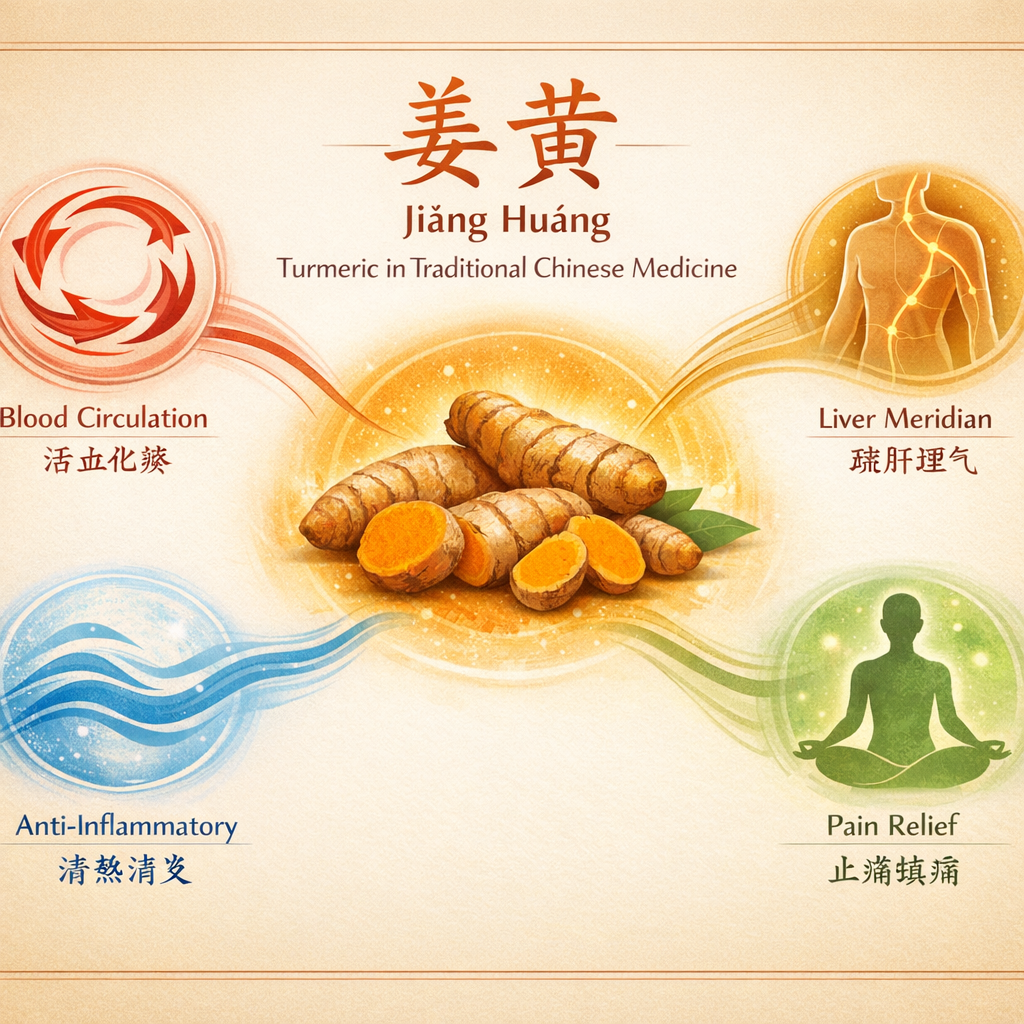
Turmeric (姜黄 Jiāng Huáng) is one of the great “Blood movers” in TCM. From the same botanical genus as Ginger, it shares its hot nature and pungent flavour, but differs through its primary action on Blood (血 xuè) and Qi. For chronic headaches of TCM origin, particularly those due to Blood Stasis, Turmeric is a first-choice food-medicine.
Energetic Profile of Turmeric in TCM
Thermal Nature, Flavour and Meridians
Culinary turmeric (Jiāng Huáng) differs from Yù Jīn (郁金), which is the tuberous root of the same plant but with slightly different properties:
- Nature: Hot (热 rè)
- Flavour: Pungent (辛 xīn) and Bitter (苦 kǔ)
- Target meridians: Liver (肝 gān), Spleen (脾 pí)
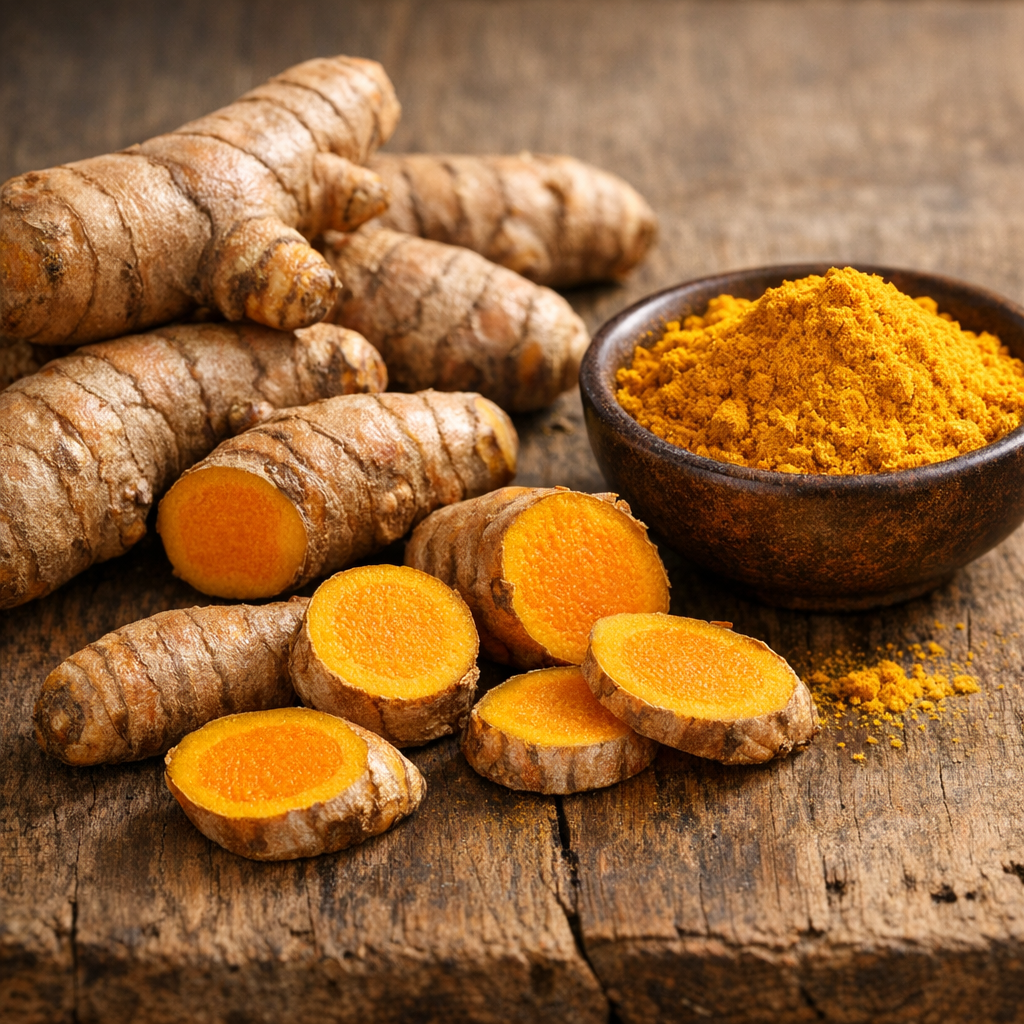
The dual pungent-bitter flavour is characteristic: the pungent mobilises and promotes circulation, the bitter descends and dries Dampness. This combination makes it a powerful ally for breaking up Stasis while draining Dampness and Phlegm pathologies.
“Jiāng Huáng promotes the circulation of Qi, moves Blood, expels Wind and relieves pain.”
— Ben Cao Gang Mu (本草纲目), Li Shizhen, 1596
Therapeutic Actions in TCM
| Action | Clinical application |
|---|---|
| Moves Blood, dissolves Stasis | Fixed pain, chronic boring headaches |
| Promotes Liver Qi circulation | Flank pain, dysmenorrhoea, emotional stagnation |
| Expels Wind-Dampness | Joint pain, rheumatism |
| Warms the meridians | Pain aggravated by cold |
| Relieves pain (Zhǐ Tòng) | Pain of all types from Cold or Stagnation origin |
Turmeric vs Yù Jīn: An Essential Distinction
In Chinese pharmacopoeia, two parts of the plant are used with different effects:
| Jiāng Huáng (rhizome) | Yù Jīn (root) | |
|---|---|---|
| Nature | Hot | Cold/Cool |
| Priority | Qi and Blood, external action | Blood and Shen Spirit, internal action |
| Indication | Pain from Cold, Stasis | Stasis with Heat, emotional disturbances |
For chronic headaches of the Blood Stasis type (syndrome 12 in the TCM headache classification), Jiāng Huáng (culinary turmeric, hot nature) is preferred unless the patient also shows signs of Heat.
Curcumin: What Modern Science Says
Curcumin, the main active pigment of turmeric (2-8% of dry weight), has been the subject of intensive research for 20 years:
| Property | Mechanism | Source |
|---|---|---|
| Anti-inflammatory | NF-κB, COX-2, TNF-α inhibition | Journal of Medicinal Chemistry, 2022 |
| Neuroprotective | Reduction of cerebral inflammation, BDNF protection | Nutrients, 2023 |
| Anti-migraine | Substance P reduction, serotonin modulation | Phytomedicine, 2021 |
| Antioxidant | Free radical neutralisation | Food Chemistry, 2020 |
| Hepatoprotective | Liver protection and regeneration | World J Gastroenterology, 2022 |
The Bioavailability Question
Curcumin is poorly absorbed alone (bioavailability < 1%). To optimise it:
- Black pepper (piperine): increases absorption by 2000%
- Fats: curcumin is fat-soluble
- Heat: slightly improves extraction
In TCM, this practical recommendation resonates with the classic principle of combining pungent spices (which move Qi and facilitate assimilation) with turmeric.
Practical Applications in Dietetics
Therapeutic Recipes
Anti-Stasis Golden Broth (For chronic fixed headaches) Target syndrome: Blood Stasis (syndrome 12)
- 500 ml beef or vegetable broth
- 1 teaspoon turmeric powder
- ½ teaspoon freshly grated ginger
- 1 tablespoon rice vinegar (moves Blood)
- Freshly ground black pepper
- Consume hot, 3-4 times per week for 3 weeks
Therapeutic Golden Latte (Golden Milk) Daily use: circulation, background anti-inflammatory
- 250 ml plant milk (coconut or oat)
- 1 teaspoon turmeric
- ½ teaspoon cinnamon
- 1 pinch black pepper
- 1 teaspoon raw honey
- Heat gently, do not boil
Strategic Food Combinations
| Food | TCM and nutritional synergy |
|---|---|
| Fresh ginger | Dual anti-pain action, perfect synergy on Qi and Blood |
| Vinegar (醋 cù) | Strengthens Blood action, enters the Liver |
| Onion | Promotes Qi circulation, associated with Stasis |
| Black sesame | Nourishes Yin and Kidney Essence |
| Fats (olive oil, coconut) | Improves curcumin absorption |
Precautions and Contraindications
- Pregnancy: Avoid medicinal doses (stimulates the uterus); moderate culinary use acceptable
- Anticoagulants (warfarin, aspirin): Significant interaction — medical consultation required
- Gallstones: Turmeric stimulates gallbladder contraction — contraindicated in case of obstruction
- Deficiency syndromes: Its mobile nature can exhaust Qi and Blood if used without tonics in pronounced deficiency
- Heat syndrome: Use with caution (hot nature) — prefer Yù Jīn instead
Turmeric and Headaches: Protocol by Syndrome
With reference to the classification of 16 headache syndromes in TCM:
| Syndrome | Relevance | Instructions |
|---|---|---|
| 12. Blood Stasis | ⭐⭐⭐ Priority | Broth + vinegar + ginger, 3-week course |
| 5. Liver Qi Stagnation | ⭐⭐ Suitable | Turmeric + fennel as seasoning |
| 1. Wind-Dampness | ⭐ Possible | In combination with radish and barley |
| 3. Liver Fire | ⚠️ Caution | Hot nature = risk of aggravation |
| 2. Yang Rising | ❌ Not recommended | Avoid, hot nature and ascending action |
FAQ on Turmeric in TCM
What is the thermal nature of turmeric in TCM? Culinary turmeric (姜黄 Jiāng Huáng) is Hot in nature, with Pungent and Bitter flavours. It targets the Liver and Spleen meridians. Its main action is to promote Qi and Blood circulation and dissolve Stasis. This hot nature makes it particularly suited to pain aggravated by cold.
Can turmeric relieve chronic headaches? Yes, particularly for Blood Stasis headaches: severe, fixed, boring or stabbing pain, often linked to old trauma. It is also useful for Liver Qi Stagnation headaches. However, it is contraindicated for headaches due to Liver Fire or Liver Yang Rising, as its hot nature could aggravate symptoms.
How to combine turmeric and ginger for maximum effect? The Turmeric + Ginger combination is synergistic: ginger amplifies turmeric’s anti-inflammatory action (gingerol-curcumin synergy) and improves digestive tolerance. In TCM, both promote Qi and Blood circulation, but ginger acts more on the surface (Wind-Cold) and turmeric at depth (Stasis). Together, they cover a broader spectrum. Always add black pepper to maximise absorption.
Discover how turmeric fits into the dietary treatment of headaches in TCM. The Yin Shi app offers detailed profiles of 500+ therapeutic foods with their complete TCM properties.