As a practitioner, you know that the boundary between Yin Deficiency (阴虚 Yīn Xū) and Floating Yang (虚阳上越 Xū Yáng Shàng Yuè) is one of the most subtle and most crucial diagnoses of our art. To err here is to risk extinguishing the fire of life whilst believing one is soothing a simple heat.
Here is an in-depth analysis of the ontological, clinical and dietary distinctions between these two syndromes with a concrete therapeutic protocol for your patients.
1. Ontological Distinction: Substance vs Anchoring
Yin is within, it is the guardian of Yang; Yang is without, it is the envoy of Yin.
-
Yin Deficiency (阴虚 Yīn Xū): This is a consumption of liquid substance, blood and essences (Jīng 精). The “sea of tranquillity” dries out, and consequently, Yang is no longer tempered, it becomes hyperactive by default. This is Empty Heat (虚热 Xū Rè).
-
Floating Yang (虚阳上越 Xū Yáng Shàng Yuè): This is a rupture of communication between the Upper and the Lower. Here, Yin (often Kidney Yin) is so exhausted, or Kidney Yang so weak, that it can no longer retain Yang at its root. Yang “escapes” upwards. This is a state of False Heat, True Cold (假热真寒 Jiǎ Rè Zhēn Hán).
2. Clinical Differentiation Table
For the professional, the fine observation of “false” signs is the diagnostic key.
| Signs | Yin Deficiency (阴虚 Yīn Xū) | Floating Yang (虚阳上越 Xū Yáng) |
|---|---|---|
| Complexion | Red cheekbones (fixed), especially in the afternoon. | Sudden redness, “made-up” (戴阳 Dài Yáng), not fixed. |
| Heat | Heat of the “five hearts” (palms, soles, chest). | Heat in the face but icy feet. |
| Thirst | Thirst for small sips, preference for cool. | Thirst but desire for hot drinks, or refusal to drink. |
| Tongue | Red, dry, little or no coating, cracks. | Pale, swollen, moist (despite sensation of heat). |
| Pulse | Thin (细 Xì) and Rapid (数 Shù). | Floating (浮 Fú), Large (大 Dà) but without force on pressure. |
3. The Dynamics of “Dragon Fire” (龙火 Lóng Huǒ)
In classics such as the Leijing (类经), Floating Yang is described as the “Dragon Fire” that leaves the depths of the ocean to rise to the sky.
The correct strategy for Floating Yang rests on the principle Yǐn Huǒ Guī Yuán (引火归元), “Returning the Fire to its Source”, a paradoxical method that uses warmth to attract Yang downwards.
4. Implications in Chinese Dietetics
The dietary strategy differs radically because the digestive apparatus (Pí Wèi 脾胃) reacts very differently to these two states.
Strategy for Yin Deficiency
Objective: Nourish Yin and Clear Heat (Zī Yīn Qīng Rè 滋阴清热)
- Natures: Cool and Neutral
- Flavours: Sweet and Sour (the association Gān Suān Huà Yīn 甘酸化阴 generates liquids)
- Key foods: Duck, pear, asparagus, goji berry, black sesame, tremella (Bái Mù Ěr 白木耳)
- Forbidden: Strong spices, strong alcohols, coffee, grilled meats
Strategy for Floating Yang
Objective: Return the Fire to the Source (Yǐn Huǒ Guī Yuán 引火归元), paradoxical strategy
- Natures: Warm and Hot (in small quantities) to “invite” Yang to descend
- Flavours: Salty (to descend to the Kidneys) and Sour (to store)
- Key foods: Cinnamon (Ròu Guì), egg yolk, prawns, walnuts
- Absolute prohibition: Raw and cold foods (aggravate the True internal Cold)
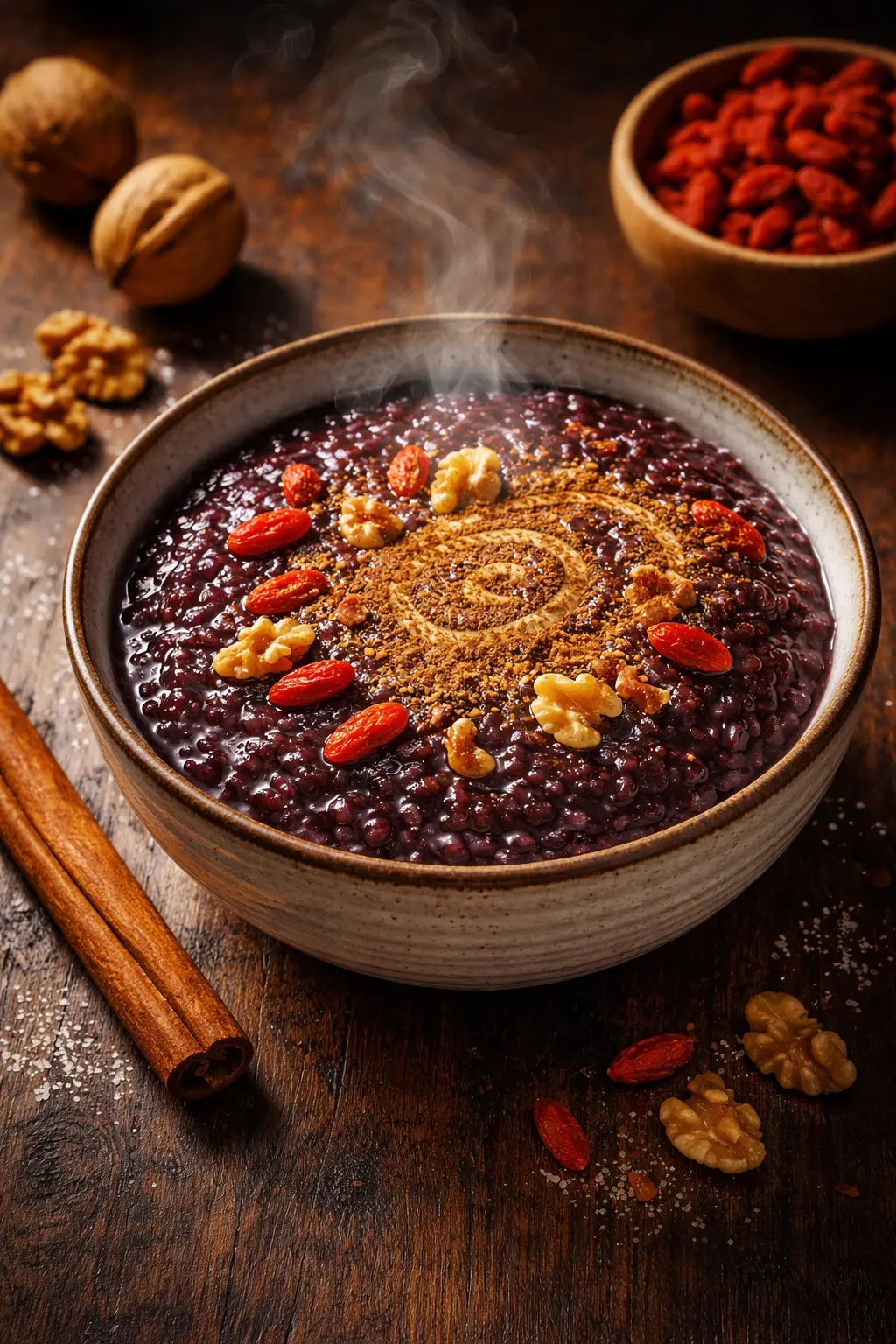
Dietary Protocol: The Anchoring Congee
Objective: Warm the lower burner to invite the “Dragon Fire” to descend, whilst consolidating the Yin root.
Formula, Ingredients for 1 person
| Ingredient | Quantity | TCM Property | Role in the formula |
|---|---|---|---|
| Black Rice (黑米 Hēi Mǐ) | 60g | Neutral, Sweet. Tonifies Kidney/Spleen | Trophic base, Kidney affinity by colour |
| Walnuts (胡桃仁 Hú Táo Rén) | 3-5 kernels | Warm, Sweet. Tonifies Kidney and anchors Qi | Helps Kidney “grasp” Yang |
| Cinnamon (肉桂 Ròu Guì) | 1 to 2g (powder) | Hot, Pungent. Minister of Fire | The pivot - Guides Fire to the source (Yǐn Huǒ Guī Yuán) |
| Egg yolk | 1 piece | Neutral, Sweet. Nourishes Blood and Yin | The anchor - Calms Shén, stabilises Floating Yang |
| Goji Berries (枸杞 Gǒu Qǐ) | 10g | Neutral, Sweet. Tonifies Liver/Kidney | Supports Yin without extinguishing Yang |
| Sea salt | A pinch | Cold, Salty | Salty flavour directs action towards the Kidneys |
Preparation Protocol
- The base infusion: Soak black rice overnight. In the morning, cook it in 5 to 6 volumes of water over very low heat (Zhōu 粥 method) for at least 40 minutes, until creamy texture.
- Integration of actives: 10 minutes before the end, add the crushed walnuts and goji berries.
- The Pivot - Crucial: Once the fire is off, add the pinch of salt and Ròu Guì powder. The residual heat is sufficient to release the essential oils without dispersing them by prolonged boiling.
- The final anchoring: Incorporate the raw egg yolk into the hot congee and mix vigorously. The texture should become creamy.
Practitioner Analysis - Why it works?
In Floating Yang, the patient often suffers from an underlying Spleen vacuity (the cold below prevents transformation).
- Black Rice and Walnuts tonify the Kidney without being as fatty as substances like Shú Dì Huáng (熟地黄), which avoids congesting the middle burner.
- The use of Cinnamon (Ròu Guì) here is not to “heat” (as in a pure Yang Deficiency), but to create a pole of attraction. Yang, by nature curious, is attracted by its own warmth at the source.
- Egg yolk is the anchor. In TCM, it is considered a “heavy” substance that calms Heart agitation (often secondary to rising Yang).
Dosage and Administration Advice
- Timing: Must be consumed imperatively at breakfast (Chén hour 辰, 7h-9h) to stabilise Yang from the beginning of the day.
- Temperature: Must be consumed very hot. Digestive cold is the number one enemy of Floating Yang.
- Sign of efficacy: The patient feels a gentle warmth descend towards the feet and a decrease in “heavy head” or ear ringing.
Conclusion for Practice
Yin Deficiency is a question of shortage (insufficient substance). Floating Yang is a question of location (failed anchoring).
An experienced practitioner will always palpate their patient’s feet: if the face burns but the ankles are ice, the diagnosis of Floating Yang imposes itself. Dietetics must then imperatively warm the lower to calm the upper, Yǐn Huǒ Guī Yuán (引火归元) strategy.
Frequently Asked Questions (FAQ)
Q: Can one simultaneously have Yin Deficiency and Floating Yang?
A: Yes, these two syndromes frequently coexist. Floating Yang often occurs on a background of advanced Yin Deficiency. The therapeutic strategy must then treat the emergency (anchor Yang) before nourishing Yin in depth.
Q: How to differentiate Floating Yang from simple hypertension?
A: Floating Yang presents cold feet with a red face, this thermal gradient is pathognomonic. Hypertension by rising Liver Yang (肝阳上亢 Gān Yáng Shàng Kàng) presents more diffuse heat and a wiry pulse (Xián 弦), without the upper/lower dissociation.
Q: How long should the anchoring congee be prescribed?
A: In acute phase (hot flushes, sudden dizziness), offer the congee daily for 2 to 3 weeks. In maintenance, 3 to 4 times per week is sufficient. Re-evaluate after one month of treatment.