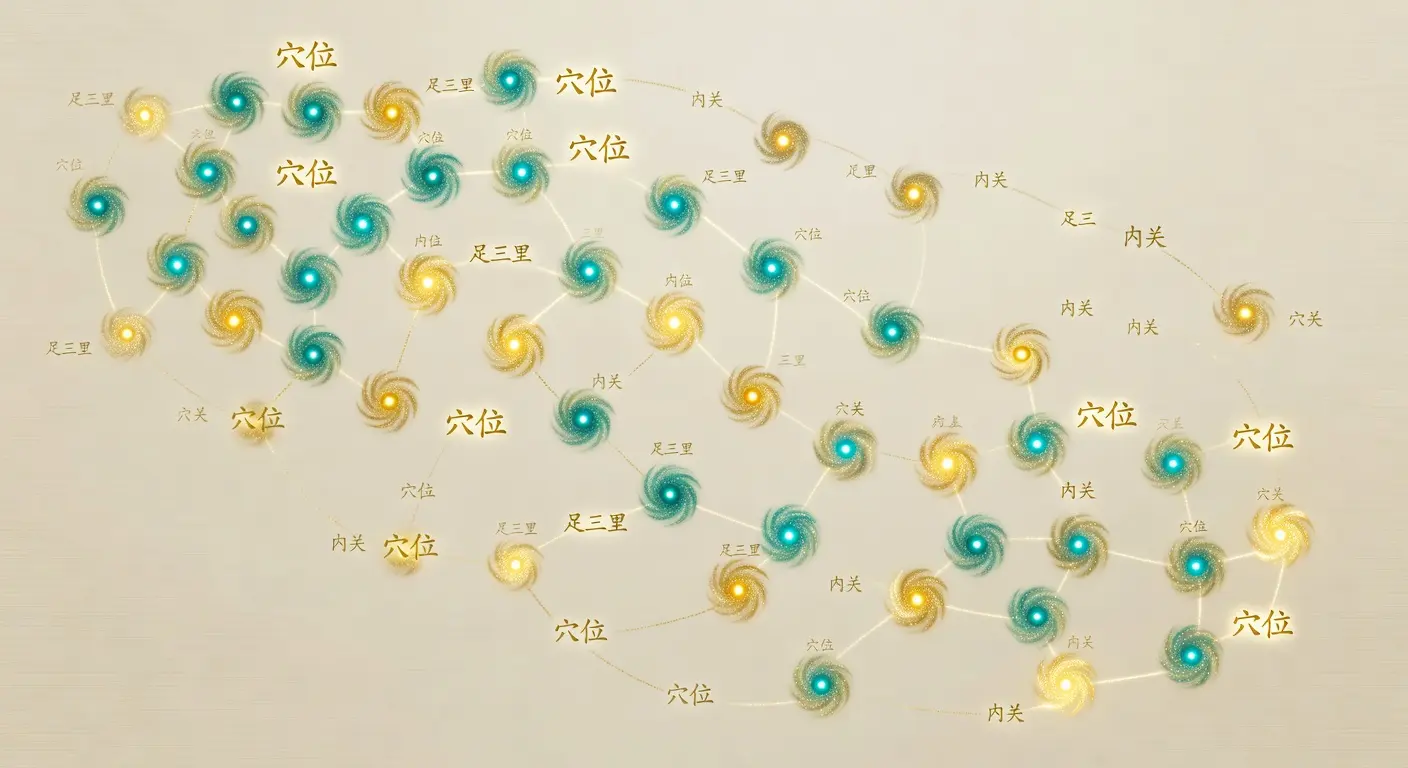
Acupuncture points (穴位 Xué Wèi) in Traditional Chinese Medicine are the access gates located on meridians where Qi and Blood are particularly accessible and where external treatments (needles, moxibustion, massage, cupping) can influence internal organs and regulate Qi and Blood.
Acupuncture Points
穴位
- Access gates to meridians where Qi and Blood are accessible
- Stimulation points to influence internal organs
- Diagnostic zones that reflect organ state
- Entry gates for external treatments (needles, moxa, massage)
- Regulation points for Qi and Blood throughout the body
- Connection zones between surface and deep organs
Acupuncture points are the doors and windows of the bodily palace. Like valves and taps on a network of pipes, they control the flow of Qi and Blood, allowing practitioners to open, close, regulate and rebalance energetic circulation throughout the organism.
In Traditional Chinese Medicine
In TCM theory, acupuncture points are specific zones located on meridians where Qi and Blood accumulate, circulate or disperse in a particular way. Each principal meridian has specific points (generally between 9 and 67 points per meridian) that have precise therapeutic functions. Points are classified according to their function and importance:
- Shu points (输穴 Shū Xué) or transport points: five specific points on each meridian that correspond to the five phases (Wu Xing 五行) and tonify or disperse Qi of the concerned organ
- Yuan points (原穴 Yuán Xué) or source points: points where original Qi (Yuan Qi) of the organ concentrates, used to tonify and regulate the organ
- Luo points (络穴 Luò Xué) or connection points: points that connect principal meridians between them (Yin-Yang coupling), used to treat imbalances between coupled organs
- Xi points (郄穴 Xì Xué) or cleft points: points where Qi and Blood accumulate deeply, used for acute pain and crises
- Hui points (会穴 Huì Xué) or convergence points: points where several meridians meet, used to treat disorders of concerned zones
- Mu points (募穴 Mù Xué) or alarm points: points located on the anterior face of the trunk where organ Qi concentrates, used to diagnose and treat organ disorders
- Back Shu points (背俞穴 Bèi Shū Xué) or dorsal transport points: points located on the back along the Governing Vessel meridian (督脉 Dū Mài) where organ Qi is transported, used to tonify and regulate the organ
- Jing-Well points (井穴 Jǐng Xué), Ying-Spring (荥穴 Yíng Xué), Shu-Stream (输穴 Shū Xué), Jing-River (经穴 Jīng Xué), He-Sea (合穴 Hé Xué): the five transport points that correspond to the five phases and have specific functions according to their nature
Acupuncture points are used to:
- Tonify Qi and Blood: by stimulating tonification points
- Disperse excesses: by draining dispersion points
- Regulate circulation: by balancing regulation points
- Clear Heat: by using cooling points
- Warm Cold: by using warming points
- Calm Shen: by using points that anchor the mind
- Relieve pain: by using local and distal points
Practical Applications
In Chinese dietary therapy, acupuncture points are supported by foods that tonify Qi and Blood, clear obstructions, and maintain smooth circulation in meridians. Recommended foods include ginger, garlic, leeks, turmeric, saffron, basil, mint, fennel, citrus, celery, carrots, spinach, sesame seeds, walnuts, azuki beans and ginger-lemongrass infusions.
Lifestyle directly influences the quality of acupuncture points and meridians: moderate physical activity that circulates Qi and Blood (walking, tai chi, qi gong, stretching, yoga), stress management that releases Qi stagnation, protection against cold, wind and dampness (especially when sweating), sufficient sleep that regenerates Qi and Blood, and a diet that does not produce obstructions (no excess fats, sweets, cold) strengthen meridians and acupuncture points. Sedentary lifestyle, chronic stress, cold, dampness, injuries, trauma and a diet that obstructs weaken or block meridians and points.
Concrete Examples
A patient presenting with Liver Qi stagnation with stress, irritability and lateral pain may experience lateral chest and abdominal pain, irritability, mood changes, headaches at the temples, digestive disorders (bloating, nausea), wiry pulse, and reddish tongue with thin white coating. After acupuncture sessions on points that disperse Liver Qi stagnation (Taichong LR3, Qimen LR14, Yanglingquan GB34), the dietary protocol will include foods that circulate Qi and relax the Liver such as celery and carrot soup, tofu stir-fried with mushrooms and spinach, chrysanthemum and mint infusions, and stress management with deep breathing and moderate physical activity.
A patient presenting with Spleen Qi deficiency with fatigue, bloating and loose stools may experience fatigue, bloating after meals, loose stools, lack of appetite, heavy limbs, pale tongue with teeth marks and white moist coating, and weak empty pulse. After acupuncture sessions on points that tonify Spleen Qi (Zusanli ST36, Sanyinjiao SP6, Zhongwan CV12), the dietary protocol will include foods that tonify Spleen Qi such as rice porridge with dates and ginger, chicken stewed with carrots and leeks, roasted sweet potatoes, hot ginger and cinnamon infusions, and elimination of cold, raw, dairy and sweet foods.
Frequently Asked Questions
What is the difference between an acupuncture point and a meridian?
A meridian (经 Jīng) is an energetic channel that connects an organ to the body surface, circulating Qi and Blood throughout the body. It is like a river that flows constantly. An acupuncture point (穴 Xué) is a specific zone located on a meridian where Qi and Blood are particularly accessible and where external treatments can influence the organ and regulate circulation. It is like a tap or valve on the river that allows controlling the flow. Meridians are the channels; points are the access gates.
How many acupuncture points are there?
There are approximately 361 classical acupuncture points distributed along the twelve principal meridians and the eight extraordinary meridians. Each principal meridian has between 9 and 67 points. In addition, there are numerous extra points (奇穴 Qí Xué) located outside the classical meridians, used for specific disorders. The number of recognised points varies according to traditions and schools, but the 361 classical points are the most commonly used.
Which foods support acupuncture points and meridians?
Foods that support acupuncture points and meridians are generally those that tonify Qi and Blood, clear obstructions and maintain smooth circulation. We cite ginger, garlic, leeks, turmeric, saffron, basil, mint, fennel, citrus, celery, carrots, spinach, sesame seeds, walnuts, azuki beans, goji berries, jujubes, liquorice, longan and bone broths. Foods to avoid are those that obstruct circulation (very greasy and fried foods, excessive sweets), those that engender Cold (cold and raw foods, iced drinks) and those that engender Dampness (dairy products, excessive sweets, greasy foods).
Conclusion
Acupuncture points constitute one of the most precious and effective therapeutic systems in Traditional Chinese Medicine. Understanding their structure, classification, functions and complementary dietary and lifestyle approaches enables a clearer grasp of the therapeutic reasoning and support protocols offered within the Yin Shi universe.
To go further
Yin Shi ecosystem resources directly related to this article.
Which meridian carries your imbalance?
The five-organ test spots the Zang-Fu system whose points are most called upon.
Take the test →The points, gateways to the Qi
The lesson shows how meridian points are combined into regulation strategies.
Take the lesson →