Exam season is often synonymous with tension and anxiety for many students. This pressure can harm not only your mental wellbeing but also your academic performance. It is crucial to understand that stress, although natural, can be managed effectively. This article will guide you through proven strategies and practical techniques to turn your anxiety into a driver of success.
Get ready to discover how to approach your exams with greater serenity and confidence. Together we will explore concrete methods to manage this demanding period and reach your goals. Wait no longer to take control of your wellbeing during revision and exams!
Understanding exam stress

Exam-related stress is a normal bodily reaction to a situation perceived as threatening or demanding. It shows up differently in each person, but its causes and impacts are often similar.
Common causes
Several factors can contribute to exam stress. The pressure to succeed is a major cause, whether it comes from parents, teachers or yourself. This internal pressure, often fuelled by ideals of perfectionism, can turn into a paralysing fear of not measuring up. Fear of failure is also omnipresent, not only concerning grades, but also the disappointment of yourself or others, pushing some students into inaction or, conversely, into counterproductive overwork.
Inadequate preparation or poor time management are major amplifiers of this anxiety. When revision is disorganised or insufficient, the feeling of uncertainty grows, feeding the stress. Moreover, comparison with peers and high expectations can create an unhealthy competitive environment, where every success of others is perceived as a reminder of one’s own shortcomings, adding an extra layer of pressure. Uncertainty about the exam format or question types, and the feeling that the assessment system does not match one’s learning style, can also generate significant anxiety.
Impact on performance
If a certain level of stress can be stimulating, acting as a driver of performance, excessive stress quickly becomes counterproductive and harmful. Cognitively, it can cause memory “blank moments” during the exam, where well-anchored information seems inaccessible, as if the brain froze under pressure. Concentration drops drastically, making not only revision less effective but also reading questions and formulating answers difficult on the day. The capacity to make decisions and solve problems is also impaired.
Physically, stress shows up as a series of unpleasant symptoms: frequent headaches, muscle tension, digestive troubles (nausea, abdominal pain), insomnia disrupting the restorative sleep cycle, and chronic fatigue that seems never to go away. These physical manifestations exhaust the student and reduce their capacity to learn and perform.
Mentally and emotionally, the impact is equally significant. Excessive stress translates into irritability, mood swings, a persistently gloomy mood, a sense of powerlessness and, in severe cases, can lead to burnout (school burn-out) or depressive episodes. Recognising these warning signs, both physical and psychological, is the first crucial step towards proactive and effective stress management.

Practical strategies for managing stress
Fortunately, many strategies exist to master exam stress. Adopting good lifestyle habits and specific management techniques can make a huge difference.
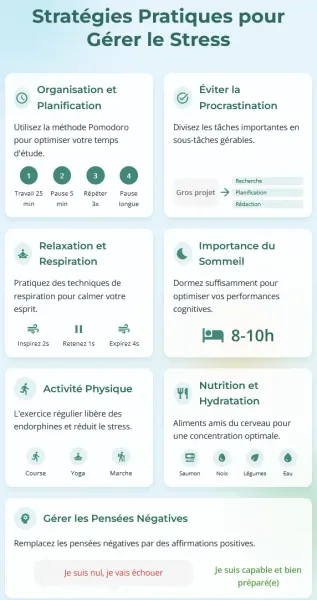
Organisation and planning
Planning is unarguably your best ally in the fight against exam anxiety. Start by establishing a realistic, detailed revision schedule. Do not underestimate the time needed and do not overestimate your capacity to study without interruption. Divide each subject into small manageable sessions, allocating specific time blocks to each topic. It is essential to build in regular short breaks (for example, the Pomodoro method: 25 minutes of work, 5 minutes of rest) to maintain optimal concentration and avoid mental exhaustion.
Set achievable goals for each study session. Instead of “revise all of history”, prefer “revise chapter 3 and do 5 exercises”. Clear, attainable goals prevent the feeling of being overwhelmed and provide satisfaction as you tick them off. Use tools such as physical or digital diaries, planning apps or simple checklists to visualise your progress. Good organisation does not only reduce uncertainty; it gives you a powerful sense of control over your preparation, considerably lowering stress.
Avoiding procrastination
Procrastination is the sworn enemy of exam preparation and a powerful generator of stress. To fight it, start by identifying its causes: fear of failure, perfectionism, lack of motivation or simple overload. Once the causes are identified, put targeted strategies in place. Divide imposing tasks into tiny sub-tasks and start with the smallest. The act of starting is often the hardest part. Set firm deadlines for these small tasks.
Create a distraction-free study environment: turn off phone notifications, close unnecessary browser tabs. Reward yourself after completing a task, even a small one. These positive rewards reinforce study behaviour. Finally, do not aim for perfection from the start; the goal is progress, not the absence of mistakes. Remember that every small step brings you closer to your final goal.
Relaxation and breathing techniques

Beyond planning, simple, regular exercises can considerably soothe your mind and body, reducing the physiological impact of stress. Deep breathing is a technique of unsuspected power, accessible at any moment. To practise it, sit comfortably or lie down. Breathe in slowly and deeply through your nose, feeling your belly expand (diaphragmatic breathing), counting to four. Hold your breath for two to three seconds, then breathe out very slowly through your mouth, as if through a straw, counting to six or eight, feeling your belly empty completely. Repeat this cycle five to ten times to calm your central nervous system and reduce your heart rate. This technique is particularly useful before a difficult revision session or just before entering the exam hall.
Progressive muscle relaxation is another effective method. It consists of tensing (for about 5-7 seconds) then releasing (for about 15-20 seconds) different muscle groups of your body in succession, starting from the feet and working up to the head. By focusing on the sensations of tension and release, you become more aware of your body’s stress signals and learn to release them voluntarily. Practise this exercise in a quiet place. Finally, mindfulness meditation, even for a few minutes a day (5 to 10 minutes, for example), can drastically improve your concentration, your emotional resilience and reduce anxiety by helping you stay anchored in the present moment, observing your thoughts and sensations without judgement. Mobile apps can guide your first sessions.
The importance of sleep
Sufficient, quality sleep is non-negotiable for cognitive performance and stress management. Teenagers need about 8 to 10 hours of sleep per night.
Create a regular bedtime routine, even at weekends. Avoid screens before sleeping, and make sure your bedroom is dark, quiet and cool. Sleep deprivation weakens your capacity to manage stress and consolidate information.
Physical activity and wellbeing
Physical exercise is an excellent natural anti-stress ally. It releases endorphins, which have a positive effect on mood. Even 30 minutes of brisk walking, running, yoga or dancing can work wonders.
Physical activity also discharges accumulated tension and improves sleep quality. Build short active breaks into your revision sessions to oxygenate your brain and recharge.
Nutrition and hydration
What you put on your plate directly influences your energy level, mood and cognitive capacities, all crucial in exam season. For teenagers facing stress, a balanced diet is not a luxury but a necessity to support brain function and emotional wellbeing. Avoid the traps of processed foods, refined sugars and saturated fats, omnipresent in fast food and snacks. They can cause fleeting energy spikes followed by brutal crashes, leaving your brain short of stable fuel and your mood on a rollercoaster.
Prefer instead foods that nourish your brain: omega-3 fatty acids (present in salmon, sardines, flaxseeds, walnuts) are essential for memory and concentration. B vitamins (wholegrains, green leafy vegetables, eggs, pulses) play a key role in energy production and the synthesis of mood-regulating neurotransmitters. Antioxidants (berries, colourful vegetables such as spinach and broccoli) protect your brain cells from oxidative stress. Don’t forget magnesium (dark chocolate, almonds, avocados), often called the “anti-stress mineral”, and probiotics (yoghurt, kefir, sauerkraut), which positively influence the gut-brain axis, an increasingly recognised link in stress management.
Hydration is equally vital. Even mild dehydration can cause fatigue, headaches and diminished concentration. Always keep a bottle of water within reach and drink regularly throughout the day. Soothing herbal teas (camomile, verbena) can also be an excellent alternative to excessive energy or caffeinated drinks. Good nutrition and adequate hydration are not mere supplements; they are fundamental pillars of your resilience against exam stress.
Managing negative thoughts
Negative self-talk, that little voice whispering doubts and fears, is one of the greatest saboteurs of your efforts and your wellbeing. Learn to identify these automatic thoughts (“I’m rubbish”, “I’ll never manage”, “It’s all pointless”) and to question them. Do not accept them as absolute truths. Ask yourself: “Is this a thought based on facts or on an emotion?”, “What would I say to a friend who had this thought?”, “What is the evidence that this thought is true or false?” Actively replace affirmations such as “I’m going to fail” with more realistic, constructive sentences such as “I prepared as well as I could and I will do my best on the day” or “Every mistake is an opportunity to learn”.
Positive visualisation is a powerful tool: take a few minutes each day to imagine yourself passing the exam, feeling calm, confident and capable. Picture yourself answering the questions with ease, managing your time effectively and leaving the exam hall with a sense of satisfaction. This practice strengthens self-confidence and prepares your brain for success. Moreover, practise self-compassion: speak to yourself as you would to a dear friend, with kindness, patience and encouragement, especially when facing difficulties. Acknowledge and validate your efforts, even the smallest, and be indulgent towards yourself. Understand that perfectionism is a burden, not a strength, and that recognising your efforts, regardless of the final result, is essential for maintaining good mental health.
Resources and support
You are not alone in facing exam stress. Seeking support is a proof of strength, not weakness.
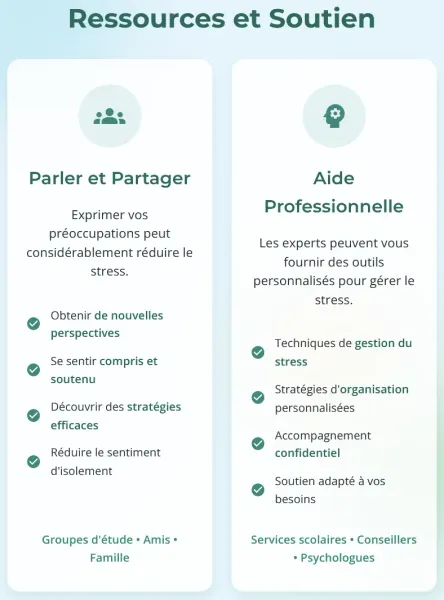
Talking and sharing
Discuss your feelings with your parents, close friends, teachers or a school counsellor. Expressing your worries can relieve a large part of the burden. Your peers may share similar experiences and strategies that worked for them.
Don’t isolate yourself; social support is a powerful shock absorber for stress. A simple exchange can bring you a new perspective or precious advice.
Professional help
If stress becomes overwhelming and significantly affects your daily life (sleep, appetite, mood), don’t hesitate to consult a professional. A psychologist or therapist can provide you with personalised tools and strategies to manage anxiety, depression or stress-related disorders.
School or university health services are often excellent resources for confidential, appropriate help. It is important not to let stress take hold durably.
The big day: strategies for the exam
Careful preparation is essential, but the exam day itself also requires specific strategies to maximise your performance and manage last-minute stress. Approaching the day with a calm, methodical attitude can make all the difference.
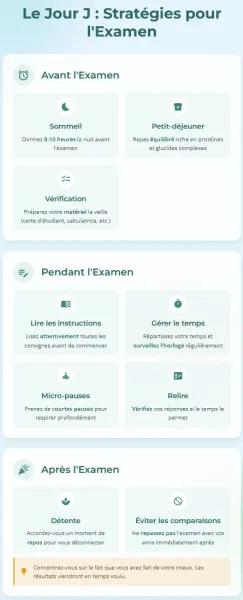
Before entering the exam hall
The evening before the exam, avoid intense last-minute revision, which would only increase your anxiety and disturb your sleep. Prefer a relaxing activity. Make sure you get a full, restorative night of sleep. On the morning of the exam, eat a balanced, light breakfast to give your brain the energy it needs without overloading it. Avoid excessive caffeine consumption, which can heighten nervousness.
Check that you have all the necessary materials: pens, calculator, ID, watch (not connected). Arrive early to avoid the stress of rushing, but not too early so as not to be overwhelmed by collective anxiety. A few minutes before starting, practise some deep breaths to refocus your mind and calm your body.
During the exam
Once the exam paper is distributed, don’t rush. Start by carefully reading all the instructions and skim the whole paper to get an overview. This will help you manage your time and identify the questions that carry the most marks or those you feel most confident about.
Allocate precise time to each section or question according to its weight and difficulty. Stick to this plan as much as possible. If you get stuck on a question, don’t panic. Move on to the next one and come back later. Often the answer will come to mind after working on something else. If stress rises during the exam, grant yourself a micro-pause: close your eyes, take three deep breaths and refocus. Don’t forget to reread your answers if time allows, to correct possible careless mistakes.
After the exam
Once the exam is finished, resist the temptation to review all the questions with your friends. It is not productive and will only amplify regret or self-judgement if you discover mistakes. The exam is over; you did your best. Focus instead on the next step or grant yourself a well-deserved moment of relaxation. Celebrate the end of a demanding period and prepare yourself mentally for the challenges ahead, applying the lessons learned about stress management.
Frequently asked questions (FAQ)
Q: How do I know if my stress is too high?
A: Signs include persistent sleep problems, frequent headaches, loss of appetite, increased irritability, difficulty concentrating, or a feeling of being overwhelmed and unable to function normally.
Q: Can exam stress be completely eliminated?
A: It is difficult to eliminate stress completely, as it is a natural reaction. The goal is to manage it and reduce it to a healthy level, where it can be stimulating rather than paralysing.
Q: Which foods help reduce stress?
A: Foods rich in omega-3 (salmon, walnuts), magnesium (green vegetables, almonds), B vitamins (eggs, wholegrains) and antioxidants (berries, colourful vegetables) are beneficial. Avoid excess caffeine and sugar.
Q: How long should you sleep before an exam?
A: For teenagers, 8 to 10 hours of sleep are recommended. It is more important to have a regular sleep routine in the days before the exam than to attempt an “all-nighter”, which would harm your concentration.
Glossary
Exam stress
A psychological and physiological reaction to the pressure and expectations linked to academic assessments, which can cause anxiety, tension and difficulty concentrating.
School anxiety
A specific form of anxiety that manifests in the educational context, often linked to performance, assessments or social interaction at school.
Mindfulness
A meditative practice consisting of intentionally paying attention to the present moment, without judgement, in order to reduce stress and improve mental clarity.
Cortisol
A steroid hormone produced by the adrenal glands in response to stress. Elevated, prolonged cortisol levels can have negative effects on health.
Relaxation techniques
A set of methods (deep breathing, progressive muscle relaxation, meditation) aimed at inducing a state of calm and reducing physical and mental tension.
Conclusion

Exam stress is a common challenge, but it does not have to be an insurmountable obstacle. By adopting a proactive approach that combines good organisation, relaxation techniques, particular attention to your sleep, diet and physical activity, and by seeking support when needed, you can not only manage it but also turn it into a strength.
Remember that your wellbeing is as important as your results. Take care of yourself, trust your abilities and approach this period with serenity. Put this advice into practice today and observe the difference it can make to your success and peace of mind. Your academic journey is one step, and you have the tools to cross it successfully!
Article written by Yin Shi with the collaboration of mental health experts. Sources: studies published in the Journal of the American Academy of Child and Adolescent Psychiatry, WHO data and principles of nutritional psychiatry. In case of psychological distress, contact the Samaritans on 116 123 (UK, 24/7), the 988 Suicide and Crisis Lifeline (US), or a mental health professional.
To go further
Yin Shi ecosystem resources directly related to this article.
Is exam stress overflowing?
The perceived stress scale measures the pressure that builds as exams approach.
Take the test →Exam stress and the HPA axis
The lesson links generalised anxiety to cortisol, GABA and nutritional approaches.
Take the lesson →