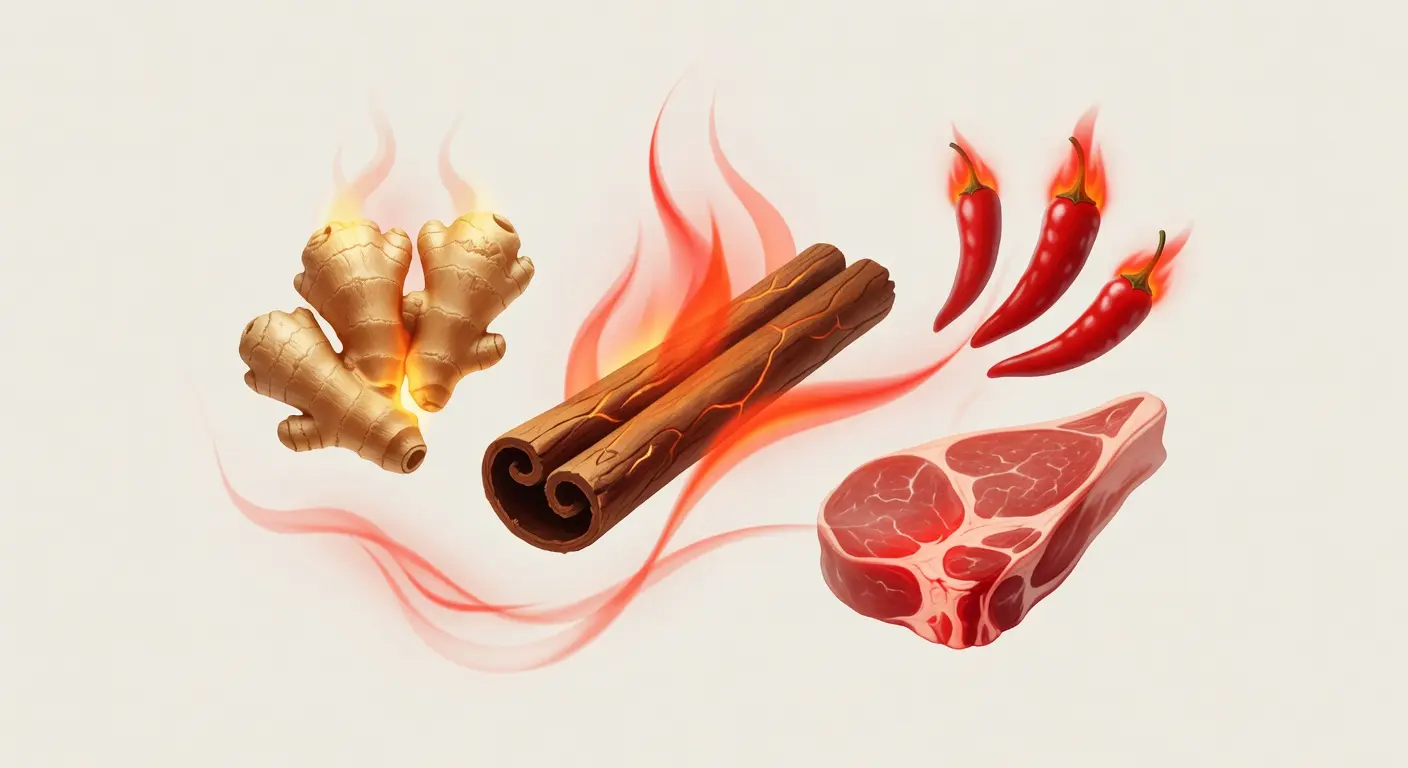
Hot foods (热食 Rè Shí) in Traditional Chinese Medicine are foods of hot or warm thermal nature that warm Yang, disperse Cold, activate Qi and Blood circulation, tonify organs, and strengthen vitality. They are indicated in Cold syndromes, Yang deficiency, Qi and Blood stagnation by Cold, and in cold climates.
Hot Foods
热食
- Warm Yang and disperse Cold
- Activate Qi and Blood circulation
- Tonify organs and strengthen vitality
- Relieve Cold-induced pain
- Stimulate digestion and transformation
- Strengthen immunity and resistance
Hot foods are like a fireplace in a winter house. They warm the cold rooms, circulate stagnant air, dry dampness, and make the house comfortable and welcoming. Without them, the house becomes damp, cold, mouldy and uninhabitable.
In Traditional Chinese Medicine
In TCM theory, hot foods are foods of hot or warm thermal nature that possess the following properties: warming Yang, dispersing Cold, activating Qi and Blood circulation, tonifying organs, strengthening vitality, relieving Cold-induced pain, stimulating digestion and transformation, and strengthening immunity and resistance.
Main Hot Foods
| Category | Foods | Nature | Main Meridian | Main Indications |
|---|---|---|---|---|
| Meats | Lamb, beef, chicken, duck, goose, rabbit, horse, pigeon, quail, beef, veal, pork | Hot or warm | Kidney, Spleen, Stomach, Lung | Yang deficiency, internal Cold, cold intolerance, lower back pain, impotence, fatigue, lack of appetite, loose stools |
| Fish | Salmon, mackerel, sardine, anchovy, herring, eel, tuna, grass carp, carp, catfish | Hot or warm | Kidney, Spleen, Stomach | Yang deficiency, internal Cold, Blood stagnation, joint pain, fatigue, lack of appetite |
| Fruits | Cherries, strawberries, blackcurrants, pomegranate, dates, jujubes, longans, lychees, bananas, mangoes, papayas, pineapples, passion fruits | Hot or warm | Spleen, Stomach, Kidney, Heart | Qi deficiency, Yang deficiency, fatigue, lack of appetite, loose stools, cold intolerance |
| Vegetables | Carrots, sweet potatoes, beetroot, turnips, pattypan squashes, pumpkins, butternut squashes, Jerusalem artichokes, parsnips, celeriac, black radishes, onions, leeks, spring onions, chives, garlic, ginger | Hot or warm | Spleen, Stomach, Lung, Kidney | Qi deficiency, Yang deficiency, internal Cold, Qi stagnation, fatigue, lack of appetite, loose stools |
| Aromatic herbs | Cinnamon, clove, basil, peppermint, thyme, rosemary, bay leaf, sage, tarragon, chervil, parsley, coriander, caraway, cumin, star anise, fennel, ginger, garlic, pepper, chilli, mustard, wasabi, horseradish | Hot or warm | Stomach, Spleen, Lung, Kidney | Internal Cold, Qi stagnation, Blood stagnation, abdominal pain, nausea, vomiting, cough, colds |
| Seeds and nuts | Sesame seeds, black sesame seeds, lotus seeds, pumpkin seeds, sunflower seeds, linseed, almonds, walnuts, hazelnuts, pistachios, cashews, pine nuts, macadamia, pecans, nutmeg, coconut, chia seeds, poppy seeds | Hot or warm | Kidney, Spleen, Stomach, Intestine | Yang deficiency, Jing deficiency, fatigue, cold intolerance, lower back pain, constipation, dryness |
| Cereals | Glutinous rice, millet, quinoa, buckwheat, spelt, wheat, barley, oats, rye, maize, sorghum, teff, fonio, amaranth | Warm | Spleen, Stomach | Qi deficiency, Yang deficiency, fatigue, lack of appetite, loose stools, cold intolerance |
| Others | Honey, maple syrup, brown sugar, muscovado sugar, molasses, liquorice, jujubes, dates, raisins, dried apricots, dried figs, prunes, dried bananas, dried mangoes, dried papayas, dried pineapples | Hot or warm | Spleen, Stomach, Kidney | Qi deficiency, Yang deficiency, fatigue, lack of appetite, loose stools, cold intolerance |
Practical Applications
In Chinese dietary therapy, hot foods are indicated in Cold syndromes, Yang deficiency, Qi and Blood stagnation by Cold, and in cold climates. They are particularly recommended in winter, in cold regions, for elderly people, for people with cold constitutions, and after illness or surgery.
Hot foods are preferably cooked over low heat, stewed, boiled, stir-fried, smoked, grilled or roasted. Long cooking over low heat strengthens their hot and warm nature. Smoking, grilling and roasting make foods hotter and more tonifying. Cold, raw or iced preparations weaken or neutralise their hot nature.
Concrete Examples
A patient presenting with Kidney Yang deficiency with persistent cold intolerance, lower back pain, impotence, diminished libido, nocturia, loose stools, pale complexion, pale swollen tongue with a white moist coating, and a deep weak pulse, will benefit from a hot and Yang-tonifying diet: lamb stewed with ginger, garlic and cinnamon (braised lamb with red wine and spices), bone and marrow broth with seaweed, mushrooms and black sesame seeds, roasted chicken with leeks, ginger and thyme, glutinous rice porridge with dates, walnuts and ginger, carrots and sweet potatoes roasted in the oven with honey and sesame seeds, grilled oysters with ginger and chives, prawns stir-fried with leek and ginger, clove, cinnamon and ginger infusion.
A patient presenting with Qi and Blood stagnation by Cold with abdominal pain, dysmenorrhoea, abundant blood clots, cold intolerance, pale or dull complexion, pale tongue with purplish spots, and a wiry or tight pulse, will benefit from a hot and circulation-activating diet: chicken stir-fried with ginger, garlic and pepper, grilled prawns with chilli and ginger, grated carrot salad with cumin and lemon (at room temperature), glutinous rice porridge with ginger and dates, cinnamon, clove and ginger infusion, mulled wine, leek and ginger chicken soup, sweet potato gratin with honey and cinnamon.
Conclusion
Hot foods constitute a fundamental category of Chinese dietary therapy that warms Yang, disperses Cold, activates Qi and Blood circulation, tonifies organs, and strengthens vitality. Understanding the main hot foods, their natures, meridians, indications, preparation methods and therapeutic applications enables a clearer grasp of the therapeutic reasoning and support protocols offered within the Yin Shi universe.
To go further
Yin Shi ecosystem resources directly related to this article.
The fire that warms: the Gate of Life
The free lesson from the free course explains the Kidney Yang that hot foods support.
Take the lesson →Is your terrain calling for warmth?
The TCM constitution test reveals whether you lean cold or hot.
Take the test →See these hot foods in the app
Cinnamon, lamb, walnut: three hot-natured foods mentioned, with full sheets.
Full sheets available after the 30-day free trial or with a subscription.