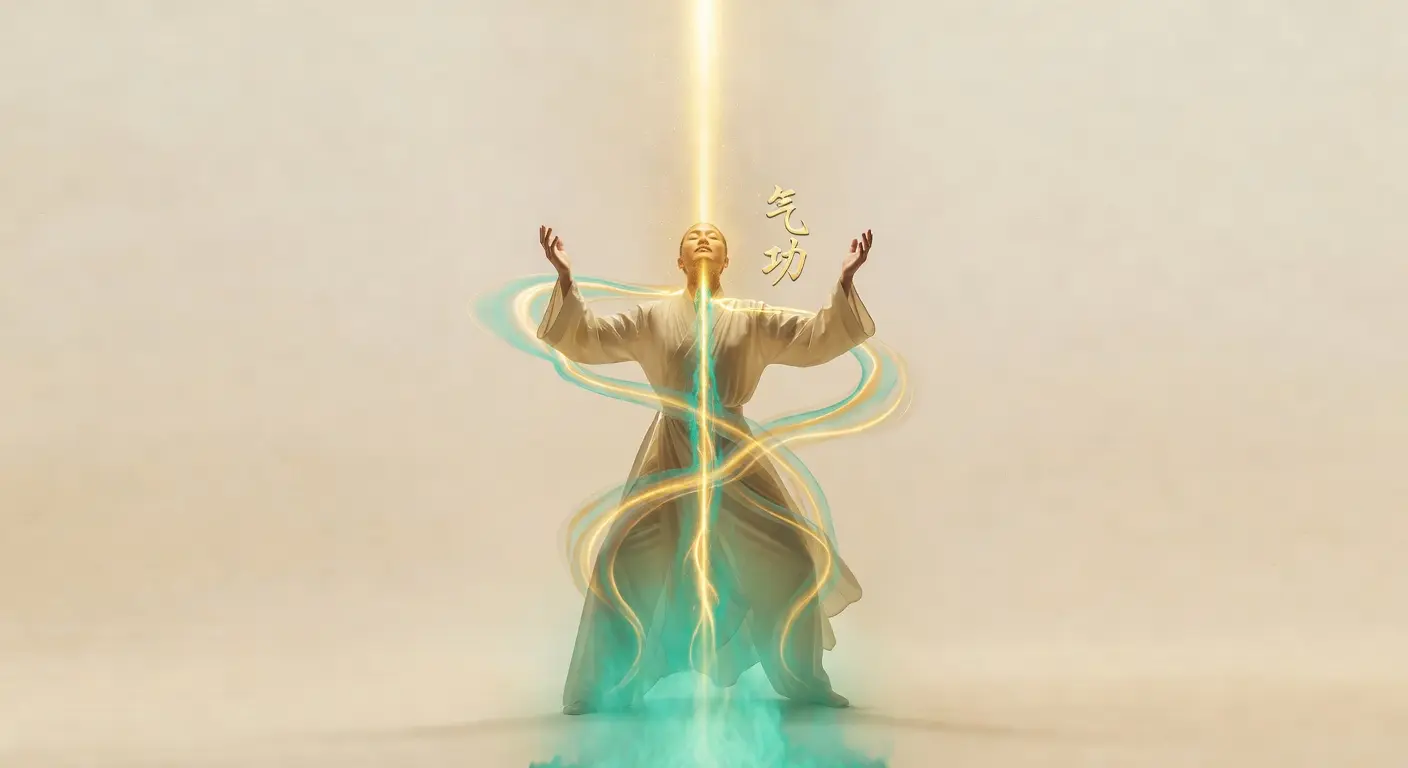
Qi Gong (气功 Qì Gōng) in Traditional Chinese Medicine is a traditional energetic practice that cultivates Qi (vital energy) through physical movements, breathing exercises, meditations, visualisations and concentration techniques. It harmonises Qi, body and mind, strengthens physical and mental health, and develops internal force, vitality and longevity.
Qi Gong
气功
- Cultivates Qi through movements, breathing and meditations
- Harmonises Qi, body and mind
- Strengthens Qi and Blood circulation in meridians
- Develops internal force, vitality and longevity
- Calms mind and anchors Shen in Heart
- Strengthens immunity and Wei Qi
Qi Gong is the cultivation of vital energy. Like a gardener who tends their garden, the Qi Gong practitioner cultivates their Qi through physical exercises, deep breathing, meditations and visualisations, harmonising Yin and Yang, strengthening Zang-Fu organs, and developing internal force and vitality.
In Traditional Chinese Medicine
In TCM theory, Qi Gong is considered a form of Dao Yin (导引 Dǎo Yǐn), a traditional energetic gymnastics that circulates Qi and Blood, harmonises Yin and Yang, strengthens Zang-Fu organs, and develops Shen (spirit, consciousness). Qi Gong is distinguished by its variety of techniques (static movements, dynamic movements, breathing, meditations, visualisations) that can be adapted to all ages, all physical conditions and all health objectives.
Fundamental principles of Qi Gong include:
- Breathing (调息 Tiáo Xī): control and regulation of breathing to capture Qi of Heaven (air) and Qi of Earth (energy of foods), and to circulate Qi in meridians. Breathing includes abdominal breathing (腹式呼吸 Fù Shì Hū Xī), reverse breathing (逆腹式呼吸 Nì Fù Shì Hū Xī), skin breathing (体呼吸 Tǐ Hū Xī), and meridian breathing (经络呼吸 Jīng Luò Hū Xī)
- Movement (调身 Tiáo Shēn): physical exercises that circulate Qi and Blood, strengthen muscles, bones, tendons and joints, and improve flexibility, balance and coordination. Movements include static movements (postures, 站桩 Zhàn Zhuāng), dynamic movements (sequences, 动功 Dòng Gōng), soft movements (柔和 Róu Hé), and vigorous movements (刚劲 Gāng Jìng)
- Mental concentration (调心 Tiáo Xīn): meditations and visualisations that calm mind, concentrate attention, anchor Shen in Heart and Dan Tian (丹田 Dān Tián, energetic centre in lower abdomen), and develop consciousness and intuition. Meditations include Dan Tian meditation (丹田意守 Dān Tián Yì Shǒu), organ meditation (内视 Nèi Shì), meridian meditation (经络意守 Jīng Luò Yì Shǒu), and void meditation (虚静 Xū Jìng)
- Visualisation (观想 Guān Xiǎng): visualisation techniques that direct Qi towards organs, meridians, body zones or specific objectives, using intention (Yi 意) to guide Qi (以意领气 Yǐ Yì Lǐng Qì)
- Sounds and vibrations (六字诀 Liù Zì Jué): six sounds (嘘 Xū, 呵 Hē, 呼 Hū, 呬 Xì, 吹 Chuī, 嘻 Xī) that vibrate in Zang-Fu organs and meridians, clarifying Heat, dispersing Stagnations, and harmonising organs
Health benefits of Qi Gong include:
- Qi and Blood circulation: movements and breathing circulate Qi and Blood in meridians, organs and tissues, preventing Stagnations and Stases
- Strengthening of Lung and Kidney Qi: deep abdominal breathing strengthens Lung Qi (which governs breathing) and Kidney Qi (which captures air Qi)
- Tonification of Spleen and Stomach Qi: trunk and lower abdomen movements massage digestive organs, improving transformation and digestion
- Calming Shen and anchoring mind: mental concentration and meditation calm Shen, reduce anxiety, improve sleep and strengthen concentration
- Strengthening muscles, bones and tendons: physical movements strengthen muscles, bones, tendons and joints, preventing fragility and pain
- Joint and muscle flexibility: soft and varied movements improve joint mobility, muscle and fascia flexibility, preventing stiffness and pain
- Balance and coordination: varied movements and static postures improve balance, coordination and proprioception
- Immunity and Wei Qi: regular practice strengthens Wei Qi (protective Qi) and immunity, preventing colds, flu and infections
- Longevity and vitality: cultivation of original Qi (Yuan Qi 元气) and conservation of Jing (Essence 精) prolong life, delay ageing and maintain vitality
Practical Applications
Qi Gong is ideally practised outdoors, in a calm and natural environment (park, garden, forest, seaside), where air is fresh and nature Qi is abundant. It is generally practised in the morning (between 5am and 9am, when Lung and Spleen Qi is active) or in the evening (between 5pm and 7pm, when Kidney Qi is active), on an empty stomach or 1 to 2 hours after meals. Clothing is loose and comfortable, shoes flat and non-slip.
Regular Qi Gong practice (ideally 20 to 60 minutes per day, 3 to 7 days per week) progressively develops internal force, vitality, flexibility, balance, concentration and longevity. It is recommended to learn Qi Gong with a qualified instructor who teaches breathing, movement, meditation and visualisation techniques adapted to each practitioner’s physical condition and health objectives. The most widespread traditional styles include medical Qi Gong (医疗气功 Yī Liáo Qì Gōng), martial Qi Gong (武术气功 Wǔ Shù Qì Gōng), spiritual Qi Gong (道家气功 Dào Jiā Qì Gōng), and cosmetic Qi Gong (美容气功 Měi Róng Qì Gōng).
Chinese dietary therapy complements Qi Gong by providing nutrients that support Qi and Blood circulation, strengthen Zang-Fu organs, cultivate Jing, and calm Shen. Recommended foods include rice, millet, green vegetables, fresh fruits, nuts, sesame seeds, azuki beans, black beans, mushrooms, seaweed, tofu, chicken, fish, eggs, and chrysanthemum, jasmine, green tea, goji berry and jujube infusions.
Conclusion
Qi Gong (气功 Qì Gōng) constitutes a fundamental energetic practice in Traditional Chinese Medicine for cultivating vital energy, harmonising body and mind, and developing longevity. Understanding its principles, techniques and complementary dietary approaches enables a clearer grasp of the therapeutic reasoning and support protocols offered within the Yin Shi universe.
To go further
Yin Shi ecosystem resources directly related to this article.
The Qi that Qigong sets circulating
The Qi entry provides the theoretical foundation of the practice.
Read the article →The mind–body unity that Qigong cultivates
The lesson links Taoist psychosomatics to the practice of energy cultivation.
Take the lesson →