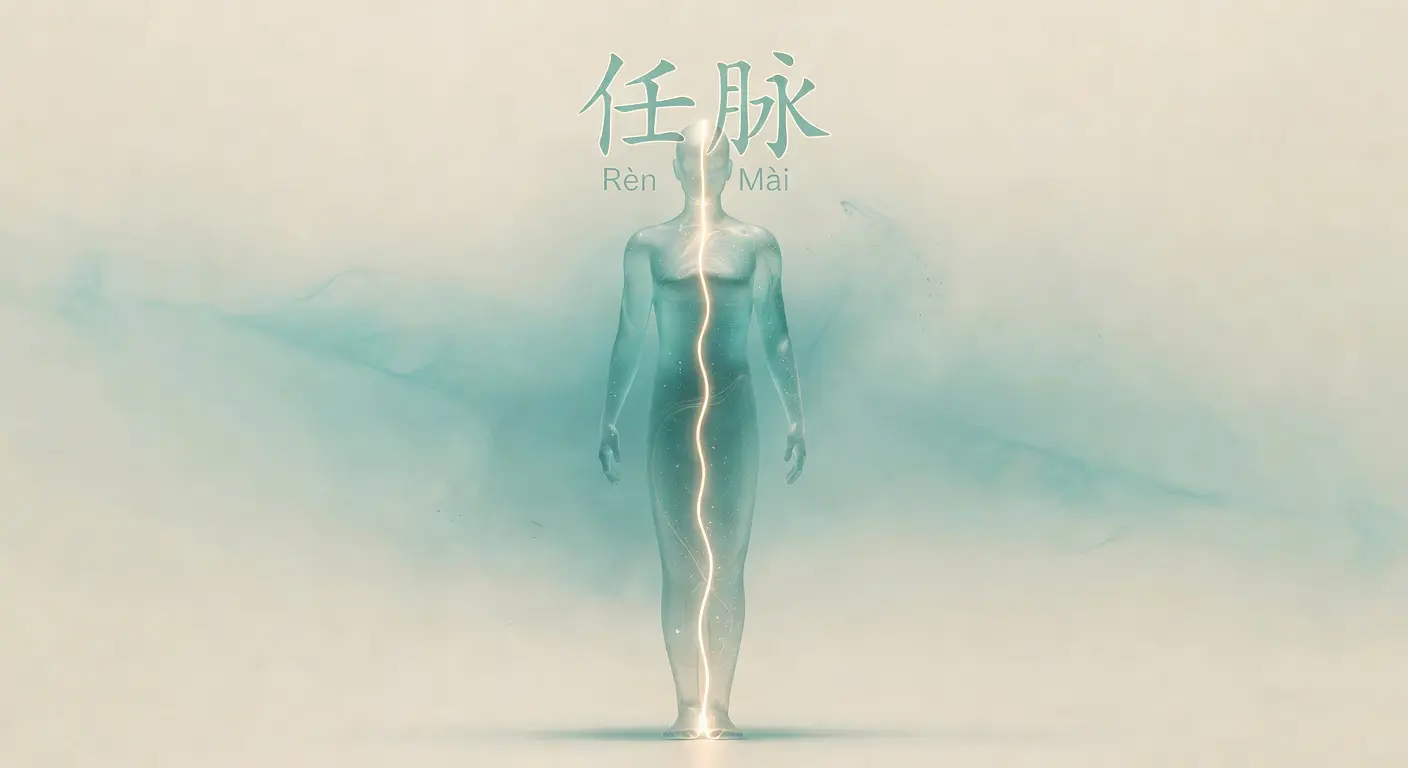
The Ren Mai (任脉 Rèn Mài), or Conception Vessel, is one of the eight extraordinary meridians (奇经八脉 Qí Jīng Bā Mài) in Traditional Chinese Medicine. It circulates on the anterior median line of the body, from the perineal region to the chin, nourishing Yin of the entire organism.
Ren Mai
任脉
- Nourishes Yin of the entire body
- Supports reproduction, fertility and gestation
- Governs organic fluids and secretions
- Regulates Yin organs (Kidney, Spleen, Lung, Heart, Liver)
- Maintains Qi and Blood in vessels
- Protects foetus during gestation
The Ren Mai is like an underground river that irrigates all fertile lands. It flows in shadow, in silence, in depth, bringing coolness, moisture, nourishment and life to all Yin organs. It is the mother who nourishes, protects, gives life.
In Traditional Chinese Medicine
In TCM theory, the Ren Mai is one of the eight extraordinary meridians, which are deep energy reservoirs. It is the principal vessel of Yin, which nourishes Yin of the entire body, supports reproduction, fertility, gestation, breastfeeding, organic fluids, Qi and Blood.
Main functions of the Ren Mai include:
- Nourishing Yin of the entire body: the Ren Mai is the principal vessel of Yin, which nourishes Yin of all Zang-Fu organs, tissues, muscles, bones, skin, hair, eyes, ears, tongue, nose and brain
- Supporting reproduction, fertility and gestation: the Ren Mai governs uterus, ovaries, testicles, prostate, vagina, vulva, perineum, cervix, fallopian tubes, foetus, placenta, amniotic fluid, and all reproductive processes
- Governing organic fluids and secretions: the Ren Mai governs all body secretions (hormones, enzymes, neurotransmitters)
- Regulating Yin organs: the Ren Mai regulates Yin functions of Zang-Fu organs, particularly Kidney, Spleen, Lung, Heart and Liver
- Maintaining Qi and Blood in vessels: the Ren Mai maintains Qi and Blood in vessels, preventing bleeding
- Protecting foetus during gestation: the Ren Mai protects foetus, placenta, amniotic fluid and uterus during gestation
Main points of the Ren Mai include:
- RN1 Huiyin (会阴): intersection point of Ren Mai, Du Mai and Chong Mai, located at perineum
- RN4 Guanyuan (关元): accumulation point of Kidney Qi and Jing, located three inches below navel
- RN6 Qihai (气海): sea of Qi point, located one and a half inches below navel
- RN8 Shenque (神阙): navel point, tonifies Qi, Yang and Jing
- RN12 Zhongwan (中脘): Fu influence and food sea point, located four inches above navel
- RN17 Tanzhong (膻中): sea of Qi point, located in middle of line joining nipples
- RN22 Tiantu (天突): heavenly window point, located in depression above sternum
- RN24 Chengjiang (承浆): intersection point of Ren Mai and Chong Mai, located under lower lip
Practical Applications
In Chinese dietary therapy, the Ren Mai is supported by foods that nourish Yin, support reproduction, tonify Qi and Blood, and govern organic fluids. Recommended foods include dark and black foods (black beans, black sesame seeds, black seaweed, blueberries, blackberries, blackcurrants), red foods (tomatoes, beets, strawberries, cherries, raspberries, pomegranate), white and light foods (pears, apples, radishes, turnips, kohlrabi, almonds), Yin-nourishing foods (tofu, black beans, black sesame seeds, lotus seeds, goji berries, longan, jujubes, pears, apples, cucumbers, courgettes), Qi-tonifying foods (rice, millet, quinoa, buckwheat, sweet potatoes, carrots, beets), Blood-nourishing foods (jujubes, goji berries, longan, figs, grapes, beets, spinach, chicken liver, eggs, fatty fish), seasonal vegetables, seasonal fruits, aromatic herbs, mushrooms, seaweed, and liquorice, jujubes, goji berries, black sesame seeds and lotus infusions.
Lifestyle is crucial to support the Ren Mai: moderate physical activity that circulates Qi and Blood (walking, tai chi, qi gong, swimming, yoga), stress and emotion management that preserves Yin and Shen (meditation, deep breathing, relaxation), sufficient sleep that enables Yin to regenerate (7 to 9 hours, ideally 10pm-6am), balanced sexuality that does not dissipate Jing or Yin, regular and moderate diet that nourishes Yin and Qi, sufficient hydration (warm or room temperature water), protection against cold, heat and dryness, and a life in harmony with seasons strengthen the Ren Mai.
Concrete Examples
A patient presenting with Ren Mai Yin deficiency with fertility disorders may experience infertility or difficulty conceiving, recurrent miscarriages, vaginal dryness, decreased libido, hot flushes, night sweats, deep fatigue, dull complexion, red little-coated tongue, and fine rapid pulse. The TCM dietary protocol will include foods that nourish Ren Mai Yin such as black bean and goji berry porridge, tofu stir-fried with mushrooms and spinach, dry-roasted black sesame seeds as snacks, steamed pears with honey and lotus seeds, cucumbers and courgettes in light salad, fatty fish grilled or steamed, seasonal green vegetables sautéed, seasonal fresh fruits, and chrysanthemum, pear juice, goji berries and black sesame seed infusions.
Conclusion
The Ren Mai (任脉 Rèn Mài) constitutes one of the most important extraordinary meridians in Traditional Chinese Medicine. Understanding its functions, points and dietary and lifestyle support approaches enables a clearer grasp of the therapeutic reasoning and support protocols offered within the Yin Shi universe.
To go further
Yin Shi ecosystem resources directly related to this article.
Yin, the principle of matter
Re-reading the Yin entry sheds light on the Conception Vessel that governs it.
Read the article →Ren Mai, the Conception Vessel of Yin
The lesson places the Ren Mai among the eight extraordinary vessels and its role on the Yin axis.
Take the lesson →