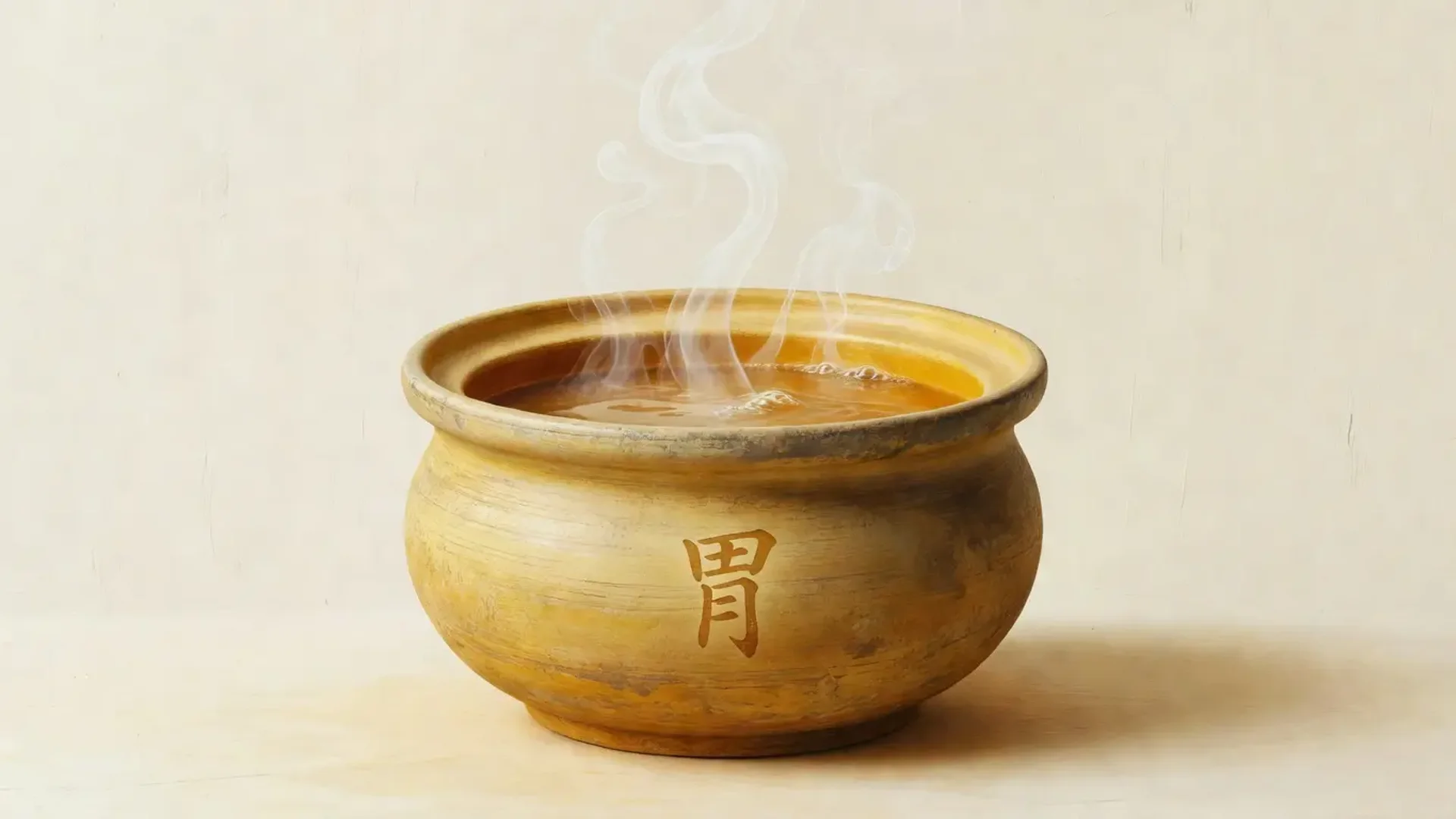
The Stomach (胃 Wèi) in Traditional Chinese Medicine is the receptacle of food, the organ that receives nourishment, coarsely grinds it and sends it down to the Spleen for final transformation. It governs “reception and descent” (受纳和降 Shòu Nà Hé Jiàng) and controls the preference for moderate humidity and coolness.
Stomach
胃
- Receives and contains food and drink
- Coarsely grinds food for the Spleen
- Sends Qi and food down towards the intestine
- Prefers moderate humidity and coolness
- Controls appetite and satiety sensation
- Coordinates with the Spleen for complete digestion
The Stomach is the earthen pot that receives food. Like a mortar, it coarsely grinds food and prepares it for the fine transformation of the Spleen. A harmonious Stomach accepts food with pleasure, processes it without pain and naturally sends it down towards the intestine.
In Traditional Chinese Medicine
In TCM theory, the Stomach and Spleen form a Yin-Yang pair that collaborates in digestion. The Stomach is Yang (hollow organ, Fu): it receives, descends and prefers moderate humidity. The Spleen is Yin (solid organ, Zang): it transforms, transports and prefers dryness. The Stomach “likes humidity” (prefers a slightly humid and cool environment), the Spleen “likes dryness” (prefers a dry and warm environment). This complementarity is essential for harmonious digestion.
The Stomach governs:
- Reception: the acceptance of food, appetite, the capacity to eat
- Grinding: the coarse preparation of food for the Spleen
- Descent: the sending of food downwards (intestines, Large Intestine)
- Humidity: the preference for a slightly humid and cool environment
- Appetite: the sensation of hunger, satiety, the pleasure of eating
The Stomach is particularly vulnerable to Heat (which dries it and causes excessive thirst, heartburn), Cold (which contracts and causes pain, vomiting), Dampness (which obstructs and causes nausea, mucus vomiting), and Qi Stagnation (which causes bloating, reflux, nausea).
Practical Applications
In Chinese dietary therapy, the Stomach is regulated by cool or neutral nature foods, of sweet or slightly sour flavour, rich in liquids and easy to digest. Foods that support the Stomach include rice, millet, apples, pears, carrots, sweet potatoes, tofu, mushrooms, seaweed, sesame seeds, walnuts, clear vegetable broths and liquorice infusions.
Lifestyle directly influences Stomach quality: regular meals, taken in calm and conviviality, attentive chewing, moderate quantity (neither too little nor too much), moderate temperature foods (neither too hot nor too cold), and sufficient sleep regulate the Stomach. Meals taken in stress, haste, anger or sadness, very hot or very cold foods, excess pungent, grilled foods or alcohol, and constant snacking disturb the Stomach.
Concrete Examples
A patient presenting with Stomach Heat may experience intense and permanent thirst, excessive appetite (polyphagia), heartburn and acid regurgitation, inflamed and bleeding gums, a red tongue with a thick dry yellow coating in the centre, and a rapid full pulse. The dietary protocol will include foods that clear Stomach Heat and nourish its Yin such as millet porridge with black beans, tofu stir-fried with mushrooms and spinach, steamed pears, chrysanthemum and lemon juice infusions, and dry-roasted black sesame seeds in small quantity.
A patient presenting with Stomach Cold may experience upper abdominal pain improved by heat and aggravated by cold, nausea and vomiting of clear liquids, absence of thirst, preference for hot drinks, a pale tongue with a white moist coating in the centre, and a deep slow pulse. The dietary protocol will include warming foods that disperse Stomach Cold such as rice porridge with ginger and dates, chicken stewed with leeks and garlic, roasted sweet potatoes, hot ginger and cinnamon infusions, and boiling root vegetable soups.
Frequently Asked Questions
What is the difference between Stomach and Spleen in TCM?
The Stomach and Spleen form a Yin-Yang pair that collaborates in digestion. The Stomach (Yang, Fu) “receives and descends”: it accepts food, coarsely grinds it and sends it downwards. It likes moderate humidity and coolness. The Spleen (Yin, Zang) “transforms and transports”: it extracts Qi and Blood from food and sends them upwards (ascending of clear Qi). It likes dryness and warmth. The Stomach is the receptacle, the Spleen is the transformer. The Stomach is appetite, the Spleen is transformation. The Stomach is the Yang of digestion, the Spleen is the Yin.
How to recognise a Stomach disorder?
Classic signs of a Stomach disorder include appetite disorders (lack of appetite or excessive appetite), nausea and vomiting, heartburn and acid regurgitation, upper abdominal pain, bloating, gastric reflux, excessive thirst or absence of thirst, preference for hot or cold foods, tongue with a thick coating (yellow for Heat, white and moist for Cold, greasy for Dampness), and rapid full pulse (Heat) or deep slow pulse (Cold). The emotions that affect the Stomach are excessive worry (reflection) which weakens the Spleen and anger which makes Stomach Qi rise.
Which foods regulate the Stomach?
Foods that regulate the Stomach are generally of cool or neutral nature, of sweet or slightly sour flavour, rich in liquids and easy to digest. We cite rice, millet, apples, pears, carrots, sweet potatoes, tofu, mushrooms, seaweed, sesame seeds, walnuts, clear vegetable broths, liquorice infusions, fresh ginger (moderation), honey and lotus seeds. Foods to avoid according to the imbalance are very hot foods (grilled foods, fried foods, very hot spices) for Heat, very cold and raw foods for Cold, greasy and fried foods for Dampness, and meals taken in stress for all imbalances.
Conclusion
The Stomach constitutes the fundamental organ of reception and digestive preparation in Traditional Chinese Medicine. Understanding its functions, pathologies and dietary regulation approaches enables a clearer grasp of the therapeutic reasoning and support protocols offered within the Yin Shi universe.
To go further
Yin Shi ecosystem resources directly related to this article.
The Stomach in the Middle Burner
The free lesson from the free course describes the role of the Stomach and Small Intestine in digestion.
Take the lesson →Which TCM organ needs your attention?
The five-organ test spots the Zang-Fu system most called upon in you.
Take the test →