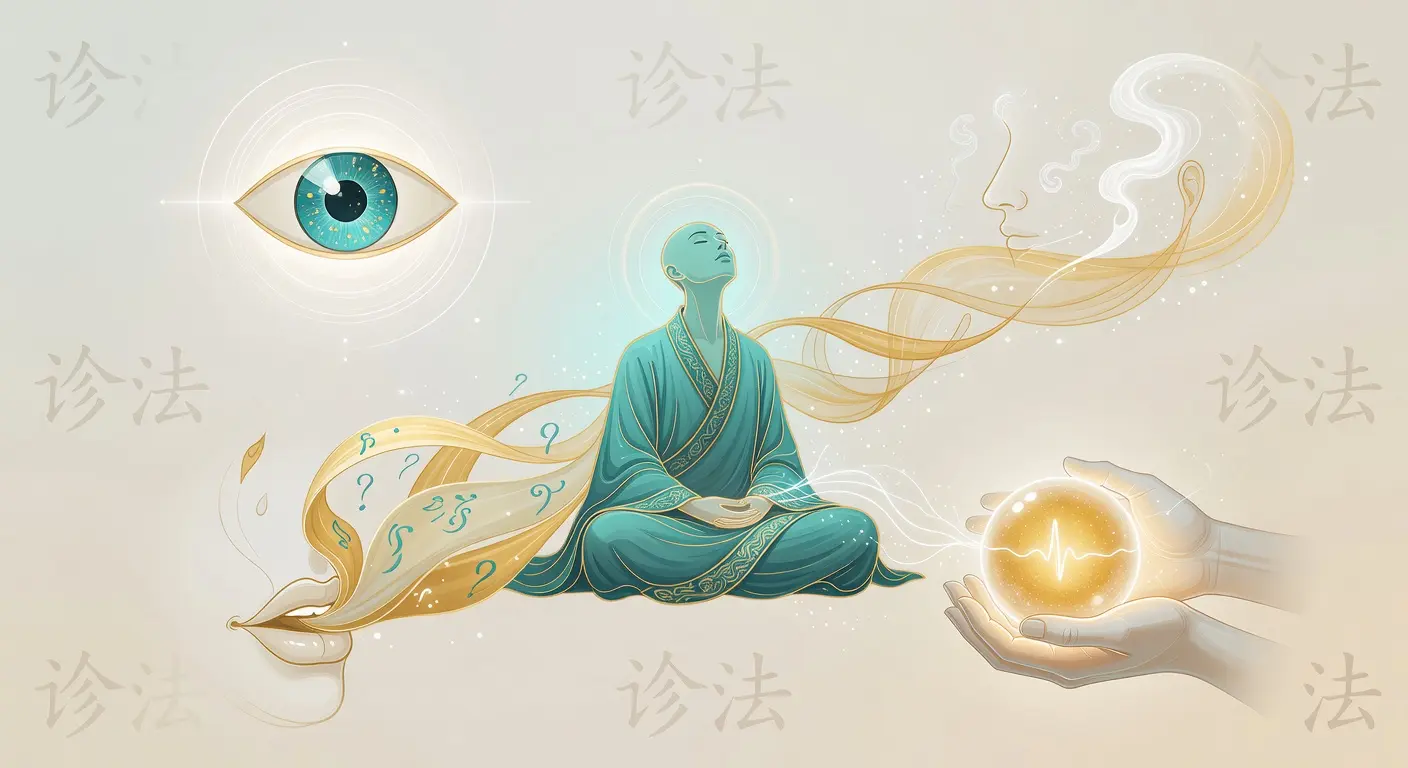
Diagnosis in Traditional Chinese Medicine (诊法 Zhěn Fǎ, “examination methods”) rests on four fundamental pillars: observation (望 Wàng), auscultation-olfaction (闻 Wén), interrogation (问 Wèn) and palpation (切 Qiè). These four methods enable the practitioner to decipher the patient’s energetic state, identify Qi, Blood, Yin and Yang imbalances, and establish a differentiated diagnosis (辨证 Biàn Zhèng).
TCM Diagnosis
诊法
- Rests on four pillars: observation, auscultation-olfaction, interrogation, palpation
- Deciphers energetic state of Qi, Blood, Yin and Yang
- Identifies imbalances by differentiated diagnosis (辨证 Biàn Zhèng)
- Guides treatment (acupuncture, moxibustion, pharmacopoeia, dietary therapy)
- Uses tongue, pulse, voice, odour, symptoms and signs
TCM diagnosis is like reading an open book. The patient’s body tells its energetic story: the tongue reveals the state of internal organs, the pulse reveals Qi and Blood circulation, the voice reveals Shen state, the odour reveals perversities presence, and symptoms reveal deep imbalances.
In Traditional Chinese Medicine
In TCM theory, diagnosis is the base of all treatment. Without a precise diagnosis, treatment risks being ineffective or even counter-productive. TCM diagnosis is not limited to disease (病 Bìng) but identifies the imbalance motif (证 Zhèng), which is the specific combination of symptoms and signs that characterises the patient’s energetic state at a given moment. The same motif can manifest through different diseases; the same disease can manifest through different motifs. Treatment targets the motif, not the disease.
The Four Pillars of Diagnosis (四诊 Sì Zhěn)
1. Observation (望 Wàng)
Observation examines the face, complexion, eyes, tongue, lips, nails, hair, posture, movements, skin, and general aspect of the patient. It reveals the state of internal organs, Qi, Blood, Yin and Yang.
- Complexion: pale (Blood or Qi deficiency), red (Heat or excess Blood), yellow (Dampness or Spleen Qi deficiency), bluish (Blood Stasis or Cold), blackish (Kidney Yang deficiency)
- Tongue: tip (Heart), edges (Liver and Gall Bladder), centre (Stomach and Spleen), root (Kidney), underside (internal organs). Colour, shape, coating and moisture reveal imbalances
- Eyes: bright (stable Shen, sufficient Qi), dull (weakened Shen, empty Qi), red (Liver or Heart Heat), yellow (Liver-Gall Bladder Heat-Dampness), dry (Liver or Lung Yin deficiency)
- Nails: pink and smooth (abundant Blood), pale and fragile (Blood deficiency), wrinkled and brittle (Yin deficiency), purplish (Blood Stasis), yellow and thick (Dampness-Heat)
- Posture and movements: upright and fluid (harmonious Qi and Blood), stooped and slow (Qi or Yang deficiency), rigid and jerky (Qi or Blood Stagnation), collapsed and weak (severe Qi or Yang deficiency)
2. Auscultation-Olfaction (闻 Wén)
Auscultation-olfaction listens to the voice, breathing, cough, gurgling, intestinal noises, and smells breath odour, body odour, urine, stools, and expectorations.
- Voice: strong and clear (abundant Qi and Blood, stable Shen), weak and extinguished (Qi or Blood deficiency), hoarse and dry (Lung or Heart Heat), trembling and panting (Qi or Yang deficiency), shrill and irascible (Liver or Heart Heat)
- Breathing: deep and regular (harmonious Lung and Kidney Qi), short and superficial (Lung or Kidney Qi deficiency), panting and noisy (Lung or Heart Heat), slow and deep (Kidney Yang deficiency), whistling (Dampness or Cold in bronchi)
- Cough: dry and irritating (Lung Heat or Dryness), with white expectorations (Lung Cold or Dampness), with yellow expectorations (Lung Heat-Dampness), weak and chronic (Lung Qi deficiency), nocturnal and dry (Lung Yin deficiency)
- Breath odour: fresh and neutral (harmonious organs), acrid and pungent (Liver or Stomach Heat), sweet and bland (Spleen Dampness), putrid and fetid (Intestinal Heat-Dampness), acid and rancid (Stomach Heat with regurgitations)
- Body odour: neutral and fresh (harmonious organs), acrid and pungent (Liver or Heart Heat), sweet and bland (Spleen Dampness), putrid and fetid (Intestinal Heat-Dampness), ammoniacal (Kidney Yang deficiency)
3. Interrogation (问 Wèn)
Interrogation questions the patient about their symptoms, habits, lifestyle, emotions, diet, sleep, stools, urine, menstruation, sexuality, medical history, and family history.
- Main symptoms: what is the main complaint? Since when? Where? How? What aggravates it? What improves it? What are the associated symptoms?
- Sweating: spontaneous sweating (diurnal, nocturnal, local, general), exertion sweating, heat sweating, stress sweating, cold sweating, sweat odour, sweat quantity
- Appetite and thirst: appetite (normal, excessive, diminished, absent), thirst (present, absent, with desire to drink, without desire to drink), food preferences (hot, cold, sweet, salty, sour, bitter, pungent), taste in mouth (bitter, sweet, salty, sour, pungent, bland, sticky), nausea, vomiting, bloating, stools (shape, colour, odour, frequency, difficulty, pain), urine (colour, quantity, frequency, pain, burning)
- Sleep: bedtime, wake-up time, sleep quality (deep, light, fragmented), difficulty falling asleep, night waking, dreams (agitated, nightmares, frequent), fatigue upon waking, daytime sleepiness, naps
- Emotions: emotional state (calm, anxious, depressed, irritable, angry, sad, fearful, joyful), emotional factors (stress, grief, anger, fear, worry, joy), impact of emotions on health (digestion, sleep, pain, fatigue)
- Lifestyle: physical activity (type, frequency, intensity, duration), work (type, hours, stress, posture), housing (climate, dampness, temperature, ventilation), clothes (protection against cold, wind, dampness), leisure activities (relaxation, meditation, tai chi, qi gong, yoga, sport)
- Sexuality and reproduction: libido (normal, increased, diminished, absent), sexual activity (frequency, satisfaction, pain), sexual disorders, menstruation (date of first periods, cycle, duration, quantity, colour, clots, pain, PMS), pregnancies, births, breastfeeding, menopause
- Medical history: past illnesses (chronic, acute, infectious, surgical, traumatic), past treatments, vaccinations, allergies, intolerances, hospitalisations
- Family history: family illnesses (cardiovascular, digestive, respiratory, endocrine, psychiatric, autoimmune, cancerous), causes of death of parents and grandparents, family constitution
4. Palpation (切 Qiè)
Palpation examines the pulse at the radial artery (腕脉 Wàn Mài), the abdomen, the back, the limbs, the skin, the muscles, the bones, and the acupuncture points. The pulse is the most important diagnostic method in TCM.
- Pulse position: left hand (Heart, Liver, Kidney), right hand (Lung, Spleen, Kidney)
- Pulse quality: floating (表 Biǎo, surface), deep (里 Lǐ, interior), slow (寒 Hán, Cold), rapid (热 Rè, Heat), full (实 Shí, Excess), empty (虚 Xū, Deficiency), wiry (弦 Xián, Liver or pain), slippery (滑 Huá, Dampness or Phlegm), fine (细 Xì, Blood or Yin deficiency), weak (弱 Ruò, Qi or Yang deficiency), surging (洪 Hóng, Heat), choppy (涩 Sè, Blood Stasis)
Practical Applications
In Chinese dietary therapy, diagnosis guides food choices according to the identified imbalance motif. Foods are chosen according to their thermal nature, flavour, meridian tropism and therapeutic actions to correct the identified imbalance.
Conclusion
TCM diagnosis (诊法 Zhěn Fǎ) constitutes the fundamental basis of all treatment in Traditional Chinese Medicine. Understanding the four pillars of diagnosis, their methods and their clinical application enables a clearer grasp of the therapeutic reasoning and support protocols offered within the Yin Shi universe.
To go further
Yin Shi ecosystem resources directly related to this article.
What does your tongue say about your terrain?
The visual tongue test illustrates one of the four pillars of TCM diagnosis.
Take the test →The four examinations of the TCM consultation
The lesson details Si Zhen: looking, listening, asking, palpating.
Take the lesson →