Fragmented sleep: the silent epidemic of the 21st century
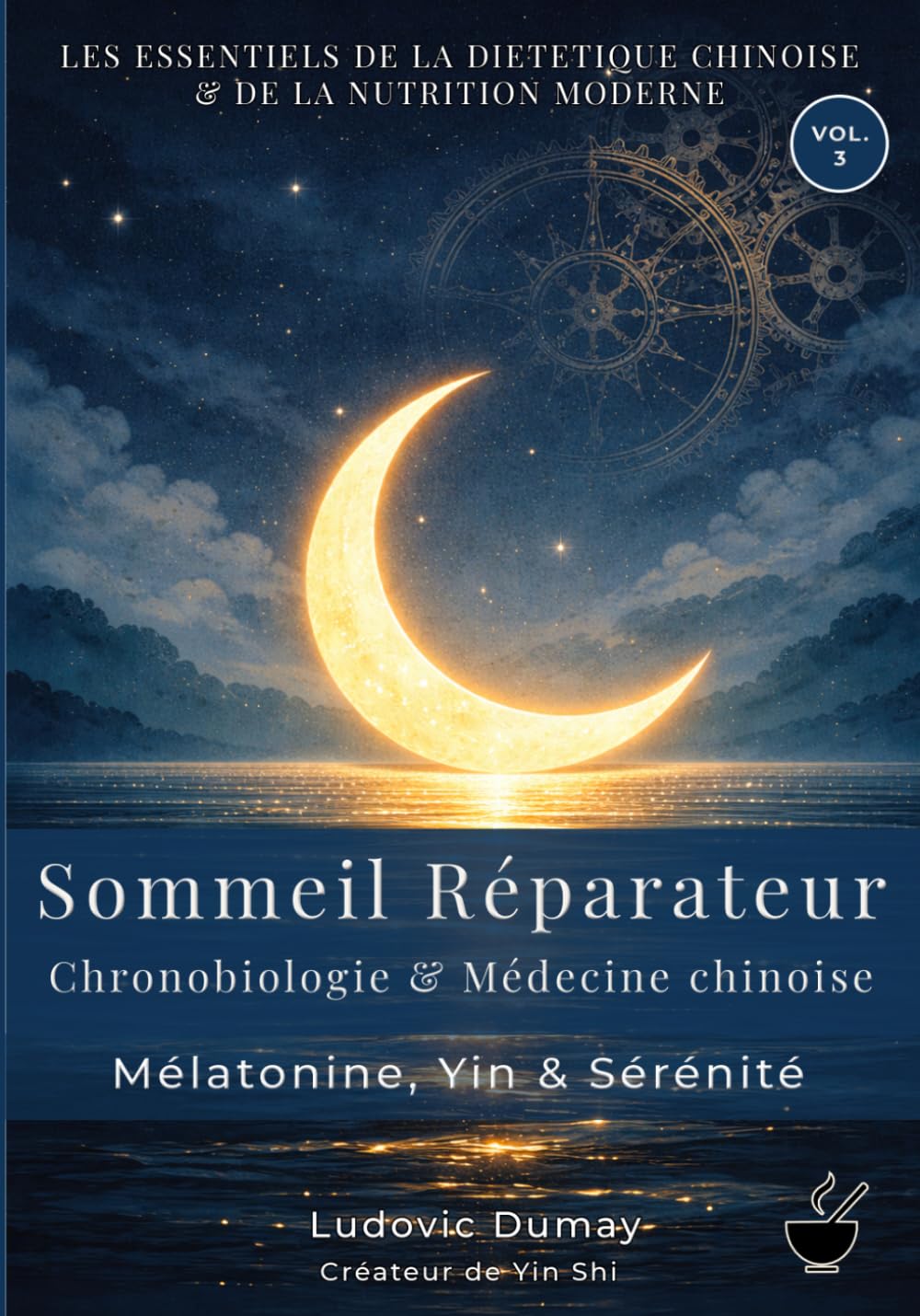
Sleeping 7 or 8 hours no longer guarantees a rested awakening: a third of people live with fragile sleep, boosted by sleeping pills and fragmented by stress. Reparative Sleep offers an integrative answer where modern chronobiology dialogues with Traditional Chinese Medicine (TCM) without blurring the registers.
This 158-page volume decodes the mechanisms of the biological clock, sets out four insomnia profiles (Heart, Liver, Lung, Spleen) and unfolds concrete solutions: sleep nutrition, targeted micronutrition, Chinese and Western phytotherapy, evening rituals and supervised four-week programmes.
Why this book?
The problem
Most sleep guides stick either to neuroscience or to “wellness” routines. They ignore the precise typology of insomnia, do not distinguish early cortisol from Heart Blood deficiency, and offer generic lists of “anti-stress” foods without a protocol.
The solution
This book combines chronobiology data (cortisol, melatonin, suprachiasmatic nucleus, sleep pressure) and TCM frameworks (Wei Qi, Ming horary correspondences, differentiated diagnostics). Every recommendation is sourced, contextualised and convertible into daily action: questionnaires, recipes, rituals, personalised programmes.
What you will discover
Part 1: The Physiology of Sleep, the Body and Mind at Rest
- The biological clock: circadian cycles, cortisol/melatonin compared with the Zi Wu Liu Zhu (子午流注) cycle, presented as a system of Ming resonances rather than a fixed “clock”
- The neurotransmitter/Vital Substances dialogue: serotonin & Heart Blood, adenosine & sleep pressure, orexin & persistent Yang
- Blue light and its dual reading (scientific and TCM) with light-hygiene protocols
Part 2: Diagnosis, Understanding Why You Do Not Sleep
- Insomnia typology crossing modern biomarkers and TCM profiles (Heart, Liver, Lung, Spleen)
- Personal assessment: integrative questionnaire, logbook and connected tracking tools
Part 3: Integrative Food Solutions
- Sleep nutrition: tryptophan, Yin foods, carbohydrate timing, therapeutic recipes
- Micronutrition: magnesium, vitamin D, zinc, iron, omega-3, reasoned exogenous melatonin
- Integrative phytotherapy: valerian, passionflower, hops, Suan Zao Ren (酸枣仁), Bai Zi Ren (柏子仁), He Huan Pi (合欢皮)
Part 4: Lifestyle and Practical Protocols
- Evening rituals: chronobiological routine, Qi Gong/self-massage, sanctuarised bedroom
- 4-week programmes adapted to each profile (Blood deficiency/GABA, Liver stagnation/Cortisol, Yin deficiency/Inflammation)
Unique methodology
Integrative approach
Each chapter juxtaposes recent scientific data (published between 2019 and 2025) with classical frameworks (Suwen, Lingshu) and later codifications (Zi Wu Liu Zhu, Koten-Ha). Convergences are flagged, divergences assumed.
Who is this book for?
- TCM practitioners: enrich your assessments with circadian and nutritional indicators
- Therapists: offer ready-to-use programmes (recipes, rituals, follow-ups)
- Clients: understand why you wake between 1am and 5am and correct the root cause
- The general public: break free from sleeping-pill dependence with validated natural solutions
Reparative Sleep FAQ
1. Is this book aimed at TCM beginners?
Yes. Energetic concepts are explained progressively with clear correspondence tables and historical reminders (classics vs modern codifications).
2. Can I follow the protocols if I take sleeping pills?
Yes, but always under medical supervision. The proposed routines support a gradual withdrawal and insist on coordination with your doctor.
3. How long before I feel a change?
The programmes are designed over four weeks, the time needed to recalibrate the biological clock. Many readers notice improved sleep onset from the first week.
4. Do the recipes suit specific diets?
Each therapeutic evening recipe includes vegetarian, gluten-free or low-FODMAP variants, with the corresponding energetic indication.
5. What is the difference from a classic sleep guide?
This volume precisely maps night waking to TCM profiles and modern biomarkers, proposes personalised protocols and recalls the pedagogical nature of horary correspondences (Ming tradition, Japanese Koten-Ha readings).
6. Do I need to read the previous volumes?
No. Each volume is self-contained. This one summarises the TCM basics needed in the context of sleep. To go deeper into digestion, see Digestion: The TCM & Science Alliance. For metabolism, see Metabolism & Slimming.
7. Are the nutritional recommendations scientifically supported?
Yes, every piece of advice is linked to recent peer-reviewed studies in neuroscience, clinical nutrition and chronobiology.
The author: Ludovic Dumay
Therapist, trainer in Chinese dietetics and cupping therapy since 2010, I devotes my career to building bridges between two worlds: the millennia-old wisdom of Traditional Chinese Medicine and the advances of modern science.
My deep conviction is that the best therapist is the one who masters both languages.
I support practitioners from Chinese medicine to anchor their practice in current scientific data, and Western therapists to enrich their approach with the energetic and systemic vision of TCM.
This dual transmission is the guiding thread of my books: concrete, accessible works that are clinically applicable, transforming complexity into everyday tools.
Ordering the book
Available on Amazon: Order Reparative Sleep
Format: Paperback, 158 pages
ISBN: 9798252760865
Collection: The Essentials of Chinese Dietetics & Modern Nutrition, Volume 3
To go further
Yin Shi ecosystem resources directly related to this article.
L'insomnie d'endormissement et le Vide de Sang du Cœur
La leçon Académie sur l'un des terrains centraux du livre : le Shen qui ne trouve plus sa demeure.
Take the lesson →Les aliments qui apaisent le Shen
Les fiches pratiques de l'application pour le dîner qui prépare la nuit.
Full sheets available after the 30-day free trial or with a subscription.
L'insomnie en MTC : six terrains, six solutions
L'article encyclopédie qui cartographie les insomnies selon le Shen, le Yin et le Sang.
Read the article →Quel vide pèse sur vos nuits ?
Le test Qi-Sang-Yin-Yang mesure les quatre ressources dont dépend la qualité du sommeil.
Take the test →