Yin-Yang (阴阳 Yīnyáng) is the cornerstone of all classical Chinese thought, and by extension, the foundation of Chinese dietetics. Understanding this principle means understanding why certain foods “warm” or “cool” in the energetic sense, why eating ice cream in winter weakens digestion, and why headaches of the “Liver Yang Rising” type require cold or cool-natured foods to calm them.
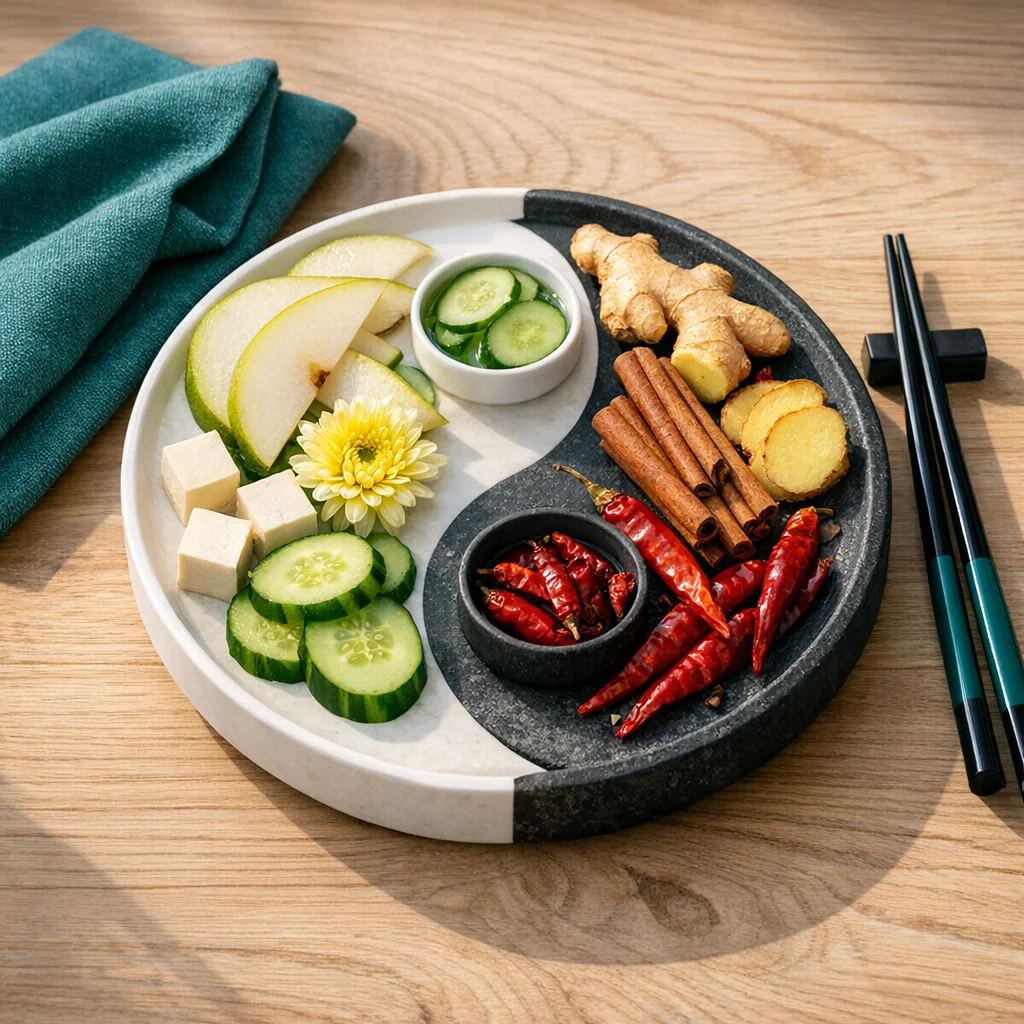
The Yin-Yang Principle: Beyond the Symbol
Yin-Yang is not a fixed duality — it is a dynamic model of perpetual transformation. The Huangdi Neijing (黄帝内经) lays the foundation:
“Pure Yin constitutes the Earth, pure Yang constitutes Heaven. The Qi of Earth rises and creates clouds; the Qi of Heaven descends and creates rain.”
The Four Principles of Yin-Yang
| Principle | Description | Dietary application |
|---|---|---|
| Opposition | Yin and Yang are opposites | Cold ↔ Hot, Moist ↔ Dry |
| Interdependence | Each contains the seed of the other | No food is 100% Yin or Yang |
| Dynamic balance | They regulate each other | Excess Yang creates Yin deficit |
| Transformation | One can transform into the other | Cooking transforms a Yin food into Yang |
Yin and Yang in Diet
Thermal Nature: The Key Concept
A food’s thermal nature is its energetic effect on the body after ingestion — independent of its physical temperature. An iced mint tea has a cooling effect (cold nature). A hot curry has a warming effect (hot nature).
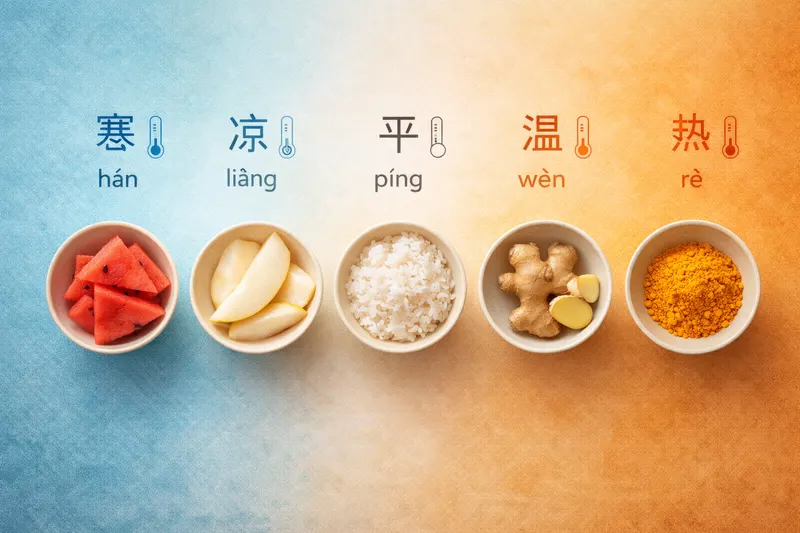
The thermal nature scale comprises 5 degrees:
| Nature | Chinese | Pinyin | Effect | Typical foods |
|---|---|---|---|---|
| Cold | 寒 | hán | Strongly cools, drains Heat | Crab, cucumber, watermelon, strong green tea |
| Cool | 凉 | liáng | Moderately cools | Pear, tofu, wheat, celery, lettuce |
| Neutral | 平 | píng | Balanced | Rice, carrot, beef, corn, grape |
| Warm | 温 | wēn | Moderately warms | Fresh ginger, garlic, chicken, oats |
| Hot | 热 | rè | Strongly warms | Turmeric, cinnamon, lamb, black pepper |
The 5 Flavours and Their Yin-Yang Nature
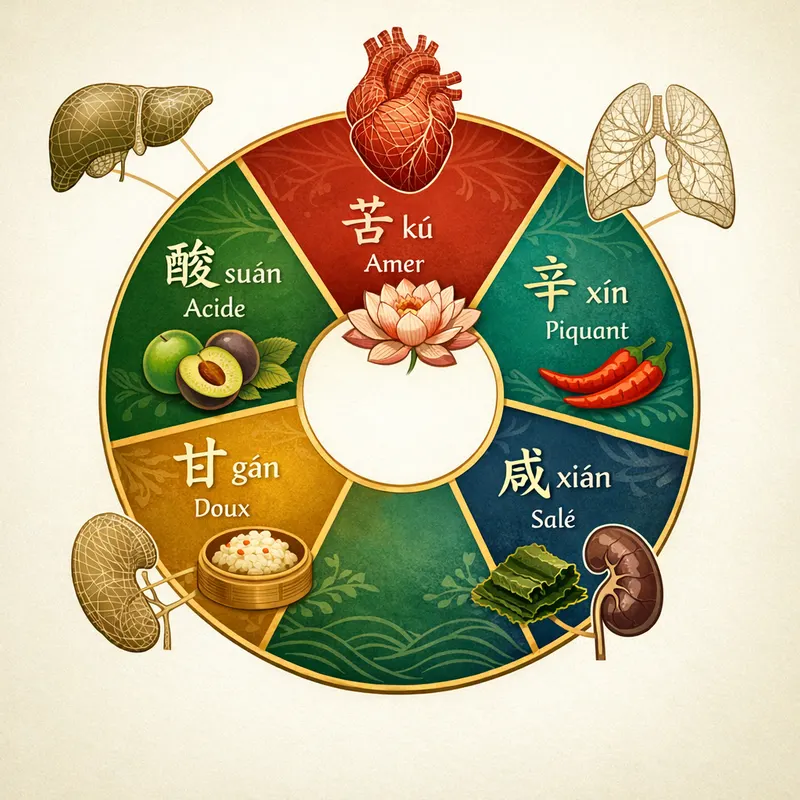
Flavours also have a Yin-Yang polarity:
| Flavour | Chinese | Target organ | Nature | Action |
|---|---|---|---|---|
| Sour (酸 suān) | — | Liver | More Yin | Astringent, retains |
| Bitter (苦 kǔ) | — | Heart | More Yin | Descends, dries, cools |
| Sweet (甘 gān) | — | Spleen | Neutral | Tonifies, moistens, slows |
| Pungent (辛 xīn) | — | Lung | More Yang | Disperses, promotes circulation |
| Salty (咸 xián) | — | Kidney | More Yin | Softens, descends, moistens |
Yin-Yang Imbalances and Headaches
The TCM classification of headaches can be read through the Yin-Yang lens:
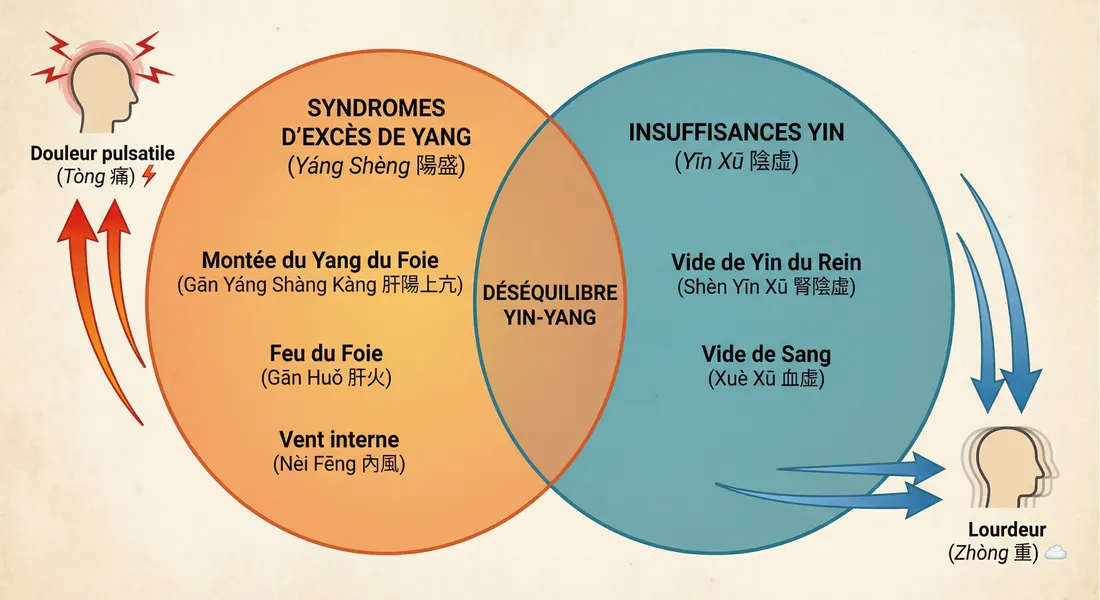
Yang Excess
Yang is in excess — it rises to the head, causing heat and pressure.
Corresponding syndromes:
- Liver Yang Rising (syndrome 2): Yang ascends unchecked, rises to the head. Pulsating pain, sides and temples. Aggravated by anger.
- Liver Fire (syndrome 3): Yang transformed into Fire. More intense, with thirst, dark urine.
- Liver Wind (syndrome 4): Extreme Yang generating internal Wind.
- Stomach Heat (syndrome 13): Yang excess in the Stomach meridian.
Dietary strategy: Nourish Yin to anchor Yang. Cool/cold-natured foods.
| Yang foods to reduce | Yin foods to favour |
|---|---|
| Alcohol, strong spices | Cucumber, melon, tofu |
| Excessive red meat | Celery, seaweed, pear |
| Coffee | Chrysanthemum (Jú Huā), light green tea |
| Fried foods | Green vegetables steamed |
Yin Deficiency (Yin Insufficiency)
Yin is insufficient — it can no longer anchor Yang, which rises excessively.
Corresponding syndromes:
- Kidney Deficiency (syndrome 16): Kidney Essence (deep Yin) is depleted. Headache in the brain itself, at the occiput.
- Blood Deficiency (syndrome 15): Blood (material Yin) is insufficient to nourish and anchor.
Dietary strategy: Nourish and tonify Yin.
| Quintessential Yin foods |
|---|
| Oysters, mussels (nourish Kidney Yin) |
| Black sesame (Hēi Zhī Ma) |
| Black beans (Hēi Dòu) |
| Mulberries (Sāng Shèn) |
| Goji berries (Gǒu Qǐ Zǐ) |
| Pear, peach |
| Unsweetened soy milk |
Yin Excess
Yin is in excess — it obstructs, weighs down, blocks circulation.
Corresponding syndromes:
- Dampness (syndrome 7): Yin in excess, obstructing clear Yang.
- Turbid Phlegm (syndrome 8): Dampness condensed into Phlegm.
- Wind-Dampness (syndrome 1): Pathological Yin aggravated by external factors.
Dietary strategy: Warm Yang to transform Dampness.
| Yin foods to reduce | Yang foods to favour |
|---|---|
| Dairy, cheese | Cooked ginger |
| Raw, cold foods | Rice, oats (dry cooking) |
| Banana, refined sugar | Barley (draining properties) |
| Fats and fried foods | Bell pepper, fennel |
Yang Deficiency (Yang Insufficiency)
Yang is insufficient — not enough warmth and force to propel and warm.
Corresponding syndromes:
- Qi Deficiency (syndrome 14): Qi Yang is insufficient to send clarity to the head.
- Cold Stagnation/Liver (syndrome 6): Yang cannot warm the Liver meridian.
Dietary strategy: Tonify and warm Yang.
Yin-Yang in Daily Practice
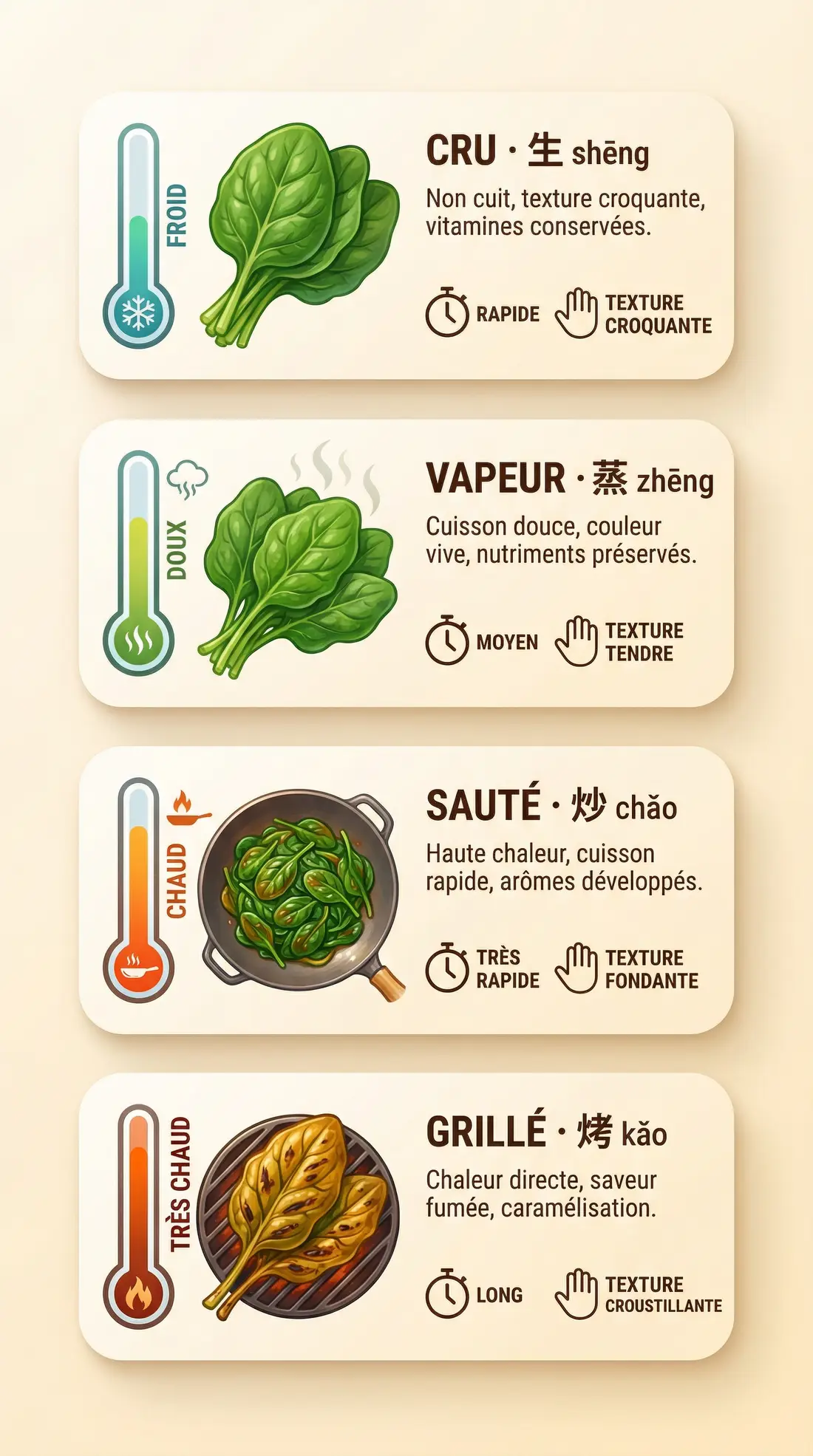
Cooking Transforms Nature
Cooking is an act of Yin → Yang transformation:
| Cooking method | Energetic transformation |
|---|---|
| Raw | Stays Yin |
| Steamed | Slightly Yang |
| Stir-fried (wok) | Moderate Yang |
| Long-simmered | Moderate Yang (deep warmth) |
| Grilled, roasted | Strong Yang |
| Deep-fried | Strong Yang but pathological (generates Damp-Heat) |
A telling example: raw spinach is cool (Yin) in nature. Steamed, it becomes neutral. Stir-fried in a wok with ginger, it becomes slightly warm (Yang).
Adapting Diet to Seasons
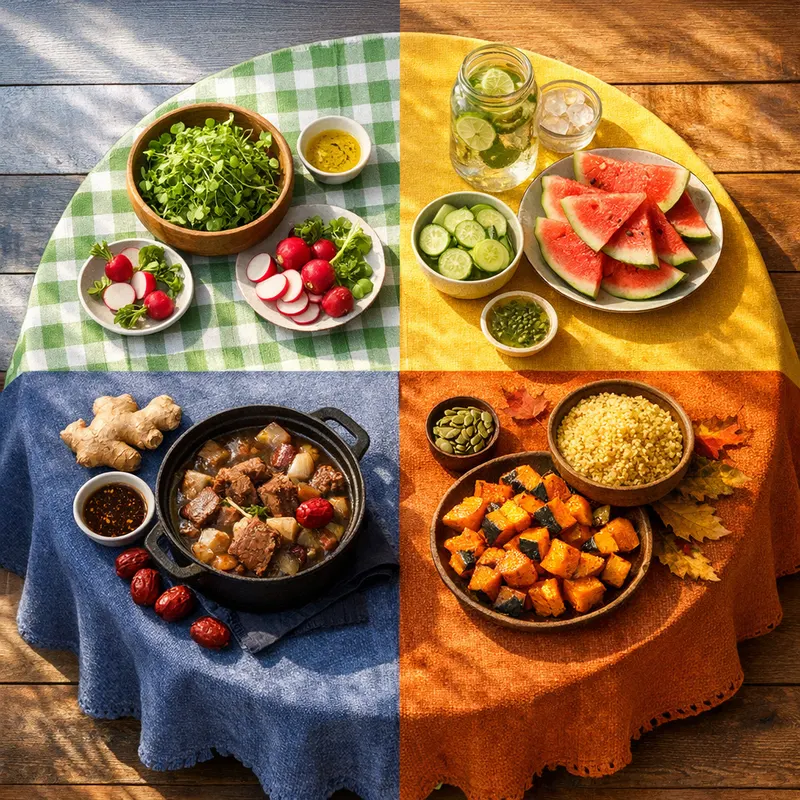
Yin-Yang follows seasonal cycles:
| Season | Dominant energy | Recommended diet |
|---|---|---|
| Spring | Rising Yang | Light, green, slightly pungent foods |
| Summer | Maximum Yang | Cool, hydrating, Yin foods |
| Autumn | Rising Yin | Moistening, slightly warm foods |
| Winter | Maximum Yin | Yang, warm, nourishing foods |
Adapting Diet to Constitution
Your Yin-Yang constitution determines your needs:
Yang constitution (tendency to heat):
- Signs: red complexion, frequent thirst, warm to touch, constipation
- Needs: Yin foods (cool/cold), moderation of spices
- Risk: Yang Rising, Liver Fire
Yin constitution (tendency to cold):
- Signs: cold extremities, chilliness, clear urine, loose stools
- Needs: Yang foods (warm/hot), long cooking methods
- Risk: Dampness, Phlegm, Yang Deficiency
FAQ on Yin-Yang in Diet
What is the thermal nature of a food in TCM? Thermal nature is the energetic effect a food produces in the body after digestion, regardless of its physical temperature. There are 5 natures: cold, cool, neutral, warm and hot. For example, mint is cool even consumed as a hot tea, and ginger is warm even in a cold decoction.
How do you balance Yin and Yang in daily diet? The basic rule: vary thermal natures, favour neutral foods (rice, carrots, beef) as a base, and adjust according to season and how you feel. In winter, add warm spices (ginger, cinnamon); in summer, increase cool foods (cucumber, watermelon, mint). Avoid extremes — too many cold foods (ice cream, cold drinks) or too many hot foods (alcohol, strong spices) consistently.
Why is eating warm important in TCM? In TCM, cooking heat amplifies Yang and facilitates digestion by the Spleen-Stomach. Raw and cold foods consumed in excess “extinguish the digestive fire” (Spleen Yang), reducing the capacity to transform food into Qi (气 qì) and Blood (血 xuè). This is why hot soup is preferable to a cold smoothie in the morning, especially for tired or chilly individuals.
What is the link between Yin-Yang and headaches? Most headaches in TCM can be explained by a Yin-Yang imbalance. Yang excess (Liver Fire, Yang Rising) causes intense, pulsating headaches. Yin deficiency (Kidney Deficiency, Blood Deficiency) creates a relative Yang excess that rises to the head. Yin excess (Dampness, Phlegm) obstructs the rising of clear Yang and causes dull headaches with heaviness.
To deepen your understanding of Qi and Blood, two fundamental substances in TCM, consult our dedicated articles. To identify the foods suited to your Yin-Yang constitution, the Yin Shi app offers a personalised analysis according to TCM principles.