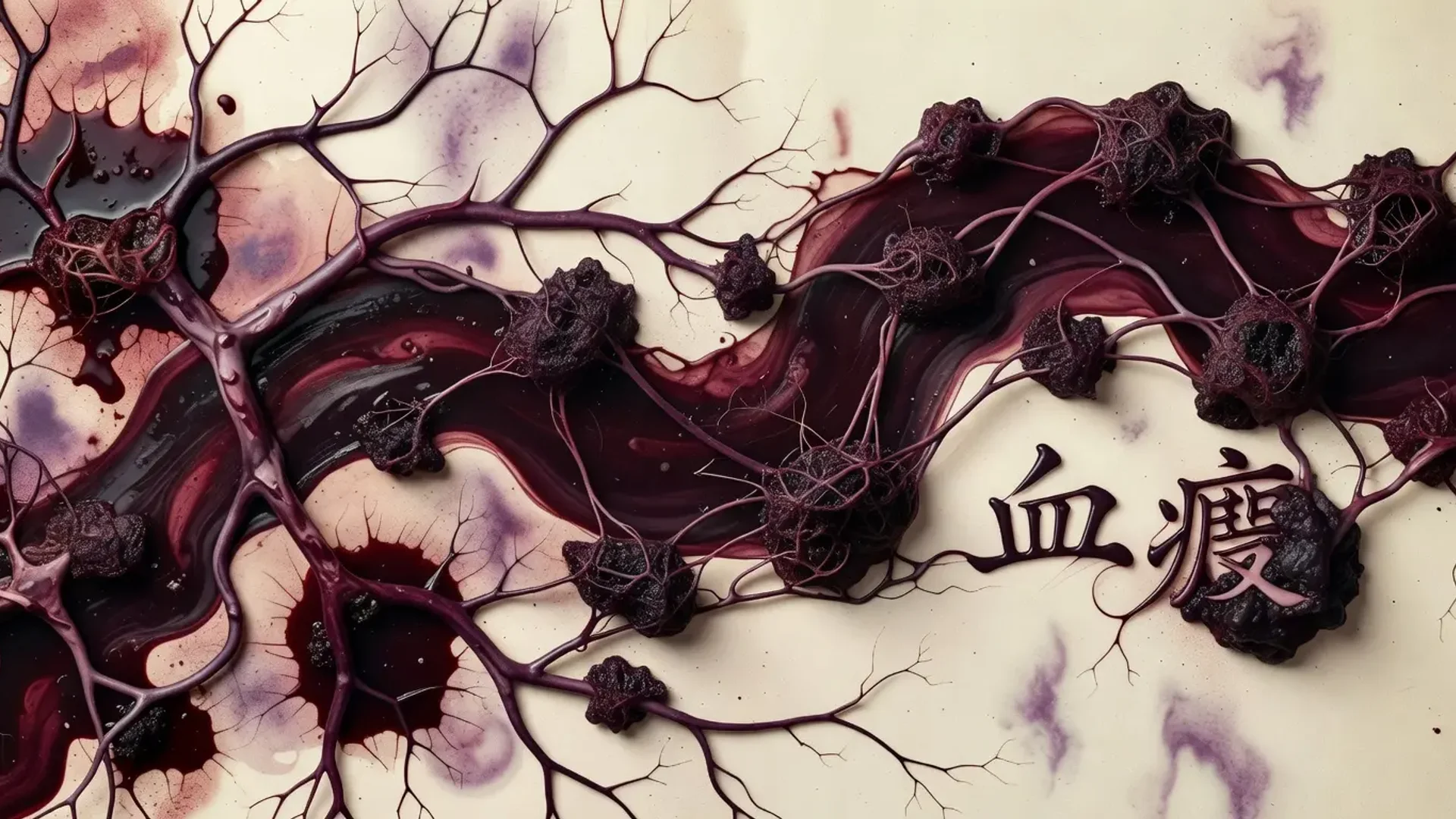
Blood stasis (血瘀 Xuè Yū) is a fundamental syndrome in Traditional Chinese Medicine, characterised by a blockage of Blood circulation that manifests as fixed and stabbing pain, masses, dull complexion, purple tongue and scaly or depigmented skin.
Blood Stasis
血瘀
- Manifests as fixed, stabbing pain aggravated by pressure
- Affects the Liver, Heart, Spleen and blood vessels
- Causes subcutaneous masses, dull complexion and slow healing
- Requires foods and spices that mobilise Blood
- May result from Blood deficiency, Cold, Heat or stagnant Qi
Blood stasis represents the blockage of blood circulation. Blood, which should flow like a river’s water, becomes stagnant and forms “marshes” of coagulated blood that obstruct vessels, organs and tissues.
In Traditional Chinese Medicine
In TCM theory, Blood stasis occurs when Blood circulation is slowed or blocked. The main causes are Qi deficiency that no longer pushes Blood (Qi is the commander of Blood), Cold that contracts vessels and slows Blood, Heat that coagulates Blood, Qi stagnation that leads to Blood stagnation, physical trauma, significant Blood loss that leaves stagnant residues, or ageing that burdens circulation.
Blood stasis can concern different organs and tissues:
- Liver Blood stasis: fixed hypochondriac pain, abdominal masses, painful cycles with clots, irritability
- Heart Blood stasis: palpitations, suffocating chest pain, bluish complexion, purple tongue
- Uterus Blood stasis: dysmenorrhoea with dark clots, irregular cycles, infertility, endometriosis
- Limb Blood stasis: varicose veins, indurated oedema, numbness, venous ulcers
- Cutaneous Blood stasis: dull complexion, pigment spots, hypertrophic scars, scaly skin
Practical Applications
In Chinese dietary therapy, Blood stasis is treated with foods that mobilise Blood, promote its circulation and dissipate stagnations. Foods that mobilise Blood include turmeric, saffron, ginger, garlic, spinach, beetroot, black sesame seeds, rice wine (in moderation), citrus fruits, basil, cumin, seaweed and red fruits.
Cooking method directly influences Blood mobilisation: hot and spicy cooking, stews with mobilising spices, hot ginger and turmeric infusions, and foods consumed hot activate circulation. Cold, raw or refrigerated foods contract vessels and aggravate Blood stasis.
Concrete Examples
A female patient presenting with Uterus Blood stasis may experience very painful periods with dark and abundant clots, irregular cycle, unexplained infertility, palpable pelvic mass, dull greyish complexion and purple tongue with purple spots on the edges. The dietary protocol will include Blood-mobilising foods such as rice porridge with turmeric and ginger, spinach sautéed with garlic, roasted beetroot, hot saffron and ginger infusions, and dry-roasted black sesame seeds as snacks.
A patient presenting with Blood stasis after trauma (fall, sprain, fracture) may experience fixed and stabbing pain at the impact site, indurated swelling, persistent bruising, slow healing and local stiffness. The dietary protocol will include foods that dissipate traumatic stasis such as hot chicken soups with ginger and garlic, sautéed spinach, beetroot, fresh turmeric infusions and dry-roasted black sesame seeds.
Frequently Asked Questions
What is the difference between Blood stasis and Blood deficiency?
Blood deficiency is a quantitative or qualitative insufficiency of Blood (lack of Blood), manifesting as pallor, fatigue, dizziness. Blood stasis is a qualitative blockage of Blood circulation (stagnant Blood), manifesting as fixed pain, masses, dull complexion, purple tongue. A patient may simultaneously have Blood deficiency and Blood stasis (“stasis within deficiency”), which complicates treatment as one must both tonify and mobilise.
How to recognise Blood stasis?
The classic signs of Blood stasis include fixed and stabbing pain (especially nocturnal), palpable subcutaneous or abdominal masses, dull or greyish complexion, purple (purplish) tongue sometimes with purple spots on the edges, purple lips, purple or striated nails, slow healing, easy and persistent bruising, scaly or depigmented skin, and thin, tight or irregular pulse.
Which foods mobilise Blood?
Blood-mobilising foods are generally of warm or hot nature, pungent or aromatic, and consumed hot. These include turmeric, saffron, fresh ginger, garlic, spinach, beetroot, black sesame seeds, rice wine (moderation), citrus fruits, basil, cumin, seaweed, red fruits (redcurrants, raspberries), oily fish and hot ginger-turmeric infusions. Foods to avoid are cold foods, iced drinks and prolonged sedentary lifestyle.
Conclusion
Blood stasis constitutes the fundamental syndrome of blocked circulation in Traditional Chinese Medicine. Understanding its causes, manifestations and mobilising dietary approaches enables a better grasp of the therapeutic reasoning and support protocols proposed in the Yin Shi universe.
- Blood
- Liver
- Blood deficiency
- Qi
- Pain
To go further
Yin Shi ecosystem resources directly related to this article.
Is your Blood stagnating somewhere?
The Oketsu score assesses the signs of blood stasis described by Japanese medicine.
Take the test →Recognising and mobilising Blood stasis
The lesson gives the diagnosis of Blood Stagnation and the foods that mobilise it.
Take the lesson →