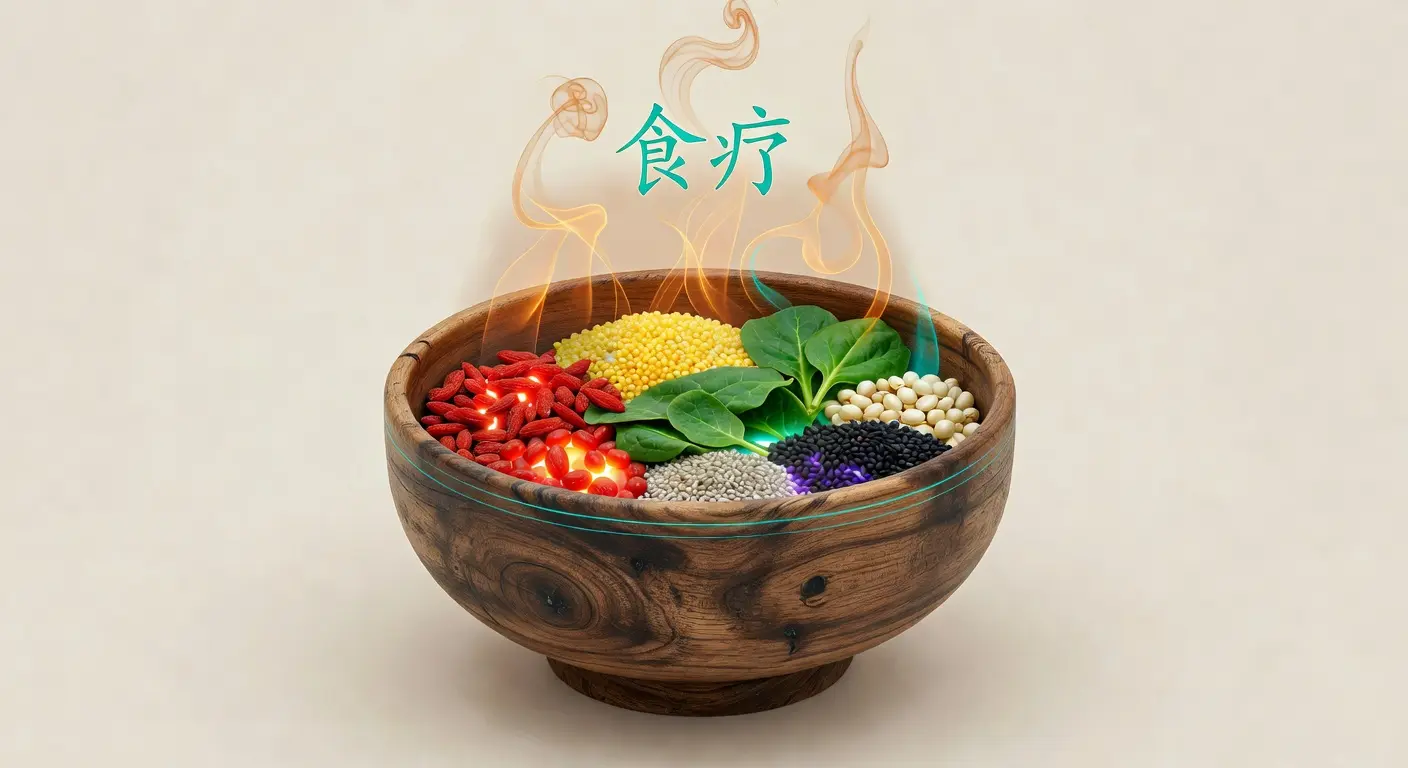
Dietary therapy in Traditional Chinese Medicine (食疗 Shí Liáo, “food therapy”) is a fundamental therapy that uses the energetic properties of foods (thermal nature, flavours, organ-meridian tropisms) to balance Qi, Blood, Yin and Yang, tonify Zang-Fu organs, disperse external and internal perversities, and maintain health and prevent disease.
Dietary Therapy
食疗
- Uses the energetic properties of foods to balance Qi, Blood, Yin and Yang
- Tonifies Zang-Fu organs according to organ-meridian tropisms
- Disperses external perversities (Wind, Cold, Heat, Dampness, Dryness) and internal ones
- Prevents disease and maintains health
- Complements and supports other therapies (acupuncture, moxibustion, herbal medicine)
- Adapts to individual constitution, climate, season and lifestyle
TCM dietary therapy is the medicine of the kitchen. Like an alchemist who transforms raw materials into an elixir of health, the Chinese dietician transforms everyday foods into energetic therapy. Each food has a nature, a flavour, a tropism and an action that can balance or imbalance the body depending on how it is chosen, prepared and consumed.
In Traditional Chinese Medicine
In TCM theory, diet is the first line of therapy (药食同源 Yào Shí Tóng Yuán, “foods and medicines share the same source”). Foods are classified according to their energetic properties that determine their action on the body:
Thermal Nature (四气 Sì Qì)
The thermal nature of a food determines its effect on body temperature and metabolism:
- Hot foods (热 Rè): warm Yang, disperse Cold, activate circulation. Examples: lamb, beef, ginger, garlic, cinnamon, clove, chilli, turmeric
- Warm foods (温 Wēn): tonify Qi and Yang, warm the Centre, facilitate digestion. Examples: chicken, turkey, cooked carrots, sweet potatoes, dates, jujubes, sesame seeds
- Neutral foods (平 Píng): balance Yin and Yang, tonify Qi, nourish Blood. Examples: rice, millet, tofu, apples, pears, raw carrots, spinach
- Cool foods (凉 Liáng): clear Heat, moisten Yin, calm Fire. Examples: cucumbers, courgettes, radishes, apples, pears, citrus, chrysanthemum
- Cold foods (寒 Hán): disperse Heat, clear Fire, reduce inflammation. Examples: watermelon, melon, banana, lemon, grapefruit, ice, iced drinks
Flavours (五味 Wǔ Wèi)
The flavour of a food determines its action on Zang-Fu organs and meridians:
- Pungent flavour (辛 Xīn): circulates Qi and Blood, disperses Wind and Cold, opens pores. Examples: ginger, garlic, leeks, basil, mint, turmeric, chilli, fennel
- Sweet flavour (甘 Gān): tonifies Qi and Blood, harmonises the Spleen, softens tension, relieves pain. Examples: rice, millet, sweet potatoes, carrots, dates, jujubes, honey, liquorice
- Sour flavour (酸 Suān): astringes, contracts, tonifies Yin, harmonises the Liver, stops sweating and diarrhoea. Examples: lemon, vinegar, tomatoes, cherries, gooseberries, elderberry
- Bitter flavour (苦 Kǔ): clears Heat, dries Dampness, descends Qi, tonifies the Heart. Examples: dandelion, artichoke, chicory, coffee, green tea, chrysanthemum
- Salty flavour (咸 Xián): descends Qi, softens masses, purifies blood, nourishes the Kidney. Examples: seaweed, fish, prawns, oysters, sea salt
Organ-Meridian Tropisms (归经 Guī Jīng)
The tropism of a food determines the organ or meridian towards which it is directed and which it tonifies or regulates:
- Lung tropism: pears, apples, citrus, almonds, liquorice, ginger, leeks, white
- Spleen-Stomach tropism: rice, millet, sweet potatoes, carrots, dates, jujubes, ginger, liquorice, yellow
- Liver tropism: spinach, beetroot, black sesame seeds, eggs, longan, jujubes, green
- Heart tropism: jujubes, goji berries, longan, saffron, eggs, chicken liver, red
- Kidney tropism: black beans, black sesame seeds, walnuts, bone broths, seaweed, nuts, black
Cooking Methods
The cooking method modifies the thermal nature and properties of foods:
- Steaming (蒸 Zhēng): preserves nutrients, is neutral, suits all imbalances
- Boiling (煮 Zhǔ): moistens, is neutral to cool, suits Heat and Dryness syndromes
- Stir-frying (炒 Chǎo): circulates Qi, is warm to hot, suits Cold and Qi Stagnation syndromes
- Roasting (烤 Kǎo): dries and warms, is hot, suits Cold and Dampness syndromes
- Grilling (煎 Jiān): circulates Qi and warms, is warm to hot, suits Cold and Stagnation syndromes
- Deep-frying (炸 Zhá): engenders Heat and Dampness, is hot and greasy, to avoid or consume in moderation
- Raw (生 Shēng): preserves freshness, is cool to cold, suits Heat syndromes, to avoid for Cold syndromes
Practical Applications
TCM dietary therapy is applied according to individual constitution, energetic imbalance, climate, season, lifestyle and age. Fundamental principles include:
- Balance Yin and Yang: consume foods that balance the body’s thermal nature. A hot body (Heat, excessive Yang) requires cool or cold foods; a cold body (Cold, insufficient Yang) requires warm or hot foods
- Tonify Qi and Blood: consume foods that tonify Qi (rice, millet, sweet potatoes, carrots, dates, jujubes, ginger) and Blood (spinach, beetroot, black sesame seeds, eggs, chicken liver, longan, jujubes)
- Nourish Yin and Yang: consume foods that nourish Yin (tofu, black beans, black sesame seeds, pears, apples, courgettes, cucumbers) and Yang (lamb, beef, chicken, ginger, garlic, cinnamon, clove, sesame seeds)
- Disperse perversities: consume foods that disperse Wind (ginger, garlic, leeks, basil, mint), Cold (ginger, garlic, leeks, cinnamon, clove, lamb), Heat (cucumbers, courgettes, pears, apples, tofu, chrysanthemum), Dampness (azuki beans, celery, carrots, sweet potatoes, seaweed, shiitake mushrooms)
- Respect the seasons: consume seasonal foods that correspond to the climate’s nature. Spring (Wood, Liver): green, pungent foods that circulate Qi. Summer (Fire, Heart): red, sweet and cool foods that clear Heat. Autumn (Metal, Lung): white, sour foods that tonify the Lung. Winter (Water, Kidney): black, salty foods that nourish the Kidney
- Respect constitution: adapt diet to individual constitution. Excessive Yang constitution (hot body, sweating, thirst, red tongue): cool and neutral foods. Insufficient Yang constitution (cold body, cold intolerance, fatigue, pale tongue): warm and hot foods. Excessive Yin constitution (cold body, heaviness, loose stools, pale swollen tongue): warm and drying foods. Insufficient Yin constitution (hot body, thirst, night sweats, red poorly coated tongue): cool and Yin-nourishing foods
- Respect lifestyle: adapt diet to lifestyle. Sedentary person: light foods that circulate Qi, that do not produce Dampness. Active person: nourishing foods that tonify Qi and Blood, that support effort. Stressed person: foods that calm Shen, that nourish the Heart, that circulate Liver Qi. Overworked person: foods that tonify Qi and Yin, that nourish Shen
Concrete Examples
A patient presenting with Spleen Qi deficiency syndrome with chronic fatigue, lack of appetite, loose stools and bloating may experience persistent fatigue, lack of appetite especially in the morning, loose stools or morning diarrhoea, a sensation of heaviness after meals, bloating, a pale and dull complexion, a pale swollen tongue with teeth marks on the edges and a white coating, and a soft weak pulse. The TCM dietary protocol will include warm and sweet foods that tonify Spleen Qi such as rice porridge with ginger and dates, chicken stewed with carrots and jujubes, roasted sweet potatoes, dry-roasted sesame seeds as snacks, liquorice and ginger infusions, and elimination of cold, raw, dairy and sweet foods that weaken the Spleen.
A patient presenting with Liver Heat syndrome with headaches, irritability, insomnia and red eyes may experience lateral and throbbing headaches, irritability and easy anger, insomnia with difficulty falling asleep, red and dry eyes, a bitter mouth, thirst, a red tongue with a yellow coating on the edges, and a rapid wiry pulse. The TCM dietary protocol will include fresh and bitter foods that clear Liver Heat such as tofu stir-fried with mushrooms and spinach, cucumbers in a light salad, steamed pears, chrysanthemum and lemon juice infusions, lotus seed infusions, and a drastic reduction of hot and spicy foods (alcohol, coffee, chilli, fried foods) that increase Liver Heat.
Frequently Asked Questions
What is the difference between TCM dietary therapy and Western nutrition?
TCM dietary therapy and Western nutrition are two complementary approaches to food and health. Western nutrition is based on the chemistry of foods (macronutrients, micronutrients, calories, fibres, antioxidants) and on body physiology (metabolism, digestion, absorption, nutrient utilisation). TCM dietary therapy is based on the energy of foods (thermal nature, flavours, organ-meridian tropisms, energetic actions) and on the body’s energetic balance (Qi, Blood, Yin, Yang, Zang-Fu organs, meridians). Western nutrition measures nutrients; TCM dietary therapy feels energy. Both approaches can be combined for holistic nourishment that feeds the body chemically and energetically.
How to choose foods according to the season in TCM?
In TCM, foods are chosen according to the season to adapt to the climate and strengthen the season’s organ. Spring (Wood, Liver, February-March-April): green foods (spinach, broccoli, peas, asparagus), pungent (ginger, garlic, basil, mint), that circulate Liver Qi and disperse Wind. Summer (Fire, Heart, May-June-July): red foods (tomatoes, beetroot, strawberries, cherries), sweet and cool (cucumbers, courgettes, melons, pears), that clear Heart Heat and nourish Yin. Autumn (Metal, Lung, August-September-October): white foods (pears, apples, kohlrabi, radishes), sour (lemon, vinegar, elderberry, gooseberries), that tonify the Lung and protect against Dryness. Winter (Water, Kidney, November-December-January): black foods (black beans, black sesame seeds, seaweed, mushrooms), salty (seaweed, fish, prawns, bone broths), that nourish the Kidney and strengthen Yang.
How to adapt TCM dietary therapy to individual constitution?
Individual constitution in TCM determines the most appropriate foods. Excessive Yang constitution (hot body, sweating, thirst, preference for cool, red tongue, rapid pulse): prioritise cool and cold foods (cucumbers, courgettes, melons, pears, apples, tofu, chrysanthemum), avoid hot and spicy foods (lamb, beef, ginger, garlic, chilli, turmeric, fried foods, grilled foods). Insufficient Yang constitution (cold body, cold intolerance, fatigue, preference for warmth, pale tongue, deep slow pulse): prioritise warm and hot foods (lamb, beef, chicken, ginger, garlic, cinnamon, clove, sweet potatoes, cooked carrots), avoid cold and raw foods (salads, raw vegetables, sushi, iced drinks, excess fresh fruit). Excessive Yin constitution (cold body, heaviness, loose stools, preference for dry, pale swollen tongue, soft slow pulse): prioritise warm and drying foods (ginger, garlic, leeks, turmeric, azuki beans, celery, carrots, sweet potatoes), avoid cold, damp and greasy foods (dairy products, sweets, fried foods, raw foods, iced drinks). Insufficient Yin constitution (hot body, thirst, night sweats, preference for cool, red poorly coated tongue, fine rapid pulse): prioritise cool and Yin-nourishing foods (tofu, black beans, black sesame seeds, pears, apples, courgettes, cucumbers, eggs, longan, jujubes), avoid hot and drying foods (lamb, beef, chilli, fried foods, grilled foods, coffee, alcohol).
Conclusion
TCM dietary therapy constitutes the fundamental food therapy that uses energetic properties (thermal nature, flavours, organ-meridian tropisms) to balance Qi, Blood, Yin and Yang, tonify Zang-Fu organs, disperse external and internal perversities, and maintain health and prevent disease. Understanding its principles, approaches, practical applications and adaptations to individual constitution, climate, season and lifestyle enables a clearer grasp of the therapeutic reasoning and support protocols offered within the Yin Shi universe.
To go further
Yin Shi ecosystem resources directly related to this article.
Which constitution should your diet serve?
The CCMQ questionnaire measures the terrain that Chinese dietetics adjusts.
Take the test →Shi Liao, where food becomes care
The lesson presents the concept of Shi Liao and the boundary between food and medicine.
Take the lesson →