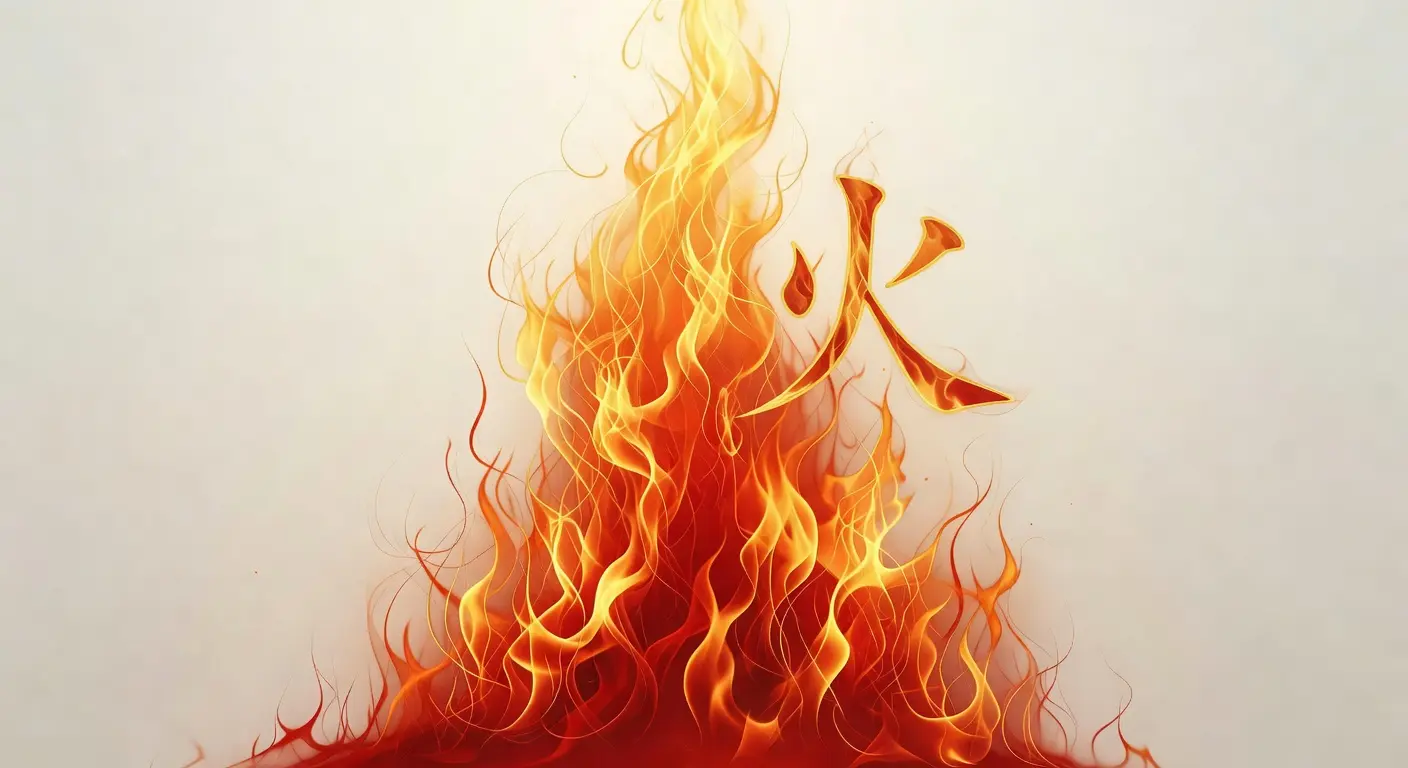
Fire (火 Huǒ) in Traditional Chinese Medicine is one of the five fundamental elements (五行 Wǔ Xíng) that govern the cyclical transformations of nature and the human body. It corresponds to summer, the South, the Heart (心 Xīn), the Small Intestine (小肠 Xiǎo Cháng), the movement of ascent and blossoming, the colour red, the bitter flavour, the emotion of joy, the blood vessels and the tongue.
Fire
火
- Governs the movement of ascent, blossoming and heat
- Corresponds to the Heart (心 Xīn) and the Small Intestine (小肠 Xiǎo Cháng)
- Animates Blood, consciousness and Shen (spirit)
- Controls blood circulation and vessels
- Influences the tongue, speech and communication
- Is associated with joy, sociability and openness
Fire is the vital flame of the Heart. Like the midday sun that illuminates everything, it brings warmth, consciousness, joy and the capacity to relate. It is the energy that ascends, blossoms, communicates and transforms matter into consciousness.
In Traditional Chinese Medicine
In the theory of the five elements (五行 Wǔ Xíng), Fire governs heat, consciousness, communication and blossoming. It is the element of full light, maximum expansion, maturity and manifestation. Its fundamental characteristics include:
- Season: summer (xià 夏), when the sun is at its zenith, heat is maximal and nature is in full bloom
- Direction: South, where the sun is hottest and light is most intense
- Organs: Heart (心 Xīn, Zang) and Small Intestine (小肠 Xiǎo Cháng, Fu)
- Colour: red (红 Hóng), colour of blood, heat and vitality
- Flavour: bitter (苦 Kǔ), flavour that clears Heat, descends Qi and tonifies the Heart
- Emotion: joy (喜 Xǐ), which opens the Heart, relaxes Shen and promotes Qi and Blood circulation
- Tissues: blood vessels (脉 Mài), which transport Blood throughout the body
- Openings: tongue (舌 Shé), which reflects the state of the Heart and Blood
- Fluid: sweat (汗 Hàn), which flows when Heart and Lung Qi push fluids outwards
- Sound: laughter (笑 Xiào), vocal expression associated with Heart Qi
- Sense: speech, which depends on Shen and Heart Qi
The Heart (心 Xīn), organ of Fire, has vital functions:
- Governs Blood and vessels (心主血脉 Xīn Zhǔ Xuè Mài): the Heart propels Blood through the vessels, nourishing organs, tissues and Shen. Heart Blood deficiency causes palpitations, insomnia, memory and concentration disorders
- Houses Shen (心藏神 Xīn Cáng Shén): the Heart is the seat of Shen (spirit, consciousness, mental clarity, quality of presence, sleep, memory, concentration, communication). Heart imbalance causes Shen disorders (insomnia, agitation, anxiety, depression, mental confusion, mania)
- Opens into the tongue (心开窍于舌 Xīn Kāi Qiào Yú Shé): the Heart nourishes the tongue through Blood. Heart imbalance causes speech disorders (stuttering, aphasia, mutism), tongue pain, ulcers, abnormal tastes and a red or pale tongue
- Is associated with joy (心主喜 Xīn Zhǔ Xǐ): moderate joy opens the Heart, relaxes Shen and promotes Qi and Blood circulation. Excessive joy dissipates Heart Qi and Shen, causing dispersion, agitation and instability. Absence of joy closes the Heart and constrains Shen
Practical Applications
In Chinese dietary therapy, Fire is supported by foods that nourish Heart Blood, calm Shen, clear Heart Heat, and balance joy. Recommended foods include red foods (tomatoes, beetroot, strawberries, cherries, raspberries, watermelon, pomegranate), bitter foods (artichoke, chicory, endive, dandelion, green tea, moderate coffee, dark chocolate), foods that nourish Blood (jujubes, goji berries, longan, figs, grapes, beetroot, spinach, chicken liver), foods that calm Shen (lotus seeds, black sesame seeds, sunflower seeds, almonds, walnuts, kiwis, bananas, pears), cereals (rice, millet, quinoa, buckwheat), seasonal vegetables, fresh fruits, lean fish, poultry, and chrysanthemum, jasmine, green tea, liquorice and goji berry infusions.
Lifestyle directly influences Fire balance: moderate social and creative activity that opens the Heart and relaxes Shen, stress management that preserves Shen and Heart Qi (meditation, deep breathing, relaxation, creative activities, emotional expression), sufficient sleep that allows the Heart to store Blood and Shen to rest (7 to 9 hours, ideally 22h-6h), regular and moderate eating that does not overload the Heart and Stomach, and healthy emotional expression that neither represses nor dissipates joy strengthen Fire. Mental and emotional overwork, chronic stress, excessive emotions (excessive joy, anger, fear, worry, sadness), lack of sleep, eating that engenders Heat (alcohol, coffee, chilli, fried foods, grilled foods, sweets), and physical and mental overheating weaken or imbalance Fire.
Concrete Examples
A patient presenting with Heart Heat with agitation, insomnia and mouth ulcers may experience inner agitation and irritability, insomnia with difficulty falling asleep and frequent awakenings, restless dreams and nightmares, mouth and tongue ulcers, a bitter mouth and intense thirst, a red tongue with a yellow coating, and a rapid full pulse. The TCM dietary protocol will include fresh and bitter foods that clear Heart Heat and calm Shen such as tofu stir-fried with spinach and lotus seeds, cucumbers in a light salad with lemon, steamed pears with honey, chrysanthemum, lemon juice and liquorice infusions, lotus seeds as snacks, fresh watermelon in summer, light azuki bean soup, and a drastic reduction of hot and spicy foods (alcohol, coffee, chilli, fried foods, grilled foods).
Frequently Asked Questions
What is the relationship between Fire and the other elements?
In the generation cycle (生 Shēng), Fire engenders Earth (火生土 Huǒ Shēng Tǔ): fire produces ashes that fertilise the earth. In the control cycle (克 Kè), Fire dominates Metal (火克金 Huǒ Kè Jīn): fire melts metal. Fire is engendered by Wood (木生火 Mù Shēng Huǒ): wood burns and produces fire. Fire is dominated by Water (水克火 Shuǐ Kè Huǒ): water extinguishes fire. These relationships explain the interactions between organs, emotions, flavours and seasons in TCM.
How to recognise a Fire imbalance?
Classic signs of a Fire imbalance include palpitations, insomnia with agitation or difficulty falling asleep, restless dreams or nightmares, altered memory, mental confusion, mouth ulcers (Heart Fire), facial redness (Heat) or pallor (Blood deficiency), thirst (Heat) or absence of thirst (Cold), a red tongue with yellow coating (Heart Fire) or pale poorly coated tongue (Blood deficiency), and a rapid full pulse (Heat) or fine empty pulse (deficiency). The emotions associated with Fire are joy (in excess it weakens) and agitation (which disturbs Shen).
Which foods support Fire?
Foods that support Fire are generally of hot or neutral nature, nourishing to Blood, Yin and Shen, and which clear Heat according to the imbalance. We cite red foods (tomatoes, beetroot, strawberries, cherries, raspberries, watermelon, pomegranate), bitter foods (artichoke, chicory, endive, dandelion, green tea, moderate coffee, dark chocolate), foods that nourish Blood (jujubes, goji berries, longan, figs, grapes, beetroot, spinach, chicken liver), foods that calm Shen (lotus seeds, black sesame seeds, sunflower seeds, almonds, walnuts, kiwis, bananas, pears), cereals, seasonal vegetables, fresh fruits, lean fish, poultry, and chrysanthemum, jasmine, green tea, liquorice and goji berry infusions. Foods to avoid are very hot and drying foods (grilled foods, fried foods, very hot spices) for Heat, and cold raw foods that weaken Blood for Blood deficiency. Excessive coffee and alcohol weaken or disturb Fire.
Conclusion
Fire constitutes the fundamental element of summer, heat, consciousness and communication in Traditional Chinese Medicine. Understanding its characteristics, associated organs (Heart and Small Intestine), dysfunctions and dietary and lifestyle approaches to balance it enables a clearer grasp of the therapeutic reasoning and support protocols offered within the Yin Shi universe.
To go further
Yin Shi ecosystem resources directly related to this article.
Fire: Heart, summer and the bitter flavour
The free lesson from the free course links the Fire element to the Heart, the Small Intestine and the bitter flavour.
Take the lesson →Which element dominates your terrain?
The Five Elements test locates Wood, Fire, Earth, Metal and Water in your profile.
Take the test →