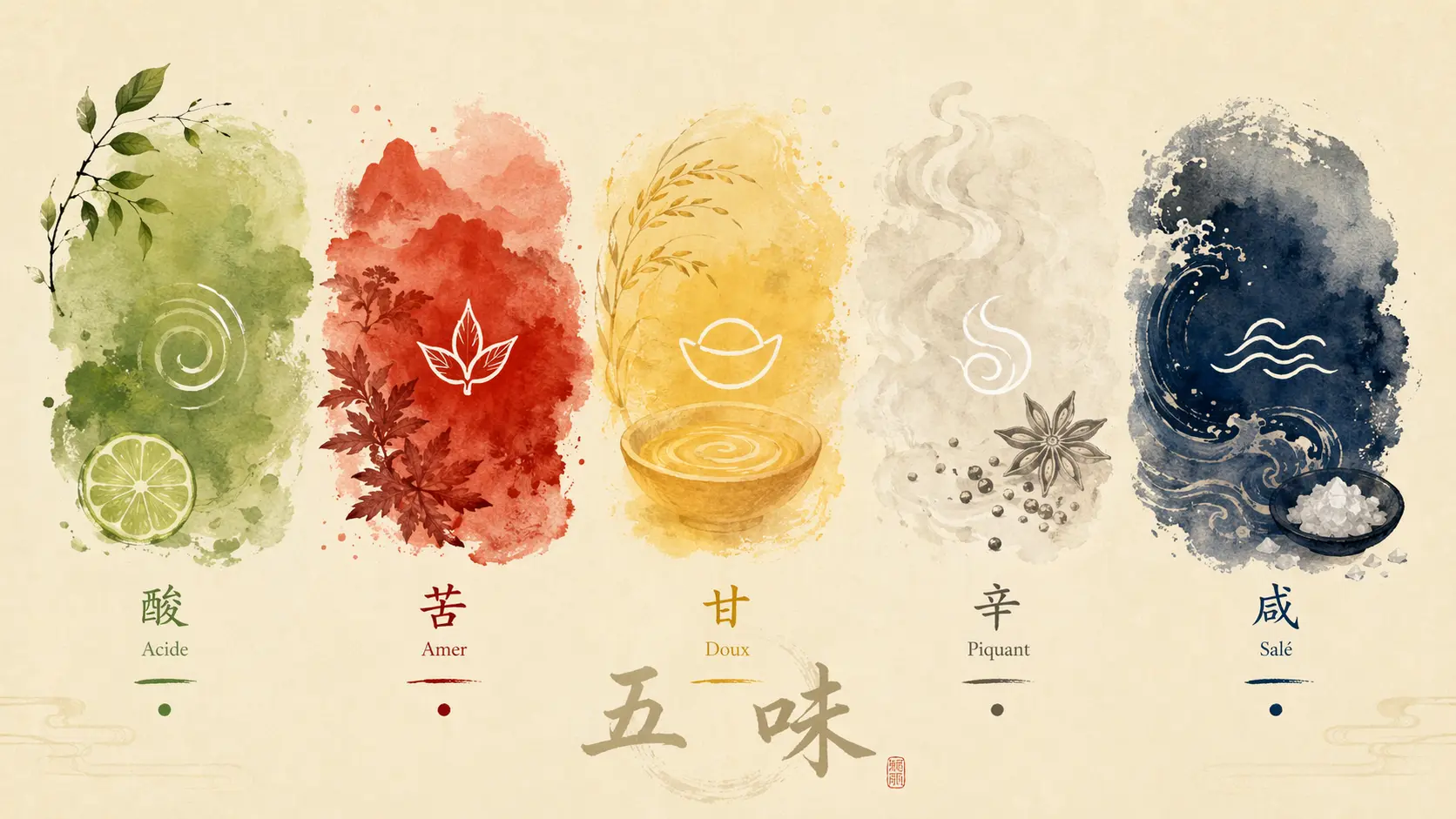
The five flavours (五味 Wǔ Wèi) are a fundamental concept of Chinese dietary therapy that classifies foods according to their perceived taste and energetic action on the body. Each flavour possesses a specific affinity with a Zang organ and exerts distinct therapeutic actions that complement thermal nature.
Food Flavour
五味
- Sour - astringes, tonifies, consolidates, stops fluid loss
- Bitter - drains, dries, clears heat, lowers Qi
- Sweet - tonifies, harmonises, slows, softens crises
- Pungent - disperses, warms, activates Qi and Blood circulation
- Salty - drains downward, moistens, softens, improves digestion
The five flavours are like five musicians in an orchestra. Sour is the violin that tightens and concentrates. Bitter is the double bass that clarifies and drains. Sweet is the cello that nourishes and harmonises. Pungent is the flute that disperses and activates. Salty is the drum that drains and moistens. Together they play the symphony of energetic balance.
In Traditional Chinese Medicine
In TCM theory, the five flavours are closely linked to the five Zang organs and the five elements. Each flavour nourishes its associated organ but can also injure it in case of excess. This relationship follows the fundamental principle: “the five flavours respectively enter the five organs” (五味各入五脏 Wǔ Wèi Gè Rù Wǔ Zàng).
The five flavours and their properties
| Flavour | Associated Zang organ | Element | Main therapeutic effect | Food examples |
|---|---|---|---|---|
| Sour (酸 Suān) | Liver (肝 Gān) | Wood | Astringes, tonifies, consolidates, stops fluid loss, calms convulsions, relaxes tendons | Lemon, vinegar, plums, gooseberries, kiwi, green tomatoes, green apples, pomegranate, green grapes, gherkins, olives, rhubarb, tamarind |
| Bitter (苦 Kǔ) | Heart (心 Xīn) | Fire | Drains, dries, clears heat, lowers Qi, calms mind, stimulates digestion | Chicory, endive, rocket, bitter Chinese cabbage, grapefruit, bitter oranges, chrysanthemum, cress, radicchio, hops, gentian, absinthe |
| Sweet (甘 Gān) | Spleen (脾 Pí) | Earth | Tonifies, harmonises, slows, softens crises, nourishes Qi and Blood, detoxifies, modulates other flavours | Rice, millet, potatoes, carrots, sweet potatoes, beets, bananas, dates, figs, grapes, melons, pears, liquorice, jujubes, honey, sugar |
| Pungent (辛 Xīn) | Lung (肺 Fèi) | Metal | Disperses, warms, activates Qi and Blood circulation, opens pores, circulates defensive Qi | Ginger, garlic, leeks, spring onion, pepper, cinnamon, clove, basil, mint, horseradish, wasabi, chilli, mustard, chives, tarragon |
| Salty (咸 Xián) | Kidney (肾 Shèn) | Water | Drains downward, moistens, softens, improves digestion, dissipates nodules, purifies blood | Seaweed, oysters, mussels, prawns, sardines, anchovies, herring, tuna, salmon, sea salt, soya, black beans, sesame seeds |
Practical Applications
In Chinese dietary therapy, flavours are used in a targeted manner according to the patient’s syndrome and terrain. The association of flavours with thermal natures enables creation of precise and personalised dietary prescriptions. Sweet flavour is the most common in daily diet because it is the most neutral and nourishing. Other flavours are used punctually to correct specific imbalances.
The combination of flavours modifies their effects. For example, a pungent and sweet association (like ginger with honey) warms and tonifies simultaneously. A sour and salty association (like salted plums) astringes and drains downward. A bitter and sweet association (like chrysanthemum with honey) clears heat and protects Yin.
Concrete Examples
A patient presenting with Spleen deficiency with fatigue, loss of appetite, bloating, loose stools, pale complexion, pale swollen tongue, soft weak pulse, will benefit from a sweet and warm diet: rice porridge with honey and dates, boiled carrots and sweet potatoes, pumpkin soup with ginger, sticky rice with jujubes, pear compote with almonds, liquorice and jujube infusions.
A patient presenting with Heart Heat with intense thirst, dry mouth, insomnia, agitation, mouth ulcers, red complexion, red tongue with yellow coating, rapid full pulse, will benefit from a bitter and cool diet: chrysanthemum infusion with honey, fresh grapefruit and oranges, endive and rocket salad, chicory herbal tea, cress soup, fresh grapefruit juice.
Conclusion
The five flavours constitute a fundamental classification that guides food choice in Chinese dietary therapy. Understanding flavours (Sour, Bitter, Sweet, Pungent, Salty), their associated Zang organs, their elements, their therapeutic effects, their indications and their examples enables a clearer grasp of the therapeutic reasoning and support protocols offered within the Yin Shi universe.
To go further
Yin Shi ecosystem resources directly related to this article.
Which flavour does your terrain call for?
The Five Elements test links your profile to the flavours that balance it.
Take the test →The five flavours and their actions
The lesson links sour, bitter, sweet, pungent and salty to their target organ and effect.
Take the lesson →