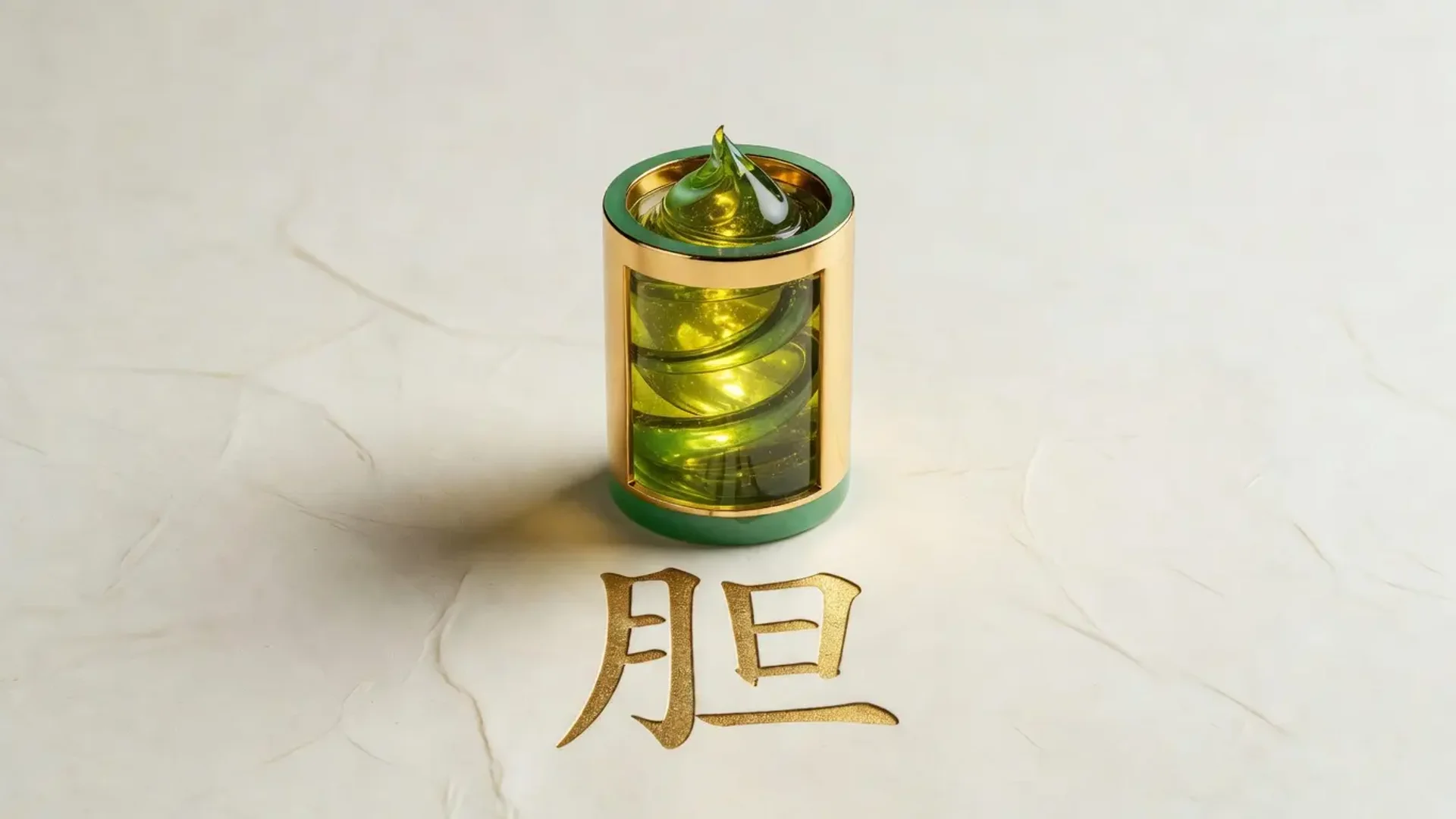
The Gall Bladder (胆 Dǎn) in Traditional Chinese Medicine is the organ that stores and concentrates bile, facilitates fat digestion, governs courage, decision and judgement. It is the Yang of the Liver and collaborates closely with it for free Qi circulation and digestion.
Gall Bladder
胆
- Stores and concentrates bile for fat digestion
- Facilitates free circulation of Liver Qi
- Governs courage, decision and judgement
- Controls strategic choices and planning
- Coordinates with Liver for digestion and emotions
- Opens into the ears and controls balance
The Gall Bladder is the Minister of Courage. It gives the audacity to decide, the clarity to judge and the strength to act. A harmonious Gall Bladder allows decisions without excessive hesitation; a troubled Gall Bladder engenders fear, indecision and nightmares.
In Traditional Chinese Medicine
In TCM theory, the Gall Bladder is a Fu (hollow) organ that stores and concentrates bile produced by the Liver. It is the Yang of the Liver (肝胆 Gān Dǎn), meaning it is the active, warm and external pole of the Liver. The Liver (Yin) produces bile and planning; the Gall Bladder (Yang) stores bile and executes decisions.
The Gall Bladder governs:
- Bile: production, storage, concentration and secretion of bile for fat digestion
- Courage: the capacity to decide, to act, to confront difficulties without excessive fear
- Judgement: clarity in choices, strategic planning, resolution
- Choices: the capacity to decide, to say yes or no, to set boundaries
- Balance: coordination with the inner ear for physical balance (dizziness, tinnitus)
- Dreams: quality of sleep, frequency of nightmares (fear, indecision)
The Gall Bladder is particularly vulnerable to Heat and Dampness-Heat (which provoke gallstones, infections, nausea), to Liver Qi Stagnation (which disturbs bile secretion), to anger and frustration (which obstruct Liver-Gall Bladder Qi), and to a diet too fatty or too hot (which overloads the Gall Bladder).
Practical Applications
In Chinese dietary therapy, the Gall Bladder is regulated by foods that facilitate bile secretion, disperse Heat and Dampness, and support the Liver. Foods that support the Gall Bladder include black radish, kohlrabi, artichoke, dandelion, turmeric, saffron, lemon, grapefruit, basil, citrus fruits, celery, carrots, spinach and chrysanthemum infusions.
Lifestyle directly influences Gall Bladder quality: anger and frustration management, regular decision-making (even small ones) to maintain Qi circulation, moderate diet in fats and fried foods, regular physical activity that circulates Qi, and sufficient sleep that calms the Liver and Gall Bladder. Fatty, fried or very hot meals, repressed anger, chronic indecision, mental overwork and short nights disturb the Gall Bladder.
Concrete Examples
A patient presenting with Gall Bladder Dampness-Heat may experience nausea and vomiting of bitter bile, pain under the right ribcage, bitter and sticky mouth, thirst without desire to drink, heavy and foggy head, red tongue with yellow and greasy coating on the right edges, and rapid soft pulse. The dietary protocol will include foods that clarify Gall Bladder Dampness-Heat such as millet porridge with azuki beans, sautéed celery with carrots, grated black radish in light salad, dandelion and chrysanthemum infusions, fresh lemon in warm water in the morning, and drastic reduction of fats and fried foods.
A patient presenting with Liver-Gall Bladder Qi Stagnation with chronic indecision may experience hypochondriac tension, frequent sighs, indecision and procrastination, nightmares with pursuits or falls, irritability, morning nausea, tongue with white coating on the edges, and wiry pulse. The dietary protocol will include foods that circulate Liver-Gall Bladder Qi such as rice porridge with basil and carrots, chicken sautéed with onions and lemon, spinach sautéed with garlic, fresh citrus fruits as snacks, chrysanthemum and mint infusions, and regular practice of decision-making (even small ones) to maintain Qi circulation.
Frequently Asked Questions
What is the difference between Gall Bladder and Liver?
The Liver and Gall Bladder form a Yin-Yang couple that collaborates in digestion, emotions and planning. The Liver (Yin, Zang) produces bile, stores Blood, governs free Qi circulation, vision, tendons and emotions (anger). The Gall Bladder (Yang, Fu) stores and concentrates bile, facilitates fat digestion, governs courage, decision and judgement. The Liver is the strategist (planning), the Gall Bladder is the minister of execution (decision and action). The Liver is the root, the Gall Bladder is the branch.
How to recognise a Gall Bladder disorder?
Classic signs of a Gall Bladder disorder include nausea and vomiting of bitter bile, pain under the right ribcage (right hypochondrium), bitter and sticky mouth (especially in the morning), thirst without desire to drink, heavy and foggy head, fear and chronic indecision, nightmares with pursuits or falls, excessive shyness, irritability, dizziness, tinnitus, red tongue with yellow and greasy coating on the right edges (Dampness-Heat) or with white coating on the edges (Qi Stagnation), and rapid soft pulse (Dampness-Heat) or wiry pulse (Qi Stagnation).
Which foods support the Gall Bladder?
Foods that support the Gall Bladder are generally of cool or neutral nature, bitter or pungent, that facilitate bile secretion, disperse Heat and Dampness, and circulate Qi. Black radish, kohlrabi, artichoke, dandelion (leaves and root), turmeric, saffron, lemon, grapefruit, basil, citrus fruits, celery, carrots, spinach, lotus seeds, chrysanthemum, mint and dandelion and chrysanthemum infusions are cited. Foods to avoid are fatty, fried, very hot meals, excessive sweets, alcohol and excess red meat.
Conclusion
The Gall Bladder constitutes the fundamental organ of courage, decision and bile secretion in Traditional Chinese Medicine. Understanding its functions, pathologies and regulatory dietary approaches enables a clearer grasp of the therapeutic reasoning and support protocols offered within the Yin Shi universe.
- Liver
- Spleen
- Heat
- Dampness
- Spleen-Pancreas
To go further
Yin Shi ecosystem resources directly related to this article.
Which TCM organ needs your attention?
The five-organ test spots the Zang-Fu system most called upon in you.
Take the test →The Gallbladder meridian
The lesson runs through the Yang meridians of the foot: Stomach, Gallbladder and Bladder.
Take the lesson →