Your belly thinks: the discovery TCM had anticipated
In 1998, neurogastroenterologist Michael Gershon published The Second Brain, a work revealing that the intestine possesses its own nervous system - the enteric nervous system - with more than 100 million neurones. The intestine produces 95% of the body’s serotonin and communicates bidirectionally with the brain via the vagus nerve.
What Gershon “discovered”, TCM had formulated more than two millennia earlier: the Spleen governs Thought (脾主意 Pí Zhǔ Yì). The concept of Yi (意) - thought, intention, mental rumination - is directly linked to the digestive function of the Spleen.
Explore the full analysis in Digestion: The TCM & Science Alliance and the Complete Guide.
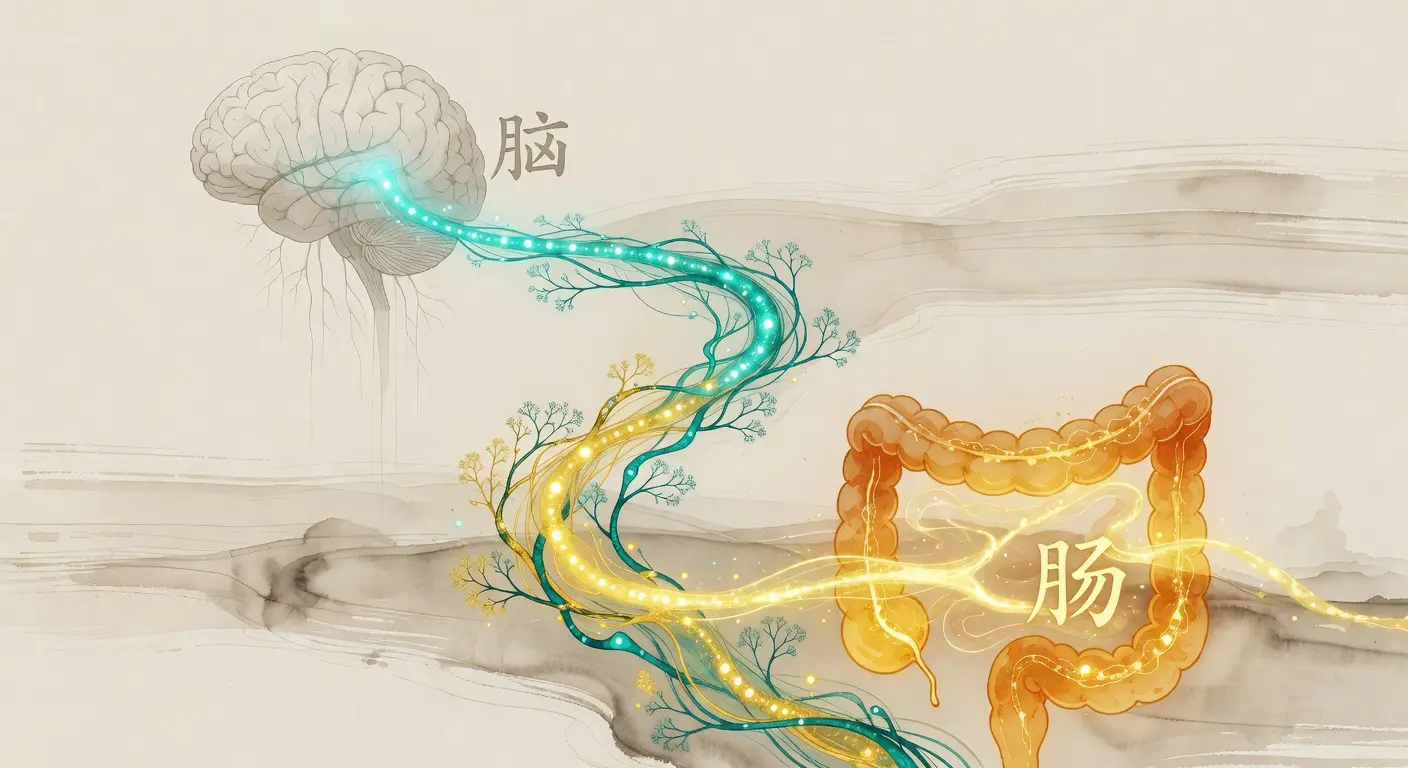
The vagus nerve: the cable between two brains
The vagus nerve (Xth cranial pair) is the longest nerve pathway of the parasympathetic system. It connects the brain stem to all abdominal organs, including the intestine. 80% of its fibres are afferent (from the intestine to the brain) - the intestine “speaks” more to the brain than the reverse.
In TCM, this bidirectional communication is described by the relationship between the Spleen and Thought:
- Healthy Spleen -> Clear thought, concentration, serenity
- Weakened Spleen -> Mental fog, rumination, anxiety
- Overthinking (rumination) -> Injures the Spleen -> vicious circle
Thought is governed by the Spleen. Overthinking injures the Spleen; the injured Spleen engenders Dampness; Dampness obstructs the Spleen.
Intestinal serotonin: the messenger of Yi
Serotonin (5-HT) is the most abundant neurotransmitter in the body. 95% is produced by the enterochromaffin cells of the intestine. It regulates transit, digestive secretion, visceral pain perception - and mood.
| Function | Mechanism | TCM Correspondence | Imbalance |
|---|---|---|---|
| Transit regulation | Enteric 5-HT | Spleen governs transport | IBS = 5-HT imbalance = deranged Spleen |
| Pain perception | Visceral hypersensitivity | Spleen Qi Stagnation | Pain without lesion = blocked Qi |
| Mood regulation | 5-HT and depression | Spleen/Thought (Yi) governs the spirit | Dysbiosis = anxiety (Foster et al., 2017) |
| Satiety signal | 5-HT and gastric emptying | Spleen knows when to stop | Hyperphagia = confused Spleen |
Synthesis - Gershon, 1998; Cryan et al., 2019; Huang Di Nei Jing
The Spleen/Thought vicious circle
The bidirectional relationship between the Spleen and Thought creates a vicious circle well known in TCM and confirmed by science:
- Chronic stress -> sympathetic system activation -> vagus braking
- Braked vagus -> digestive slowing -> dysbiosis -> less serotonin
- Less serotonin -> degraded mood -> rumination (overthinking of Thought)
- Rumination -> injures the Spleen -> weakens transformation -> Dampness
- Dampness -> low-grade inflammation -> endotoxaemia -> depression
This circle explains why antidepressants alone often fail: they ignore the digestive component. And why probiotics alone are insufficient: they ignore the energetic dimension.
Depression and microbiome: the epidemiological proof
Epidemiological studies confirm the TCM link between weakened Spleen and degraded mood:
- Jacka et al. (2010): Western diet (which weakens the Spleen) is correlated with depression in women
- Lassale et al. (2019): meta-analysis confirming the link between anti-inflammatory diet (which tonifies the Spleen) and reduced depressive risk
- Foster et al. (2017): stress alters the microbiome, which in turn amplifies the stress response
Psychonutrition - treating mood through diet - is exactly what TCM has practised for 2000 years: nourishing the Spleen to soothe Thought.
FAQ
Why does TCM say the Spleen governs Thought?
Because millennial clinical observation established a constant correlation between digestive function and mental clarity. When the Spleen is weak, thought becomes confused, concentration diminishes, rumination sets in. Modern science confirms: 95% of serotonin is intestinal, the vagus nerve connects the intestine to the brain, the microbiome influences mood. The TCM Spleen “governs” Thought in the sense that digestive function conditions mental health.
How to activate the vagus nerve to improve digestion?
Three methods validated by science and consistent with TCM: (1) Slow diaphragmatic breathing (6 breaths/minute for 5 minutes before meals); (2) Singing and humming which stimulate laryngeal vagal fibres; (3) Progressive cold exposure (end of cold shower, 30 seconds). These practices correspond to Qi Gong and Spleen Yang tonification in TCM.
To go further
- Microbiome and Spleen Qi - The fundamental parallel
- Leaky Gut and Dampness - The other face of the vicious circle
- Phytotherapy and Micronutrition - Synergies for the gut-brain axis
- Complete Guide to the Integrative Alliance - Overview
For complete protocols with respiratory exercises and digestive chronobiology:
Order the book Digestion: The TCM & Science Alliance
To go further
Yin Shi ecosystem resources directly related to this article.
The gut–brain axis, the second brain
The lesson links stress, emotions and the microbiome in the gut–brain axis.
Take the lesson →Digestion: where TCM meets science
The book deals with the gut, its barrier and its exchanges with the rest of the body.
Discover the book →