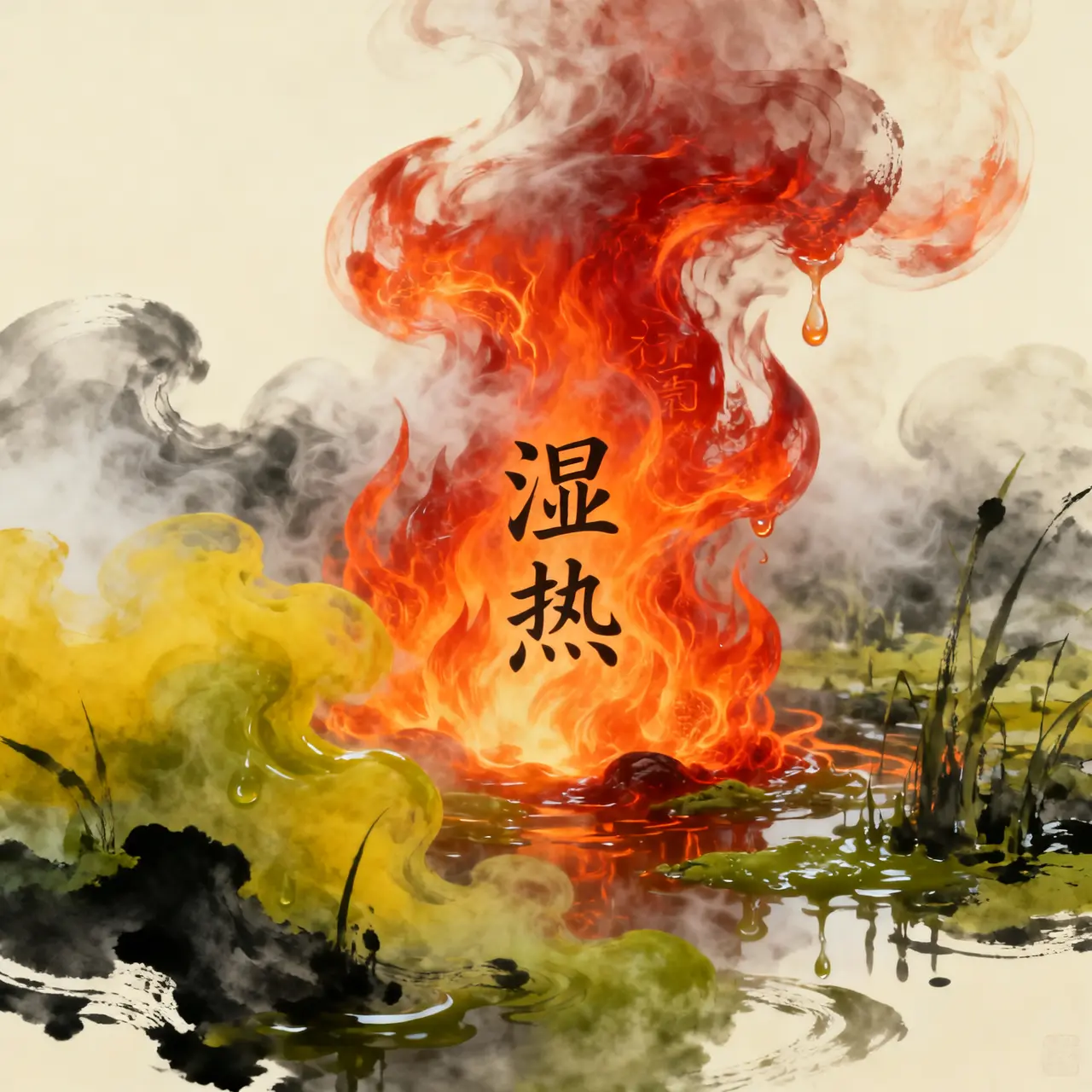
Heat-Dampness (湿热 Rè Shī) in Traditional Chinese Medicine is a mixed pathogenic factor that combines Heat (inflammation, redness, heat) and Dampness (heaviness, stagnation, stickiness). It causes particularly tenacious and difficult-to-treat symptoms because Heat burns and Dampness sticks, creating a “burning sticky” that obstructs organs and tissues.
Heat-Dampness
湿热
- Combines Heat (inflammation, redness) and Dampness (heaviness, stagnation)
- Causes burning and sticky tenacious symptoms
- Obstructs organs (Liver, Gall Bladder, Spleen, Stomach)
- Engenders red, hot and oozing eruptions
- Can cause recurrent infections and cystitis
- Requires foods that clear Heat and drain Dampness
Heat-Dampness is like stifling heat in a tropical climate. It burns, it sticks, it obstructs and it does not leave easily. It particularly attacks the Middle Burner (Spleen-Stomach) and Liver-Gall Bladder, causing digestive, cutaneous and urinary inflammations.
In Traditional Chinese Medicine
In TCM theory, Heat-Dampness is one of the most tenacious pathogenic factors. It forms when Heat (internal or external) encounters Dampness (internal or external) and combines with it. Heat tends to rise and disperse; Dampness tends to descend and stagnate. Their combination creates a pathogen that rises and descends simultaneously, obstructing organs and tissues in a complex manner.
Heat-Dampness manifests as:
- Digestive disorders: nausea, vomiting of bitter bile, heartburn, loose and sticky stools with heat sensation at elimination, stools with mucus and blood, capricious appetite, bitter and sticky mouth
- Cutaneous disorders: red, hot and oozing eczema, inflammatory acne, boils, abscesses, red and hot hives, mycoses
- Urinary disorders: urinary burning, cloudy and malodorous urine, recurrent cystitis, yellow and malodorous leucorrhoea
- General disorders: heat and heaviness sensation in the body, sticky and malodorous sweating, thirst without desire to drink (because Dampness is already present), heavy and foggy head, heavy fatigue
- Liver-Gall Bladder disorders: jaundice, pain under the right ribcage, morning nausea, emotional agitation
Heat-Dampness is particularly favoured by hot and humid climates, a diet that engenders Heat and Dampness (alcohol, sweets, fried foods, greasy foods, very hot spices), smoking, chronic stress that transforms Qi into Fire, a weakened Spleen Qi that does not transform fluids, and Liver Qi stagnation that transforms into Liver Heat.
Practical Applications
In Chinese dietary therapy, Heat-Dampness is clarified by foods that cool Heat and drain Dampness. Recommended foods include cucumbers, courgettes, pears, apples, tofu, azuki beans, black beans, seaweed, mushrooms, celery, carrots, spinach, dandelion, chrysanthemum infusions, green tea, dandelion and lemon juice.
Lifestyle is crucial to prevent and treat Heat-Dampness: cool and airy housing (not excessive air conditioning that engenders internal Cold), moderate physical activity that makes one sweat and eliminates Dampness (but without exhaustion), stress management that prevents Qi transformation into Fire, a light and cool diet, and sufficient hydration with warm or room temperature drinks. Alcohol, smoking, sweets, fried foods, greasy foods, very hot spices, chronic stress and hot and humid housing favour Heat-Dampness.
Concrete Examples
A patient presenting with Liver-Gall Bladder Heat-Dampness may experience nausea and vomiting of bitter bile, pain under the right ribcage, jaundice, bitter and sticky mouth, thirst without desire to drink, heavy and foggy head, sticky and malodorous sweating, loose and sticky stools with heat sensation, red tongue with yellow and greasy coating, and rapid soft pulse. The dietary protocol will include foods that clarify Liver-Gall Bladder Heat-Dampness such as millet porridge with azuki beans, tofu stir-fried with mushrooms and spinach, cucumbers in a light salad, steamed pears, chrysanthemum and dandelion infusions, and drastic elimination of alcohol, fried foods and hot spices.
A patient presenting with Heat-Dampness with recurrent cystitis may experience urinary burning, cloudy and malodorous urine, frequent and urgent desire to urinate, pain in the lower abdomen, heat and heaviness sensation in the lower abdomen, yellow and malodorous leucorrhoea, red tongue with yellow and greasy coating at the root, and rapid soft pulse. The dietary protocol will include foods that clarify lower abdomen Heat-Dampness such as millet porridge with azuki beans, tofu stir-fried with seaweed and mushrooms, fresh cucumbers in small quantity, dandelion and green tea infusions, lotus seeds in infusion, and an increase in warm water consumption.
Frequently Asked Questions
What is the difference between Heat-Dampness and simple Heat?
Simple Heat (热 Rè) is a pathogenic factor characterised by inflammation, redness, heat and dryness. It tends to rise and consume fluids. Heat-Dampness (湿热 Rè Shī) is a combination of Heat and Dampness where Heat burns and Dampness sticks, creating particularly tenacious symptoms. Heat-Dampness tends to obstruct (particularly the Middle Burner and Liver-Gall Bladder), to ooze (eczema, leucorrhoea), to create stickiness (sticky stools, sticky mouth, greasy coating) and to be difficult to eliminate. Simple Heat is treated by clearing Heat; Heat-Dampness is treated by clearing Heat AND draining Dampness simultaneously.
How to recognise Heat-Dampness?
Classic signs of Heat-Dampness include digestive disorders (nausea, bitter sticky mouth, loose and sticky stools), cutaneous disorders (red oozing eczema, inflammatory acne, boils), urinary disorders (burning, cloudy malodorous urine, recurrent cystitis), heat and heaviness sensation in the body, sticky malodorous sweating, thirst without desire to drink, heavy foggy head, red tongue with yellow greasy coating and rapid soft pulse. Heat-Dampness is particularly common in hot and humid climates and in people with a diet rich in alcohol, sweets, fried foods and greasy foods.
Which foods clarify Heat-Dampness?
Foods that clarify Heat-Dampness are generally fresh, light, that cool Heat and drain Dampness. We cite cucumbers, courgettes, pears, apples, tofu, azuki beans, black beans, seaweed, mushrooms, celery, carrots, spinach, dandelion, chrysanthemum, green tea, lemon juice, bitter melon, lotus seeds and watercress. Foods to avoid are those that engender Heat (alcohol, very hot spices, fried foods) and those that engender Dampness (sweets, greasy foods, dairy products, excessive raw and cold foods).
Conclusion
Heat-Dampness (湿热 Rè Shī) constitutes one of the most tenacious and complex pathogenic factors in Traditional Chinese Medicine. Understanding its mechanisms, manifestations and dietary and lifestyle approaches enables a clearer grasp of the therapeutic reasoning and support protocols offered within the Yin Shi universe.
To go further
Yin Shi ecosystem resources directly related to this article.
Heat or Cold: which way does your terrain lean?
The Eight Principles test locates your terrain between heat and cold, deficiency and excess.
Take the test →Damp-Heat: inflammatory and sticky
The lesson describes the most common mixed pathogen in chronic inflammation.
Take the lesson →