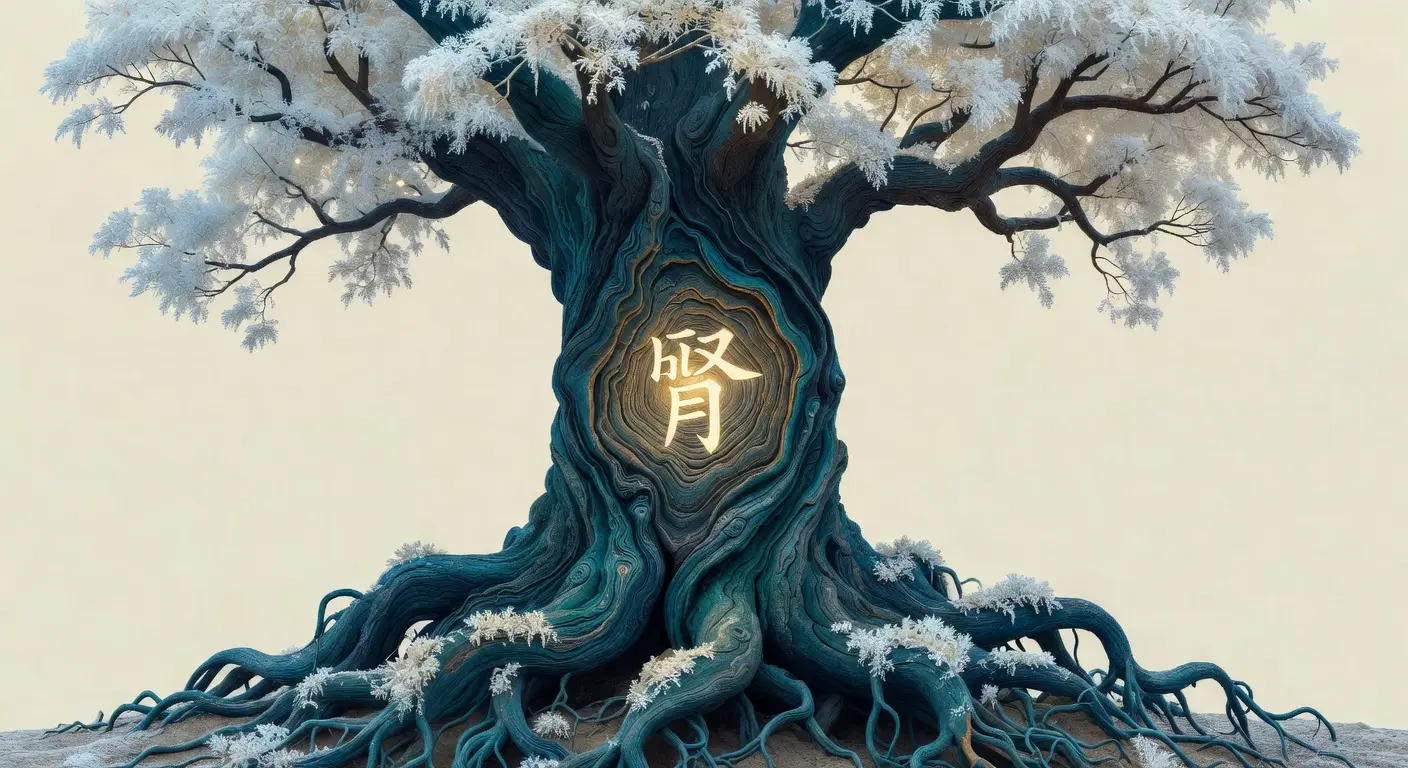
The Kidney (肾 Shèn) in Traditional Chinese Medicine is the most fundamental organ for vitality, longevity and reproduction. It stores Essence Jing, governs growth, development, bones, marrow, teeth, hair and hearing faculties.
Kidney
肾
- Stores Essence Jing (pre-natal and post-natal)
- Governs growth, development and reproduction
- Controls bones, bone marrow, teeth and hair
- Opens into the ears and governs hearing
- Controls the two lower orifices (urethra and anus)
- Houses the will (Zhi) and memory
The Kidney is the treasure of deep vitality. The Essence Jing it stores determines physical constitution, resistance to illness, growth potential and longevity. A strong Kidney ensures a long and vigorous life; a weak Kidney accelerates ageing and degeneration.
In Traditional Chinese Medicine
In TCM theory, the Kidney is considered the root of life. It stores Essence Jing (精 Jīng), that fundamental reserve inherited from parents and nourished by food, which determines growth, sexual maturity, fertility and longevity. The Kidney is also the seat of fundamental Yang (Kidney Yang 肾阳) and fundamental Yin (Kidney Yin 肾阴) of the entire body.
Kidney Yang (肾阳 Shèn Yáng) warms all other organs, ensures digestive transformation, fluid circulation and protection against Cold. Kidney Yin (肾阴 Shèn Yīn) nourishes all other organs, ensures cooling, moistening and anchoring of Yang. An imbalance of the Kidney therefore affects the entire organism.
The Kidney governs:
- Bones and marrow: bone strength, density, marrow that fills the brain
- Teeth: dental health, tooth eruption in children
- Hair: quality, colour, growth and loss of hair
- Ears: hearing, tinnitus, balance
- The two lower orifices: urination, urinary and faecal continence
- Will (Zhi): determination, memory, concentration
- Reproduction: fertility, sexual development, libido
Practical Applications
In Chinese dietary therapy, the Kidney is nourished and tonified by foods that enrich Essence Jing, warm Kidney Yang or nourish Kidney Yin according to the imbalance. Foods that tonify the Kidney include black beans, black sesame seeds, walnuts, quail eggs, oysters, seaweed, goji berries, dates, mineral-rich seafood, lean pork and bone broths.
Lifestyle directly influences Kidney quality: sufficient sleep before 11 pm (when Qi circulates in the Kidneys), sexual moderation, stress management, adapted physical activity that strengthens the lower back (tai chi, qi gong, swimming), and a mineral-rich diet preserve the Kidney. Excessive mental work, overwork, short nights, sexual dissipation and chronic cold exhaust the Kidney.
Concrete Examples
A patient presenting with Kidney Yang deficiency may experience deep coldness, chronic lower back pain aggravated by cold and dampness, very diminished libido, clear and abundant urine especially at night (nocturia), ankle oedema in the evening, profound fatigue, memory loss and a pale swollen tongue with a white coating. The dietary protocol will include warming and Kidney Yang tonifying foods such as lamb stewed with leeks and ginger, rice porridge with dates and cinnamon, dry-roasted walnuts as snacks, dry-roasted fennel seeds and hot clove and liquorice infusions.
A menopausal patient presenting with Kidney Yin deficiency may experience evening hot flushes, night sweats, thirst, tinnitus, agitation, insomnia, bone loss, hair whitening, a red tongue without coating and a fine rapid pulse. The dietary protocol will include Kidney Yin nourishing foods such as black bean and black sesame seed porridge, tofu stir-fried with mushrooms and spinach, steamed pears, chrysanthemum and goji berry infusions, and steamed mussels.
Frequently Asked Questions
What is the difference between Kidney and Spleen?
The Kidney and Spleen are both fundamental organs, but the Kidney stores Essence Jing and governs deep vitality, growth, reproduction and bones, whilst the Spleen transforms food into Qi and Blood and governs digestion. The Kidney is the root of fundamental Yin and Yang; the Spleen is the source of Post-Natal Qi. The Kidney determines constitution and potential; the Spleen determines daily energy quality.
How to recognise a Kidney disorder?
Classic signs of a Kidney disorder include lower back pain (especially chronic and aggravated by cold), profound fatigue, memory and concentration loss, reproductive disorders (infertility, diminished libido, impotence), urinary disorders (nocturia, incontinence, clear or dark urine), tinnitus, bone loss, hair whitening or loss, fragile teeth, oedema, and a tendency to fear (emotion associated with the Kidney). Kidney Yang deficiency manifests as coldness, cold extremities, loose stools, pale swollen tongue. Kidney Yin deficiency manifests as hot flushes, night sweats, thirst, insomnia, red tongue without coating.
Which foods tonify the Kidney?
Kidney tonifying foods are generally of warm or neutral nature, rich in minerals, quality proteins and rebuilding nutrients. We cite black beans, black sesame seeds, walnuts (cashews, common walnuts), goji berries, dates, quail eggs, oysters, seaweed, seafood, lean pork, bone broths, pumpkin seeds and mushrooms. Black foods (black beans, black sesame, seaweed) are particularly nourishing for the Kidney in TCM.
Conclusion
The Kidney constitutes the fundamental organ of vitality, reproduction and longevity in Traditional Chinese Medicine. Understanding its functions, pathologies and dietary tonification approaches enables a clearer grasp of the therapeutic reasoning and support protocols offered within the Yin Shi universe.
To go further
Yin Shi ecosystem resources directly related to this article.
Which TCM organ needs your attention?
The five-organ test spots the Zang-Fu system most called upon in you.
Take the test →The Kidneys, guardians of the Essence
The lesson presents the Kidneys as the reserve of Jing, vitality and longevity.
Take the lesson →