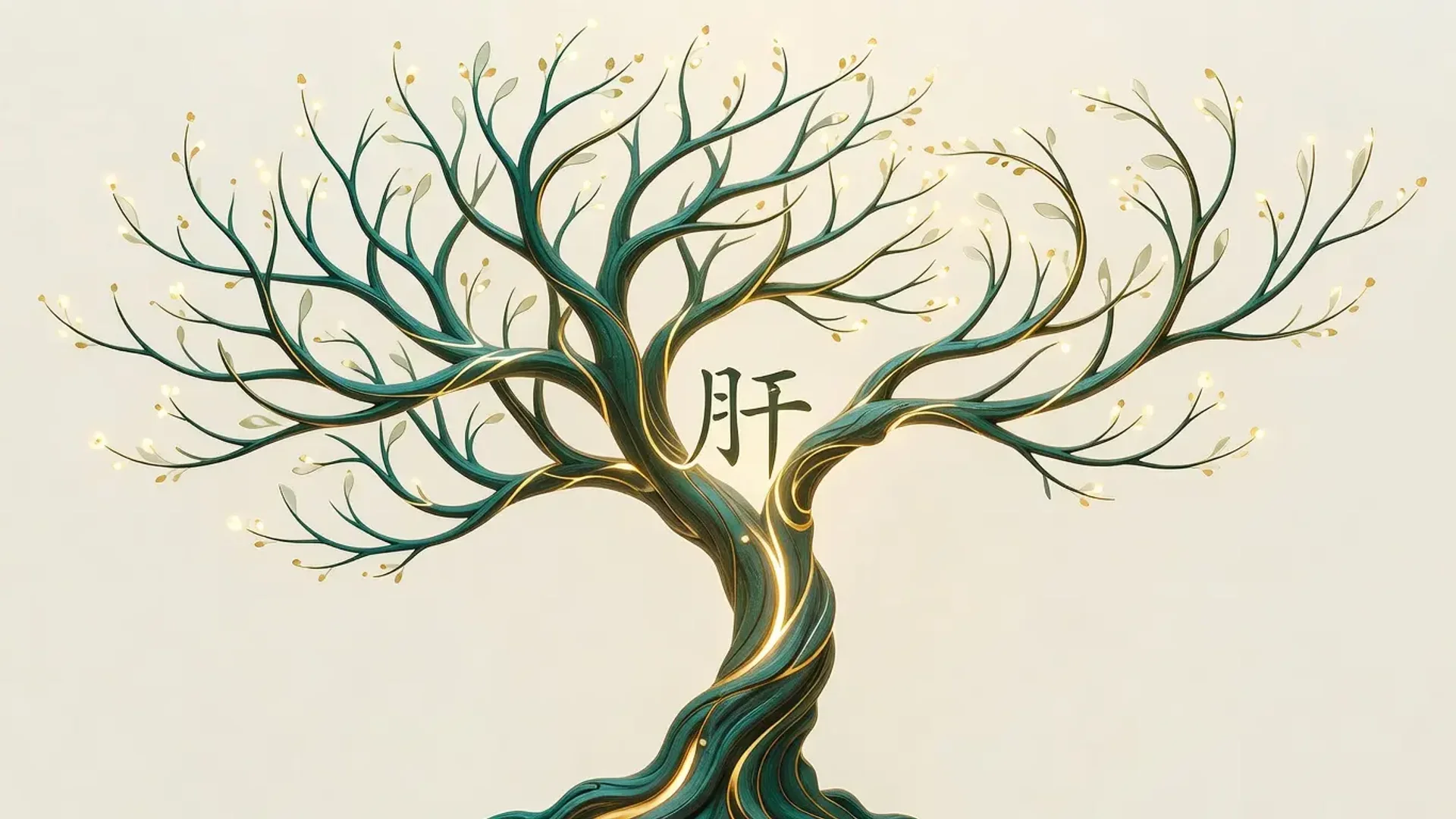
The Liver (肝 Gān) in Traditional Chinese Medicine is the organ that stores Blood, governs tendons, eyes, nails, the free circulation of Qi and emotions. It plays a central role in regulating the menstrual cycle, vision, mobility and psychological equilibrium.
Liver
肝
- Stores Blood and regulates its volume according to activity
- Governs the free circulation of Qi throughout the body
- Controls tendons, eyes and nails
- Regulates emotions (anger, frustration, irritability)
- Ensures regularity of the menstrual cycle and fertility
- Houses the ethereal soul Hun and planning
The Liver is the General of organs, responsible for strategy, planning and free circulation. When the Liver is harmonious, Qi circulates freely, emotions flow, vision is clear and movements are supple. When disturbed, Qi Stagnation, Blood deficiency or Liver Fire produce irritability, pain and menstrual disorders.
In Traditional Chinese Medicine
In TCM theory, the Liver is the most important organ for circulation and regulation. It ensures the “free circulation of Qi” (肝主疏泄 Gān Zhǔ Shū Xiè), which means it allows Qi to circulate freely throughout the body without obstruction or stagnation. This function affects digestion, emotions, Blood circulation, reproduction and even fluid metabolism.
The Liver stores Blood (肝藏血 Gān Cáng Xuè): it regulates the amount of Blood available according to physical and mental activity. At rest, Blood returns to the Liver to be stored and regenerated. During activity, the Liver releases Blood into muscles and organs. Liver Blood deficiency causes dizziness, blurred vision, stiff tendons, cycle disorders and irritability.
The Liver governs:
- Tendons: suppleness, strength and muscular coordination
- Eyes: vision, clarity, dryness or ocular irritation
- Nails: quality, solidity, colour and growth
- Emotions: anger, frustration, irritability, depression
- Menstrual cycle: regularity, quantity, quality of menses
- Free circulation of Qi: digestion, respiration, blood circulation
Practical Applications
In Chinese dietary therapy, the Liver is regulated by foods that nourish Liver Blood, promote Liver Qi circulation, calm Liver Fire or disperse Liver Wind according to the imbalance. Foods that support the Liver include spinach, beetroot, chicken liver, black sesame seeds, goji berries, jujubes, longan, eggs, mushrooms, seaweed, citrus fruits, basil and chrysanthemum infusions.
Lifestyle directly influences Liver quality: stress management, emotional expression, moderate physical activity that circulates Qi, sufficient sleep (Liver Blood regenerates during sleep) and regular meals strengthen the Liver. Repressed emotions (anger, frustration), mental overwork, short nights, excessive alcohol and irregular meals disturb the Liver.
Concrete Examples
A patient presenting with Liver Qi Stagnation may experience hypochondriac or thoracic tension, frequent sighing, bloating, irritability, cycle disorders (delayed or irregular periods with premenstrual pain), tension headaches, a tongue with a thin white coating on the edges, and a wiry pulse. The dietary protocol will include foods that promote Liver Qi circulation such as rice porridge with basil and carrots, chicken stir-fried with onions and lemon, spinach sautéed with garlic, fresh citrus fruits as snacks and chrysanthemum and mint infusions.
A patient presenting with Liver Fire with Yin deficiency may experience pulsating headaches on the temples, red and dry eyes, intense irritability, dizziness, thirst, a red tongue with a dry yellow coating on the edges, and a rapid wiry pulse. The dietary protocol will include foods that nourish Liver Yin and clear Fire such as tofu stir-fried with mushrooms and spinach, light cucumber salad, steamed pears, chrysanthemum and lemon juice infusions, and small quantities of dry-roasted black sesame seeds.
Frequently Asked Questions
What is the difference between TCM Liver and anatomical liver?
The Liver in TCM is a functional and energetic concept that encompasses the anatomical liver (hepatic organ) but also other functions: the storage and regulation of Blood, the free circulation of Qi, emotional management, menstrual cycle regulation, vision, tendons and nails. The TCM Liver partially corresponds to the autonomic nervous system, the endocrine system and hepatic metabolism in Western medicine.
How to recognise a Liver disorder?
Classic signs of a Liver disorder include hypochondriac or thoracic tension, frequent sighing, tendency to anger or irritability, headaches (especially tension-type or pulsating on the temples), dizziness, blurred vision or dry eyes, stiff or cracking tendons, fragile or striated nails, menstrual cycle disorders (delayed, irregular, painful, premenstrual), bloating, a tongue with a white coating on the edges (Qi Stagnation) or red with yellow coating (Liver Fire), and a wiry (corded) pulse.
Which foods regulate the Liver?
Foods that regulate the Liver are generally of warm or neutral nature, Blood- or Yin-nourishing, or Qi-mobilising according to the imbalance. We cite spinach, beetroot, chicken liver, black sesame seeds, goji berries, jujubes, longan, eggs, mushrooms, seaweed, citrus fruits, basil, carrots, onions, lemon, lotus seeds, chrysanthemum and mint infusions. Foods to avoid are excessive alcohol, very hot spices, fried foods, late and heavy meals, and foods that constrain Qi (dairy products, refined foods in excess).
Conclusion
The Liver constitutes the fundamental organ of circulation, regulation and emotions in Traditional Chinese Medicine. Understanding its functions, pathologies and dietary regulation approaches enables a clearer grasp of the therapeutic reasoning and support protocols offered within the Yin Shi universe.
To go further
Yin Shi ecosystem resources directly related to this article.
The Liver, reservoir and regulator of Blood
The free lesson from the free course explains how the Liver stores and distributes Blood.
Take the lesson →Which TCM organ needs your attention?
The five-organ test spots the Zang-Fu system most called upon in you.
Take the test →