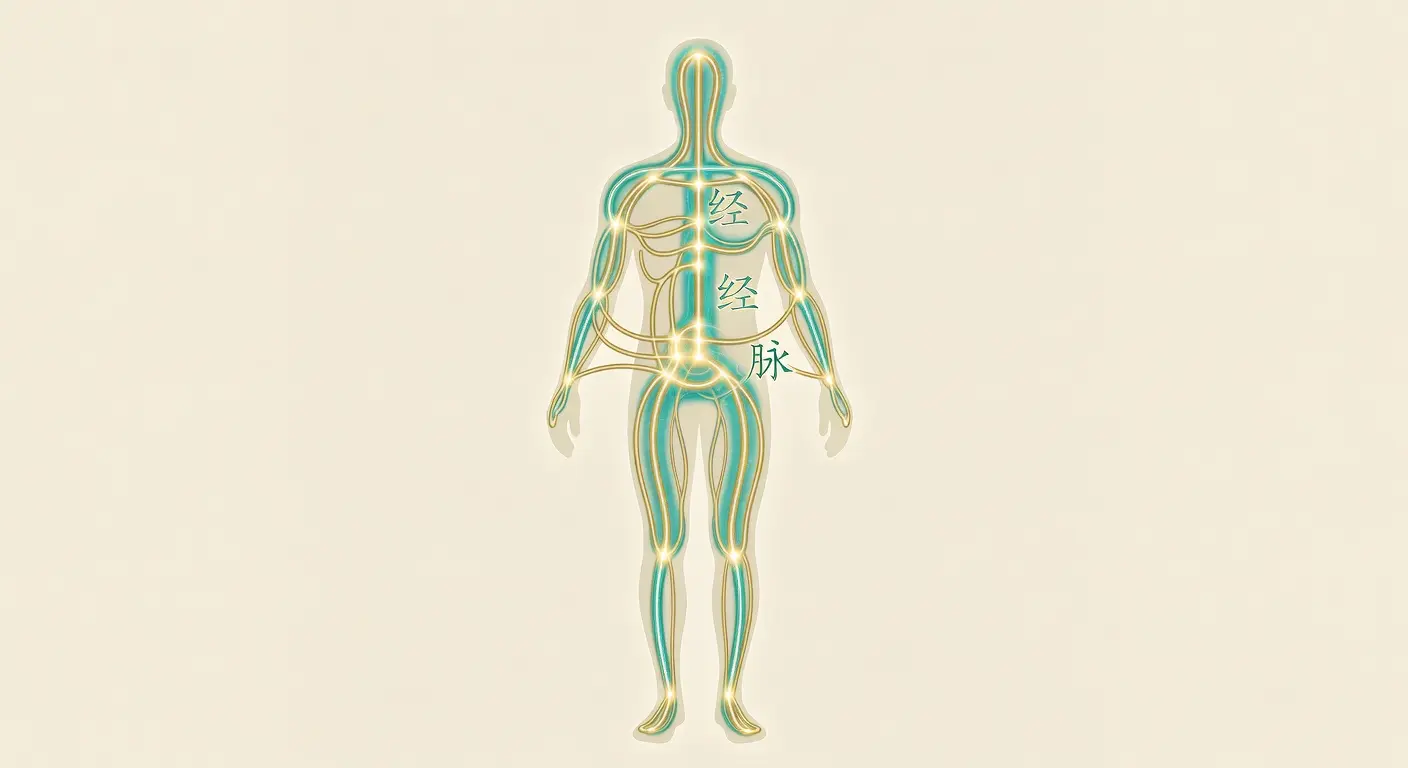
The meridians (经络 Jīng Luò) in Traditional Chinese Medicine are the network of energy channels that transport Qi (energy) and Blood (blood, nutrients) throughout the body, connecting the internal organs (Zang-Fu) to the body surface and ensuring circulation and communication between all tissues and organs.
Meridian
经络
- Transport Qi and Blood throughout the body
- Connect internal organs to the body surface
- Regulate and balance organ functions
- Protect the body against pathogenic factors
- Serve as therapeutic pathways for acupuncture and moxibustion
- Ensure communication and coordination between organs
The meridians are the body’s road network. Like motorways, departmental roads and country paths, they transport vital energy from deep organs to the skin surface, and from the surface to the organs, ensuring circulation and balance of the whole system.
In Traditional Chinese Medicine
In TCM theory, the meridians form a complex network of energy channels that traverse the entire body. They divide into two main categories:
- The principal meridians (经脉 Jīng Mài): twelve principal meridians that correspond to the twelve organs (六脏六腑 Liù Zàng Liù Fǔ: six Zang and six Fu). Each principal meridian bears the name of the organ it connects and circulates in a specific body zone. The twelve principal meridians are: Lung (肺经 Fèi Jīng), Large Intestine (大肠经 Dà Cháng Jīng), Stomach (胃经 Wèi Jīng), Spleen (脾经 Pí Jīng), Heart (心经 Xīn Jīng), Small Intestine (小肠经 Xiǎo Cháng Jīng), Bladder (膀胱经 Páng Guāng Jīng), Kidney (肾经 Shèn Jīng), Pericardium (心包经 Xīn Bāo Jīng), Triple Burner (三焦经 Sān Jiāo Jīng), Gall Bladder (胆经 Dǎn Jīng), Liver (肝经 Gān Jīng).
- The secondary meridians (络脉 Luò Mài): network of finer channels that connect principal meridians to one another, distribute Qi and Blood to tissues and organs, and ensure circulation in areas not covered by principal meridians.
The meridians have vital functions:
- Transport of Qi and Blood: the meridians transport Qi and Blood throughout the body, ensuring nutrition, warmth, protection and regulation of all tissues and organs
- Connection of organs: the meridians connect internal organs to the body surface, enabling diagnosis (pulse, tongue, skin) and treatment (acupuncture, moxibustion, massage)
- Regulation and balance: the meridians regulate and balance organ functions, ensuring harmony of Yin and Yang, Qi and Blood
- Protection: the meridians distribute Wei Qi (protective Qi) to the body surface, protecting against external pathogenic factors
- Therapeutic pathways: the meridians serve as pathways for external treatments (acupuncture, moxibustion, massage, cupping) that influence internal organs
The meridians are obstructed by Qi stagnation, Blood stasis, Cold, Dampness, Wind and external pathogenic factors. Meridian obstruction causes pain, circulatory disorders, organ dysfunction and disease.
Practical Applications
In Chinese dietary therapy, the meridians are supported by foods that tonify Qi and Blood, clear obstructions, and maintain smooth circulation. Recommended foods include ginger, garlic, leeks, turmeric, saffron, basil, mint, fennel, citrus fruits, celery, carrots, spinach, sesame seeds, nuts, aduki beans and ginger-lemongrass infusions.
Lifestyle directly influences meridian quality: moderate physical activity that circulates Qi and Blood (walking, tai chi, qi gong, stretching, yoga), stress management that releases Qi stagnation, protection against cold, wind and dampness (especially when sweating), sufficient sleep that regenerates Qi and Blood, and a diet that does not produce obstructions (no excess fat, sweets, cold) strengthen the meridians. Sedentary lifestyle, chronic stress, cold, dampness, injuries, trauma and an obstructing diet weaken or block the meridians.
Concrete Examples
A patient presenting with Liver meridian obstruction with Qi stagnation may experience hypochondriac tension, lateral headaches, dizziness, nausea, irritability, neck and shoulder muscle tension, a tongue with white coating on the edges, and a wiry pulse. The dietary protocol will include foods that circulate Liver Qi such as chicken sautéed with basil, lemon and ginger, grated carrots in light salad with parsley, coriander and lemon, spinach sautéed with garlic, fresh citrus fruits as snacks, mint and chrysanthemum infusions, and regular tai chi or qi gong practice to circulate Qi.
A female patient presenting with Lung meridian obstruction with Cold and Dampness may experience cough with white and abundant phlegm, shortness of breath, chest oppression, sensation of cold in the back, repeated colds, a pale tongue with white, moist coating, and a superficial, soggy pulse. The dietary protocol will include foods that warm the Lung and disperse Cold-Dampness such as chicken stewed with ginger and leeks, rice porridge with ginger and dates, roasted carrots and sweet potatoes, ginger-cinnamon infusions, and daily protection of the neck and nape against cold and wind.
Frequently Asked Questions
What is the difference between a meridian and a blood vessel?
The meridians in TCM are energy channels that transport Qi and Blood, but they do not exactly correspond to anatomical blood vessels. The meridians are functional and energetic pathways that connect internal organs to the body surface, ensuring circulation of Qi, Blood, fluids and information. Blood vessels in Western medicine are anatomical structures that transport blood. The meridians include blood vessels but also other energetic pathways (nervous system, fascia, connective tissues) that are not anatomically visible. Acupuncture points on the meridians are zones where Qi is accessible at the surface and where external treatments can influence internal organs.
How to recognise meridian obstruction?
The classic signs of meridian obstruction include pain along the meridian pathway, muscle tension, stiffness, numbness, tingling, circulatory disorders, dysfunction of organs connected to the obstructed meridian, masses or nodules along the meridian, colour or temperature changes along the meridian, and a pulse that reflects the obstruction (wiry for Qi stagnation, deep and slow for Cold, rapid and full for Heat). Meridian obstruction can also cause emotional disorders linked to the organ concerned (anger for Liver, sadness for Lung, fear for Kidney).
Which foods support the meridians?
Foods that support the meridians are generally those that tonify Qi and Blood, clear obstructions, and maintain smooth circulation. These include ginger, garlic, leeks, turmeric, saffron, basil, mint, fennel, citrus fruits, celery, carrots, spinach, sesame seeds, nuts, aduki beans, ginger-lemongrass, mint and basil infusions. Foods to avoid are those that obstruct (excess fat, fried foods, sweets), very cold foods that contract the meridians, and a diet that produces Dampness or internal Heat.
Conclusion
The meridians constitute the fundamental network of energy channels that transport Qi and Blood, connect internal organs to the body surface and ensure circulation and communication throughout the organism in Traditional Chinese Medicine. Understanding their structure, functions and therapeutic approaches enables a better grasp of the therapeutic reasoning and support protocols proposed in the Yin Shi universe.
- Qi
- Blood
- Acupuncture Points
- Moxibustion
- Tai Chi
To go further
Yin Shi ecosystem resources directly related to this article.
Which meridian carries your imbalance?
The five-organ test spots the Zang-Fu system whose meridian is most called upon.
Take the test →The meridians, channels of Qi
The lesson introduces the meridian network and the circulation of Qi through the body.
Take the lesson →