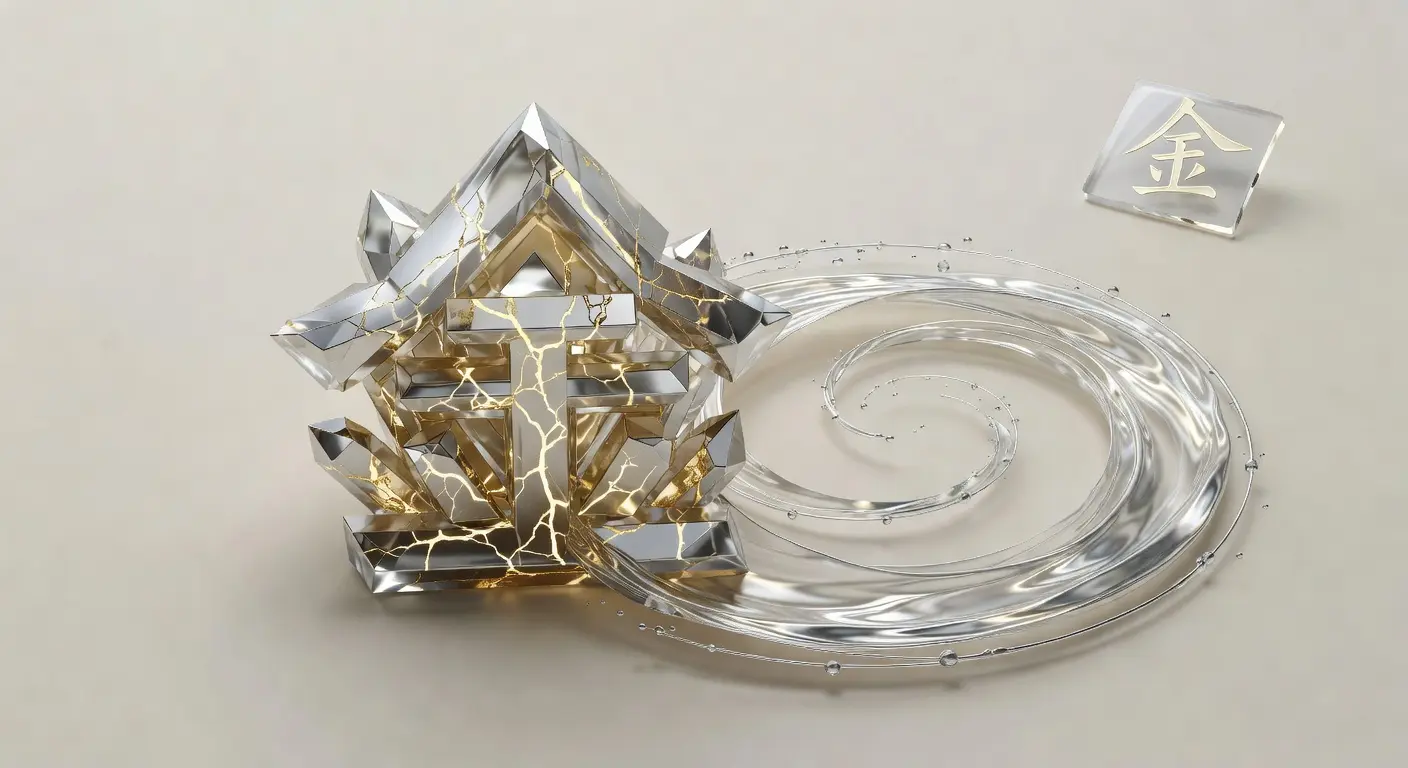
Metal (金 Jīn) in Traditional Chinese Medicine is one of the five fundamental elements (五行 Wǔ Xíng) that govern the cyclical transformations of nature and the human body. It corresponds to autumn, the West, the Lung (肺 Fèi), the Large Intestine (大肠 Dà Cháng), the movement of concentration, sorting, reception and release, the colour white, the sour flavour, the emotion of sadness and grief, the skin and hair, and the nose.
Metal
金
- Governs concentration, sorting, reception and release
- Corresponds to the Lung (肺 Fèi) and the Large Intestine (大肠 Dà Cháng)
- Ensures respiration, diffusion of Qi and fluids
- Governs the skin, hair and surface immunity
- Influences the nose, speech and communication
- Is associated with sadness, grief and letting go
Metal is the maturity of autumn. Like a tree that drops its golden leaves to prepare for winter rest, it embodies the capacity to sort, to receive what is precious, to eliminate what is superfluous, and to release with elegance. It is purity, clarity, demarcation and the quiet strength of boundaries.
In Traditional Chinese Medicine
In the theory of the five elements (五行 Wǔ Xíng), Metal governs concentration, sorting, reception, release and purity. It is the element of maturity, harvest, selection and elimination. Its fundamental characteristics include:
- Season: autumn (秋 Qiū), when nature concentrates, sorts, harvests and releases to prepare for winter rest
- Direction: West, where the sun sets and day gives way to night
- Organs: Lung (肺 Fèi, Zang) and Large Intestine (大肠 Dà Cháng, Fu)
- Colour: white (白 Bái), colour of purity, clarity and maturity
- Flavour: sour (酸 Suān), flavour that astringes, contracts and tonifies Lung Yin
- Emotion: sadness and grief (悲 Bēi), which dissipates Lung Qi, causing breathlessness, chest oppression, fatigue and a tendency to tears
- Tissues: skin and hair (皮毛 Pí Máo), which reflect the state of the Lung and Blood, and constitute the first barrier against external perversities
- Openings: nose (鼻 Bí), which reflects the state of the Lung and is the pathway for external perversities to penetrate
- Fluid: nasal mucus (涕 Tì), which moistens the nose, protects against external perversities, and reflects the state of the Lung and fluids
- Sound: weeping (哭 Kū), vocal expression associated with Lung Qi
- Sense: smell, which depends on the Lung and Nose
The Lung (肺 Fèi), organ of Metal, has vital functions:
- Governs Qi and respiration (肺主气 Fèi Zhǔ Qì): the Lung captures Qi from Heaven (atmospheric air) and combines it with Qi from cereals (produced by the Spleen) to form Zong Qi (宗气 Zōng Qì, Qi of the Chest). The Lung governs respiration, diffusion of Qi throughout the body, and gas exchange (oxygen and carbon dioxide). Lung Qi deficiency causes breathlessness, fatigue, spontaneous sweating, a tendency to colds and a weak voice
- Governs diffusion and descent (肺主宣发肃降 Fèi Zhǔ Xuān Fā Sù Jiàng): the Lung diffuses Qi, Blood and fluids towards the body surface (skin, hair, muscles) and descends them towards lower organs (Kidney, Bladder, Large Intestine). Lung imbalance causes diffusion disorders (cough, breathlessness, abnormal sweating, dry or greasy skin) and descent disorders (chronic cough, breathlessness, oedema, urinary disorders, constipation)
- Governs the skin and hair (肺主皮毛 Fèi Zhǔ Pí Máo): the Lung nourishes skin and hair through Qi and fluids it diffuses. Lung imbalance causes skin disorders (dry, greasy skin, eczema, acne, psoriasis, itching, hair loss), abnormal sweating (excessive, insufficient, nocturnal, exertional), abnormal coldness or heat of the skin, and a tendency to colds and skin infections
- Opens into the nose (肺开窍于鼻 Fèi Kāi Qiào Yú Bí): the Lung nourishes the nose through Qi and fluids. Lung imbalance causes nasal disorders (colds, sinusitis, allergies, nasal discharge, nasal congestion, nosebleeds, loss of smell), respiratory disorders (cough, breathlessness, asthma, bronchitis, pneumonia), and voice disorders (hoarse, rough, weak, absent voice)
- Is associated with sadness and grief (肺主悲 Fèi Zhǔ Bēi): moderate sadness and grief allow letting go, purification and renewal. Excessive sadness and prolonged grief dissipate Lung Qi, causing breathlessness, chest oppression, fatigue, a tendency to tears, a weak voice, loss of appetite and weakened immunity. Absence of sadness and refusal of grief block Lung Qi, causing emotional rigidity, inability to let go, accumulation of grievances and stagnation of Qi and fluids
Practical Applications
In Chinese dietary therapy, Metal is supported by foods that tonify Lung Qi, nourish Lung Yin, disperse Wind and Dryness, and strengthen surface immunity. Recommended foods include white and light-coloured foods (pears, apples, radishes, turnips, kohlrabi, Chinese cabbage, mushrooms, almonds, sesame seeds), sour and astringent foods (lemon, lime, kiwi, green apple, grapes, plums, gooseberries, cranberries), foods that tonify Lung Qi (rice, millet, quinoa, pears, apples, radishes, almonds, liquorice, ginger, leeks), foods that nourish Lung Yin (steamed pears, steamed apples, tofu, white beans, lotus seeds, goji berries, longan, jujubes), seasonal vegetables (cabbages, kohlrabi, radishes, turnips, carrots, beetroot, celery, courgettes, leeks), seasonal fruits (pears, apples, grapes, plums, gooseberries, cranberries, kiwis, lemons), aromatic herbs (ginger, leeks, basil, mint, thyme, rosemary, sage), mushrooms, seaweed, poultry, lean fish, and pear-ginger, liquorice-almond, chrysanthemum-honey, thyme-rosemary and sage-honey infusions.
Lifestyle directly influences Metal balance: deep abdominal breathing in fresh air (especially in autumn and in forests, by the sea or in mountains), protection against Wind, Cold and Dryness (especially in autumn and winter, particularly the neck, nape, upper back and thorax), moderate physical activity that strengthens the Lung and Qi (walking, tai chi, qi gong, swimming, respiratory yoga), stress management that avoids excessive sadness and prolonged grief (meditation, deep breathing, emotional expression, social support, psychotherapy, grief rituals), sufficient sleep that allows the Lung to regenerate (7 to 9 hours, ideally 22h-6h), regular and moderate eating that does not overload the Lung and Stomach, and healthy emotional expression that allows letting go and renewal strengthen Metal. Smoking, air pollution, dust, chemicals, dry and windy climates, lack of humidity, excessive sadness, prolonged grief, vocal overwork, sedentary lifestyle, lack of sleep and eating that engenders Heat or Dryness (alcohol, coffee, chilli, fried foods, grilled foods, sweets) weaken or imbalance Metal.
Concrete Examples
A patient presenting with Lung Qi deficiency with chronic breathlessness, fatigue and tendency to colds may experience breathlessness on exertion and at rest, profound fatigue, spontaneous sweating especially during the day, a weak voice, a tendency to colds and respiratory infections, dry skin, a pale tongue with a thin white coating, and a weak empty pulse. The TCM dietary protocol will include foods that tonify Lung Qi and nourish Lung Yin such as pear and ginger compote, rice and millet porridge with almonds and jujubes, steamed chicken with Chinese cabbage and mushrooms, leek and ginger soup, liquorice and almond infusions, and breathing exercises in fresh air.
A patient presenting with Lung Yin deficiency with chronic dry cough, dry skin and night sweats may experience a dry cough with little or no sputum, dry and itchy skin, night sweats, a sensation of heat in the palms and soles, thirst, dry throat, dry nasal mucus, constipation, a red tongue with little coating and cracks, and a fine rapid pulse. The TCM dietary protocol will include foods that nourish Lung Yin and clear Dryness such as steamed pears with honey and goji berries, tofu soup with white beans and lotus seeds, light mushroom and spinach salad, chrysanthemum and pear juice infusions, and a reduction of hot and drying foods.
Frequently Asked Questions
What is the relationship between Metal and the other elements?
In the generation cycle (生 Shēng), Metal engenders Water (金生水 Jīn Shēng Shuǐ): metal produces water vapour when heated, and metallic minerals purify water. In the control cycle (克 Kè), Metal dominates Wood (金克木 Jīn Kè Mù): the metal axe cuts wood. Metal is engendered by Earth (土生金 Tǔ Shēng Jīn): earth produces metal ores. Metal is dominated by Fire (火克金 Huǒ Kè Jīn): fire melts metal. These relationships explain the interactions between organs, emotions, flavours and seasons in TCM.
How to recognise a Metal imbalance?
Classic signs of a Metal imbalance include respiratory disorders (cough, breathlessness, asthma, bronchitis, pneumonia, colds, sinusitis, allergies), skin disorders (dry, greasy skin, eczema, acne, psoriasis, itching, hair loss), abnormal sweating (excessive, insufficient, nocturnal, exertional), nasal disorders (colds, sinusitis, allergies, nasal discharge, congestion, nosebleeds, loss of smell), voice disorders (hoarse, rough, weak, absent voice), emotional disorders (excessive sadness, prolonged grief, emotional rigidity, inability to let go), fatigue, weakness, spontaneous sweating, a tendency to infections, a pale tongue with white coating (Lung Qi deficiency) or red tongue with little coating and cracks (Lung Yin deficiency), and a weak empty pulse (Lung Qi deficiency) or fine rapid pulse (Lung Yin deficiency). Metal imbalance can manifest as Lung Qi deficiency (breathlessness, fatigue, tendency to colds), Lung Yin deficiency (dry cough, dry skin, night sweats), Wind-Cold invasion (colds, cough, chills), Wind-Heat invasion (fever, sore throat, yellow phlegm), or Phlegm-Dampness (chronic cough with phlegm, chest oppression, greasy skin).
Which foods support Metal?
Foods that support Metal are generally white, light-coloured, sour, astringent, that tonify Lung Qi, nourish Lung Yin, disperse Wind and Dryness, and strengthen surface immunity. We cite white and light-coloured foods (pears, apples, radishes, turnips, kohlrabi, Chinese cabbage, mushrooms, almonds, sesame seeds), sour and astringent foods (lemon, lime, kiwi, green apple, grapes, plums, gooseberries, cranberries), foods that tonify Lung Qi (rice, millet, quinoa, pears, apples, radishes, almonds, liquorice, ginger, leeks), foods that nourish Lung Yin (steamed pears, steamed apples, tofu, white beans, lotus seeds, goji berries, longan, jujubes), seasonal vegetables, seasonal fruits, aromatic herbs, mushrooms, seaweed, poultry, lean fish, and pear-ginger, liquorice-almond, chrysanthemum-honey, thyme-rosemary and sage-honey infusions. Foods to avoid are very hot and drying foods (grilled foods, fried foods, very hot spices, alcohol, coffee) for Heat and Dryness, and cold raw foods that weaken Lung Qi for Qi deficiency.
Conclusion
Metal constitutes the fundamental element of autumn, concentration, sorting and purity in Traditional Chinese Medicine. Understanding its characteristics, associated organs (Lung and Large Intestine), dysfunctions and dietary and lifestyle approaches to balance it enables a clearer grasp of the therapeutic reasoning and support protocols offered within the Yin Shi universe.
To go further
Yin Shi ecosystem resources directly related to this article.
Metal: Lung, autumn and the pungent flavour
The free lesson from the free course links the Metal element to the Lung, the Large Intestine and the pungent flavour.
Take the lesson →Which element dominates your terrain?
The Five Elements test locates Wood, Fire, Earth, Metal and Water in your profile.
Take the test →