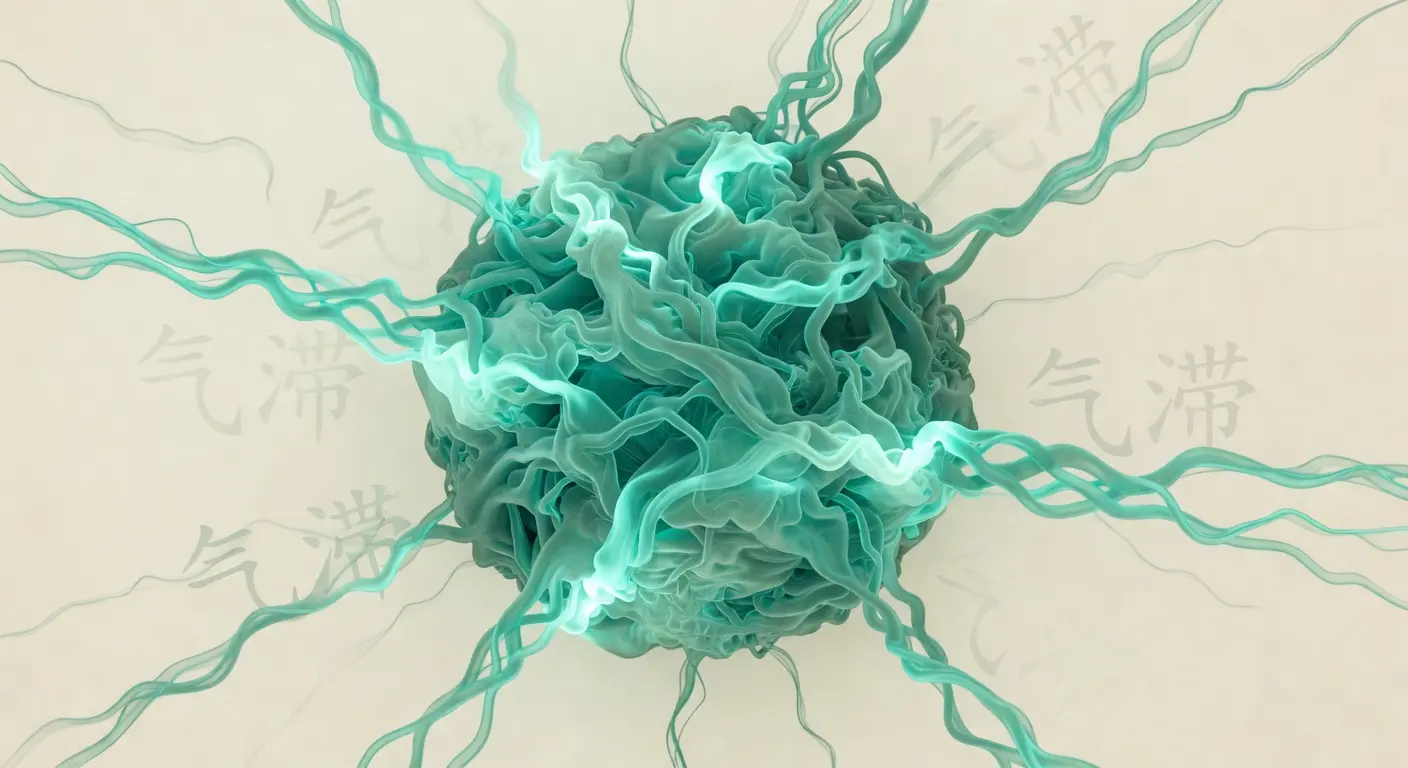
Qi stagnation (气滞 Qì Zhì) in Traditional Chinese Medicine designates a blockage, cessation or slowing of Qi (vital energy) circulation in the organs, meridians, tissues or entire body. It is one of the most frequent imbalances in modern TCM, particularly in stressed and sedentary societies.
Qi Stagnation
气滞
- Blocks, stops or slows Qi circulation
- Causes pain, tension and dysfunction
- Is often linked to stress, repressed emotions and sedentary lifestyle
- May localise in an organ, a meridian or the entire body
- May transform into Blood stasis or Heat if it persists
- Is treated with foods and activities that circulate Qi
Qi stagnation is like a traffic jam on a motorway. Traffic is dense, blocked, frozen, and every car is honking with frustration. Tensions rise, heat accumulates, and no one moves forward. Movement, breathing and relaxation are needed to unblock circulation and restore flow.
In Traditional Chinese Medicine
In TCM theory, Qi stagnation is an imbalance pattern characterised by a blockage of Qi circulation. Qi must circulate freely throughout the body, organs, meridians, tissues and emotions. When this circulation is blocked, Qi accumulates in some places and is lacking in others, causing tension, pain, swelling, dysfunction and emotional disorders.
The main causes include repressed emotions and chronic stress (suppressed anger, frustration, irritability, excessive worry), sedentary lifestyle and lack of physical activity, a diet that stagnates and obstructs (excess fat, fried foods, sweets, dairy products, processed foods), external Cold and Dampness (which contract muscles and obstruct meridians), injuries and trauma (which locally block Qi and Blood), and Qi deficiency (when Qi is insufficient, it does not circulate with enough force).
Clinical manifestations vary according to localisation. Liver Qi stagnation causes hypochondriac tension, lateral headaches, dizziness, nausea, bloating, irritability and a wiry pulse. Heart Qi stagnation causes palpitations, chest oppression, insomnia and anxiety. Spleen Qi stagnation causes loss of appetite, bloating, nausea and fatigue. Lung Qi stagnation causes cough, shortness of breath, frequent colds and sadness. Kidney Qi stagnation causes lower back pain, urinary disorders and fear. Generalised Qi stagnation causes paradoxical fatigue, generalised muscle tension, diffuse and mobile pain, bloating, sleep disorders and irritability.
Practical Applications
In Chinese dietary therapy, Qi stagnation is dispersed by foods that circulate Qi, relax tension, calm the Liver and harmonise emotions. Recommended foods include aromatic herbs and spices (basil, mint, coriander, tarragon, chives, parsley, fennel, anise, cardamom, turmeric, ginger, garlic, leeks), green vegetables (spinach, broccoli, asparagus, peas, green salads, cucumbers, courgettes, celery, carrots, beetroot), fresh and sour fruits (lemon, lime, kiwi, green apple, grapes, citrus fruits, redcurrants, cranberries), legumes (green beans, peas, broad beans, edamame, aduki beans, lentils), seeds and nuts (sesame, nuts, almonds, pumpkin seeds, sunflower seeds), lean fish, poultry, eggs, whole grains, seaweed, mushrooms, and infusions of mint, basil, chrysanthemum, lemongrass, liquorice and turmeric.
Lifestyle is crucial for treating Qi stagnation: regular and moderate physical activity that circulates Qi (walking, running, swimming, cycling, tai chi, qi gong, yoga, dance), stress and emotion management (meditation, deep breathing, relaxation, emotional expression, psychotherapy, art therapy, writing, music, nature), sufficient sleep that allows Qi to regenerate (7 to 9 hours, ideally 22h-6h), regular and moderate meals that do not stagnate, sufficient hydration, deep abdominal breathing in fresh air, and an upright and relaxed posture disperse Qi stagnation. Chronic stress, repressed emotions, sedentary lifestyle, lack of physical activity, a stagnating diet, shallow breathing, a hunched and contracted posture, lack of sleep and physical and mental overwork aggravate Qi stagnation.
Concrete Examples
A patient presenting with Liver Qi stagnation from chronic stress and suppressed anger may experience permanent hypochondriac and intercostal tension, lateral and pulsating headaches that worsen with stress, occasional dizziness, nausea and bloating, irregular stools (alternating constipation-diarrhoea), irritability and easy or suppressed anger, sensation of lump in the throat (globus hystericus), premenstrual breast pain, painful or irregular periods, a tongue with white coating on the edges, and a wiry pulse. The TCM dietary protocol will include foods that circulate Liver Qi such as chicken sautéed with basil, lime and ginger, spinach sautéed with garlic and sesame seeds, grated carrots in light salad with parsley, coriander and lemon, poached eggs on a bed of spinach, fresh citrus fruits as snacks, mint, basil and chrysanthemum infusions, and daily tai chi, qi gong, yoga or brisk walking practice to circulate Qi.
A female patient presenting with generalised Qi stagnation from sedentary lifestyle and repressed emotions may experience paradoxical fatigue (fatigue with inner agitation), generalised muscle tension (neck, shoulders, back, jaw), diffuse and mobile pain that changes place, bloating and frequent flatulence, irregular stools, sleep disorders (difficulty falling asleep, frequent waking, agitated dreams), irritability, anxiety or mild depression, a tongue with thin white coating, and a wiry pulse. The TCM dietary protocol will include foods that circulate general Qi such as fried rice with green vegetables, ginger and turmeric, aduki beans stewed with seaweed and ginger, green vegetables sautéed with garlic and basil, fresh and sour fruits as snacks, dry-roasted sesame seeds as snacks, mint, lemongrass, turmeric and liquorice infusions, and daily brisk walking, swimming, yoga, dance or qi gong practice to circulate Qi.
Frequently Asked Questions
What is the difference between Qi stagnation and Blood stasis?
Qi stagnation (气滞 Qì Zhì) is a blockage of energetic (Qi) circulation that causes tension, diffuse and mobile pain, swelling, bloating, emotions and dysfunction. Blood stasis (血瘀 Xuè Yū) is a blockage of blood (Blood) circulation that causes fixed and stabbing pain, masses, nodules, bruising, abnormal bleeding, dull complexion and purple tongue. Qi stagnation can transform into Blood stasis if it persists long, for Qi is the motor of Blood (气行则血行 Qì Xíng Zé Xuè Xíng). Conversely, Blood stasis can block Qi, causing secondary Qi stagnation. Qi stagnation treatment favours foods and activities that circulate Qi (aromatic herbs, green vegetables, fresh fruits, physical activity, stress management). Blood stasis treatment favours foods and activities that circulate Blood (turmeric, saffron, basil, moderate chilli, massage, cupping, gua sha, acupuncture).
How to recognise Qi stagnation?
The classic signs of Qi stagnation include muscle and joint tension (neck, shoulder, back, jaw, hypochondrium, intercostal tension), diffuse and mobile pain that changes place, abdominal swelling and bloating, flatulence, irregular stools (constipation, diarrhoea, alternation), sleep disorders (difficulty falling asleep, frequent waking, agitated dreams, insomnia), emotional disorders (irritability, anger, frustration, anxiety, mild depression, feeling of oppression, lump in throat sensation), digestive upset (nausea, vomiting, gastric reflux, loss of appetite, sensation of fullness), respiratory disorders (cough, shortness of breath, chest oppression, frequent colds), gynaecological disorders (painful or irregular periods, breast pain, PMS), paradoxical fatigue (fatigue with inner agitation), a tongue with thin white coating that may be thick according to localisation, and a wiry, tight or slippery pulse according to cause.
Which foods disperse Qi stagnation?
Foods that disperse Qi stagnation are generally aromatic, pungent, Qi-circulating, tension-releasing, Liver-calming and emotion-harmonising. These include aromatic herbs and spices (basil, mint, coriander, tarragon, chives, parsley, fennel, anise, cardamom, turmeric, ginger, garlic, leeks), green vegetables (spinach, broccoli, asparagus, peas, green salads, cucumbers, courgettes, celery, carrots, beetroot), fresh and sour fruits (lemon, lime, kiwi, green apple, grapes, citrus fruits, redcurrants, cranberries), legumes (green beans, peas, broad beans, edamame, aduki beans, lentils), seeds and nuts (sesame, nuts, almonds, pumpkin seeds, sunflower seeds), lean fish, poultry, eggs, whole grains, seaweed, mushrooms, and infusions of mint, basil, chrysanthemum, lemongrass, liquorice and turmeric. Foods to avoid are those that stagnate and obstruct Qi (excess fat, fried foods, sweets, dairy products, processed foods, excessive cold and raw foods), foods that contract and block Qi (iced drinks, very cold foods, cold and damp environments), and meals taken in stress, anger, sadness or worry.
Conclusion
Qi stagnation constitutes the fundamental imbalance of energetic circulation blockage in Traditional Chinese Medicine. Understanding its causes, manifestations, localisations and dietary, therapeutic and lifestyle approaches to disperse it enables a better grasp of the therapeutic reasoning and support protocols proposed in the Yin Shi universe.
- Qi
- Liver
- Spleen
- Qi deficiency
- Wind
To go further
Yin Shi ecosystem resources directly related to this article.
Is your Qi circulating freely?
The CCMQ questionnaire spots Qi stagnation among the nine constitutions.
Take the test →Recognising and releasing Qi Stagnation
The lesson gives the diagnosis of Qi Stagnation and the dietary prescriptions that release it.
Take the lesson →