Imagine a medicine where, before examining your complaint, the doctor asks which constitution you were born with, and prescribes diet, herbs and lifestyle for a given illness differently according to your type. That medicine exists. Sasang medicine (四象醫學, 사상의학, “medicine of the four types”), born in Korea at the end of the 19th century, is the most accomplished constitutional system in East Asia. Less widespread than Chinese medicine (TCM) in the West, it is deeply compatible with it: where TCM describes a moving terrain, Sasang describes a fixed framework, laid down at birth.
This article introduces the four Sasang types, their distinguishing signs, their dietary implications, and how this lens complements the TCM vision.
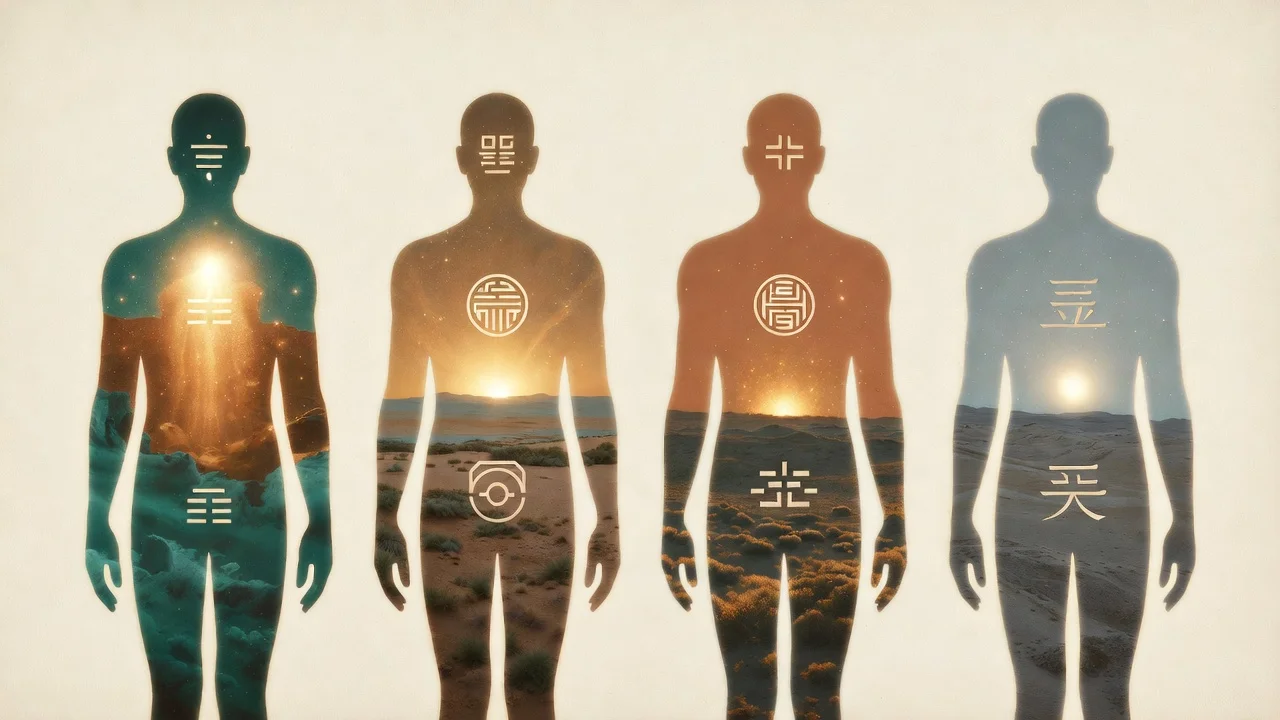
The birth of a medicine: Yi Je-ma and the Dongui Suseowon
In 1894, the Korean scholar Yi Je-ma (李濟馬, 1837-1900) published the Dongui Suseowon Bowon (東醫壽世保元, “Precious Mirror of Eastern Medicine”), the fruit of thirty years of reflection and clinical practice. His intuition: human beings are not interchangeable. The same illness does not call for the same treatment in different people, because their inborn constitutional structure differs.
Yi Je-ma called his system Sasang (四象), “four images” or “four types”, in reference to the I Ching, where the four great configurations arise from the interaction of Yin and Yang. Every human being belongs to one of four types, determined at conception and unchangeable throughout life.
“The human being possesses a constitution that does not change; treatment must be adapted to this constitution before considering the illness.”
The four constitutions at a glance
The four types arise from crossing two axes: the predominance of Yang or Yin in the individual, and the relative strength of the large organs (Lung, Liver) versus the small ones (Spleen, Kidney). In Sasang, “large” means hyperfunctional and “small” means constitutionally weak.
- Tae Yang (太陽): Lung large, Liver small. The most Yang of types, and the rarest.
- So Yang (少陽): Spleen large, Kidney small. Yang, but less than Tae Yang.
- Tae Eum (太陰): Liver large, Lung small. Yin.
- So Eum (少陰): Kidney large, Spleen small. The most Yin of types.
In practice, Tae Eum and So Eum account for the majority of the population, So Yang is less common, and Tae Yang is rare (some authors estimate it at under 1%).
| Aliment | Nature | Saveur | Méridiens | Actions | Précautions |
|---|---|---|---|---|---|
| Tae Yang (太陽) | Hot / Yang + | Large Lung, small Liver | Lung-Liver | Lean, long neck, decisive and solitary temperament | Rare (< 5%) |
| So Yang (少陽) | Hot / Yang | Large Spleen, small Kidney | Spleen-Kidney | Muscular chest, slender hips, active, quick, impatient | Heat rises to the upper body |
| Tae Eum (太陰) | Cold / Yin | Large Liver, small Lung | Liver-Lung | Broad neck and waist, solid build, steady, cautious, persevering | Prone to Dampness and overweight |
| So Eum (少陰) | Cold / Yin + | Large Kidney, small Spleen | Kidney-Spleen | Delicate build, narrow chest, gentle, anxious temperament, chilly | Frail digestion, inner cold |
The fixed constitutional framework, to be read as a lens for interpreting the terrain
Reading the four types
Tae Yang (太陽): the imperative of the heights
The Tae Yang is the rarest type. Physically, the person is lean and elongated, often with a long neck and a face where the gaze dominates. Psychologically, they are decisive, autonomous, sometimes solitary, inclined to act without consulting others. Their energy “rises”: strong voice, assertive presence.
Constitutional weakness: the Liver, “small” in this type. The Tae Yang must watch over Liver excesses (anger, overwork of the eyes and sinews) and is vulnerable to respiratory problems (their dominant organ, the Lung, is also their channel of external attack).
Diet: favours cooling, moistening foods that soften the Lung and nourish the Liver: pear, grape, shellfish, seaweed, light white fish. Avoids aggressive stimulants (strong coffee, alcohol, very hot spices) that fan an already high Yang.
So Yang (少陽): fire above, cold below
The most recognisable Yang profile in daily life: a person with a developed chest, slender hips, always on the move. Quick, enthusiastic, impatient, a lover of novelty, easily irritable. Their energy rises to the upper body: a warm face and torso but feet that may stay cold, a sign of relative Kidney weakness.
Constitutional weakness: the Kidney, “small”. The So Yang spends their energy faster than they restore it. Their classic imbalances: Heat in the upper body (flushed face, insomnia, irritability) combined with deficient warmth below (cold feet, urinary fragility).
Diet: cool and fresh foods by nature (fresh vegetables, fruit, white fish) to moderate rising Heat, while preserving Kidney Yin through restorative foods (black sesame, cooked seafood, gentle broths). Strong stimulants and alcohol, which amplify Heat in the upper body, should be cut back.
Tae Eum (太陰): the strength of stability
The most common type in the general population. The Tae Eum is physically robust: broad neck and waist, a certain heft, steady endurance. Temperamentally calm, persevering, conservative, attentive to detail, sometimes slow to decide but unshakeable once committed. They are the stabilising force of groups.
Constitutional weakness: the Lung, “small”. The Tae Eum accumulates easily: Dampness, Phlegm, body weight. Their risk is inertia of body and mind, an excess of “substance” that eventually smothers.
Diet: this is the type that benefits most from a frugal, light diet. Protein (lean meat, fish), vegetables, but limiting sugars, saturated fats, dairy and alcohol. The Tae Eum gains from sweating (exercise, sauna) to circulate their abundant substance. Fasting periods or simple meals suit them particularly well.
So Eum (少陰): the delicacy of inner cold
The most Yin profile, and the one that feels the cold most. The So Eum is physically delicate: narrow chest, fine waist, little muscular mass. Temperamentally gentle, reserved, sensitive, inclined to anxiety and worry. Their energy is internal: they need calm, regularity, reassuring routines.
Constitutional weakness: the Spleen, “small”. Digestion is the So Eum’s weak link: poor appetite, fragile stools, abdominal chilliness, slow digestion. It is the constitutional cousin of the Yang deficiency in TCM.
Diet: this type calls for warmth and regularity. Cooked meals, soups, stews, rice gruel (粥 Zhōu, congee), mild spices (ginger, cinnamon), chicken and warm broths. Raw food, cold drinks and refrigeration are its enemies. The So Eum eats little but often, at fixed times, in calm conditions.
Sasang and dietetics: what changes on the plate
The most original contribution of Sasang is to constitutionalise dietetics. Two people with the same digestive complaint will not receive the same recommendations: the Tae Eum will be asked to lighten and circulate, the So Eum to warm and regularise. This logic resonates with the TCM idea of adapting the plate to the terrain, but pushes it further: the terrain is fixed, so the diet can be a rule for life.
Tae Yang → cool, moistening, light foods; strict moderation of stimulants.
So Yang → freshness to temper the rising Heat; Kidney restorers (sesame, seafood); no aggressive stimulants.
Tae Eum → lean protein, vegetables, frugality; limit sugars, dairy, fats, alcohol.
So Eum → cooked and warm food, congee, broths, mild spices; eat little and often, on a schedule.
How do you identify your Sasang type?
Determining one’s Sasang constitution relies on a combined reading:
- Morphology: overall build, neck, chest, waist and hip proportions.
- Temperament: reactions to novelty, decision speed, dominant emotional tendencies.
- Functional signs: digestion, cold or heat tolerance, sweating, sleep.
- Questionnaires: tools such as the KS-15 or SCCQ, developed by Korean researchers, which score responses and assign a probable type.
In Korea, Sasang doctors practise this identification in consultation, sometimes assisted by physiological measurements. For the European reader, the most accessible route is a structured questionnaire followed by a reading of one’s own functional signs.
Sasang, TCM and terrain: a useful double lens
Sasang does not replace TCM; it adds a dimension. TCM describes a terrain that evolves (Qi deficiency today, Dampness tomorrow), where Sasang asserts a frame that does not change. The two are complementary: a So Eum (fixed frame) may develop a Qi deficiency (moving terrain) that is treated with warm, cooked food, an approach consistent with both readings.
This double lens is precisely the logic of the Yin Shi app: identifying your constitution (the frame) and your present imbalance (the terrain), so that food responds to both. The constitution tells you what to favour over time; the terrain tells you what to adjust right now.
FAQ
Can your Sasang constitution change over a lifetime?
No. In Sasang theory, the constitution is laid down at conception and remains stable throughout life. What changes is the state of the terrain (fatigue, excess, illness) which is expressed through the constitution. A So Eum remains So Eum, but their health will vary according to how well their lifestyle honours that framework.
Which is the most common Sasang type?
Tae Eum is generally the most frequent (around 40 to 50% of the population in Korean studies), followed by So Eum, then So Yang. Tae Yang is the rarest, probably under 5%, to the point that some practitioners consider almost every new patient to belong to one of the other three types.
How do Sasang and Ayurveda differ?
Both systems are constitutional, but their frameworks differ. Ayurveda recognises three doshas (Vata, Pitta, Kapha) combining in each person; Sasang assigns one of four fixed types. Ayurveda is based on the five elements and India; Sasang on Yin-Yang and Korea. Their dietary logics overlap (adaptation to type) but the correspondences differ.
Can a Sasang constitution be tested?
Tools exist, such as the KS-15 questionnaire or the SCCQ developed in Korea, which score your answers and assign a probable type. These instruments reach around 70% concordance with clinical diagnosis. For greater reliability, combine the questionnaire with observation of your morphology and functional signs, or consult a practitioner trained in Sasang.
Does Sasang contradict the constitution tests of Chinese medicine?
No. The two systems approach constitution differently: the CCMQ test of TCM measures a current terrain (Qi deficiency, Dampness, Yin excess), where Sasang identifies a fixed frame. A So Eum will very often show a Yang deficiency profile on the CCMQ, since their framework predisposes them to it. The two readings are superimposed, not opposed.
A birth map to guide your plate
Sasang medicine brings to East Asian dietetics what Western approaches often lack: a stable framework. The four types (Tae Yang the ascetic, So Yang the burning, Tae Eum the steady, So Eum the sensitive) each have their dominant organs, their temperament, their weaknesses and, above all, their cuisine. Identifying yours means giving a direction to your eating that no longer depends on dietary fashion.
To situate your profile, our online energy test offers a first constitutional reading in the spirit of TCM. Then explore in the Yin Shi app the foods and cooking methods suited to your terrain, and deepen your knowledge of Yin and Yang in diet to understand the foundations on which Sasang rests.
To go further
Yin Shi ecosystem resources directly related to this article.
Which Sasang type are you?
The KS-15 questionnaire classifies your Korean constitution: Tae-Yang, Tae-Eum, So-Yang or So-Eum.
Take the test →The foods for this terrain in the app
Eel, Star anise and Wheat: foods indicated for Blood deficiency, Heart Blood deficiency, Liver Blood deficiency — full sheets in the app.
Full sheets available after the 30-day free trial or with a subscription.
Sasang facing the other terrain systems
The lesson sets the Korean constitutions against the Hippocratic, Ayurvedic and Chinese models.
Take the lesson →