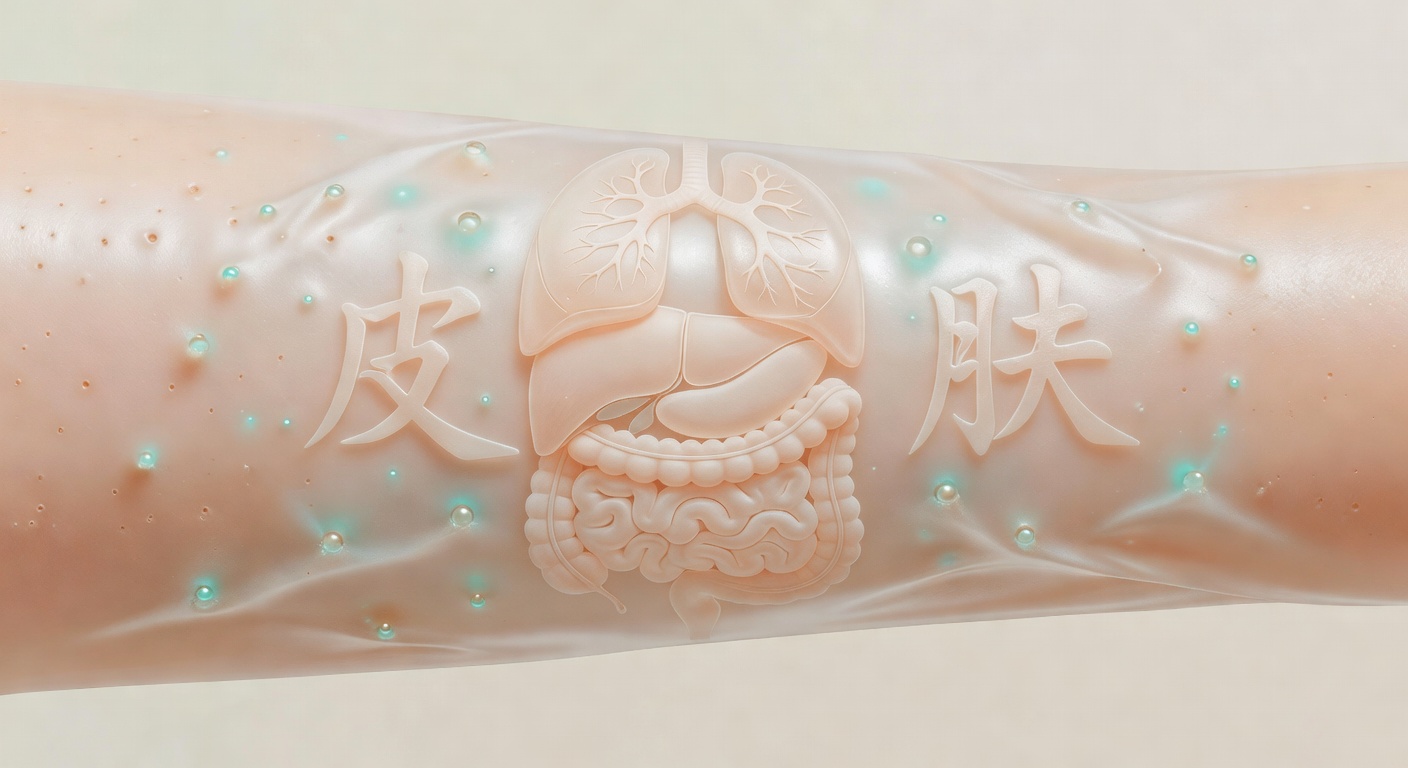
Skin (皮肤 Pí Fū) in Traditional Chinese Medicine is the mirror of internal vitality, governed by the Lung, nourished by Blood and protected by Wei Qi. It constitutes the first physical barrier against external aggressions and reflects the state of internal organs.
Skin
皮肤
- Governed by Lung which controls hair and sweating
- Nourished by Blood which ensures radiance and moisture
- Protected by Wei Qi which defends against external perversities
- Regulated by Liver which ensures circulation and detoxification
- Reflects the state of internal organs and Qi
Skin is the body’s mantle, the first rampart against the outside world. Like a garden, it reflects the quality of the soil (Blood, Yin), watering (fluids) and the fence (Wei Qi). Healthy skin is supple, radiant and resistant.
In Traditional Chinese Medicine
In TCM theory, skin is governed by the Lung (肺主皮毛 Fèi Zhǔ Pí Máo: the Lung controls skin and hair). The Lung diffuses Qi, Blood and fluids towards the body surface, ensuring skin nutrition, moisture and protection. Wei Qi circulates in the space between skin and muscles, regulating skin temperature and sweating.
Blood nourishes skin and gives it radiance. Abundant and quality Blood manifests as pink, supple and luminous skin. Blood deficiency manifests as pale, dry, dull skin and brittle hair. Kidney Yin moistens skin deeply; Kidney Yin deficiency causes skin dryness and loss of elasticity.
The Liver regulates Qi and Blood circulation in skin and connective tissues. Liver Qi stagnation can cause itching, hives, pigmentary spots or hypertrophic scars. Blood Heat (热入血分 Rè Rù Xuè Fēn) causes red eruptions, boils, inflammatory eczema.
Practical Applications
In Chinese dietary therapy, skin is nourished by foods that tonify Lung, enrich Blood and Yin, and clear Blood Heat. Recommended foods include pears, apples, citrus, tofu, black beans, black sesame seeds, spinach, beetroot, seaweed, mushrooms, goji berries, jujubes and chrysanthemum infusions.
Lifestyle directly influences skin quality: deep breathing in fresh air, protection against wind, cold and pollution, sufficient hydration, sufficient sleep (Blood regenerates during sleep), stress management (anger affects Liver and skin), and a diet rich in nutrients that nourish Blood and Yin improve skin. Smoking, polluted environments, chronic stress, insufficient sleep and a poor diet weaken skin.
Concrete Examples
A patient presenting with Blood deficiency with dry and dull skin may have pale, flaky skin, dry and brittle hair, brittle nails, chapped lips, fatigue, pale tongue with little coating, and fine and empty pulse. The dietary protocol will include spinach sautéed with garlic, steamed chicken liver, dry-roasted black sesame seeds, azuki bean and jujube porridge, dried apricots as snacks, and jujube and longan infusions.
A patient presenting with Blood Heat with inflammatory eczema may have red, hot eruptions with intense itching, boils, hot skin to the touch, agitation, thirst, red tongue with yellow coating, and rapid full pulse. The dietary protocol will include tofu stir-fried with mushrooms and spinach, cucumbers in a light salad, steamed pears with honey, chrysanthemum and lemon juice infusions, and drastic reduction of hot and spicy foods.
Frequently Asked Questions
What is the relationship between skin and Lung in TCM?
In TCM, the Lung governs skin and hair (肺主皮毛 Fèi Zhǔ Pí Máo). The Lung diffuses Qi, Blood and fluids towards the body surface, ensuring skin nutrition, moisture and protection. A strong Lung manifests as healthy, supple and resistant skin; a weak Lung as dry, dull skin vulnerable to infections and eruptions. Wei Qi, produced by the Lung, circulates under the skin and regulates skin temperature and sweating.
How to recognise a skin disorder in TCM?
Classic signs of a skin disorder in TCM include dry or oily skin, eruptions, itching, hives, pigmentary spots, scars, boils, eczema, hot or cold skin, pale or red tongue with dry or moist coating, and fine empty pulse (deficiency) or rapid full pulse (heat). The affected organ is often the Lung (dryness, eruptions), Liver (itching, hives, pigmentary spots), Heart (hot eruptions, boils) or Kidney (deep dryness, loss of elasticity).
Which foods nourish skin in TCM?
Skin-nourishing foods in TCM are generally fluid-rich, that tonify Lung and Blood, nourish Yin and clear Blood Heat. We cite pears, apples, citrus, tofu, black beans, black sesame seeds, spinach, beetroot, seaweed, mushrooms, goji berries, jujubes, chrysanthemum, longan, carrots, sweet potatoes, walnuts, almonds and fatty fish. Foods to avoid are very hot and drying foods (grilled foods, fried foods, very hot spices), excessive alcohol, very sweet foods that engender Dampness, and greasy and fried foods that obstruct Qi circulation.
Conclusion
Skin constitutes one of the most visible and precious mirrors of health in Traditional Chinese Medicine. Understanding its energetic bases (Lung, Blood, Yin, Wei Qi), dietary approaches and lifestyle adaptations enables a clearer grasp of the therapeutic reasoning and support protocols offered within the Yin Shi universe.
To go further
Yin Shi ecosystem resources directly related to this article.
Which TCM organ needs your attention?
The five-organ test spots the Zang-Fu system most called upon in you.
Take the test →The skin, territory of the Lung and Wei Qi
The lesson links skin health to the Lung and defensive Qi in TCM.
Take the lesson →