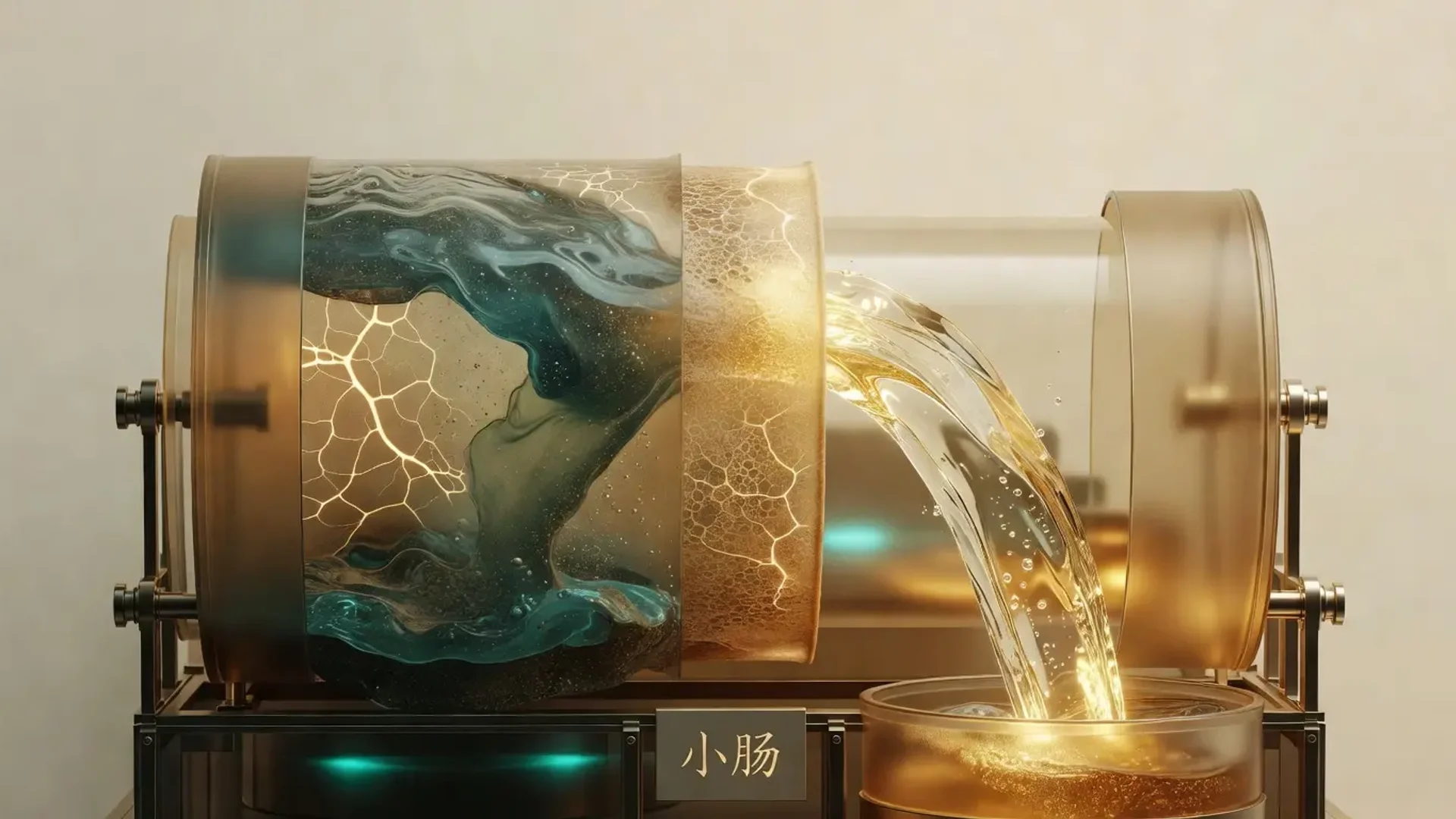
The Small Intestine (小肠 Xiǎo Cháng) in Traditional Chinese Medicine is the organ that receives food from the Stomach, transforms it, separates the “pure” (nutrients to keep) from the “impure” (waste to eliminate), and controls the reception and transformation of food.
Small Intestine
小肠
- Receives food from the Stomach and transforms it
- Separates pure (nutrients) from impure (waste)
- Sends pure towards Spleen and Blood
- Sends impure towards Large Intestine and Bladder
- Controls reception and transformation of fluids
- Coordinates with Heart and Spleen
The Small Intestine is the body’s sorter. Like a filter, it separates what is useful from what is useless, sends nutrients towards the blood and waste towards elimination. A harmonious Small Intestine ensures complete digestion and optimal absorption.
In Traditional Chinese Medicine
In TCM theory, the Small Intestine is a Fu (hollow) organ that receives partially digested food from the Stomach and transforms it into usable nutrients and waste to eliminate. It separates the “pure” (清 Qīng, clear) from the “impure” (浊 Zhuó, turbid): the pure (nutrients, Qi, clear fluids) is sent to the Spleen to be transformed into Qi and Blood, while the impure (waste, turbid fluids) is sent to the Large Intestine for faecal elimination and to the Bladder for urinary elimination.
The Small Intestine governs:
- Reception: the acceptance of food from the Stomach
- Transformation: final digestion and nutrient extraction
- Separation: sorting between pure and impure
- Distribution of the pure: sending nutrients towards Spleen and Blood
- Elimination of the impure: sending waste towards Large Intestine and Bladder
- Coordination with Heart: the Heart and Small Intestine are coupled in TCM (表里 Biǎo Lǐ). Heart Fire descends towards the Small Intestine to warm digestive transformation. An excessive Heart (Heart Fire) can cause mouth ulcers and Small Intestine disorders; a Heart deficiency can lead to Small Intestine cold and slow digestion.
The Small Intestine is particularly vulnerable to Heat (which causes mouth ulcers, dark urine, dry stools), Cold (which slows transformation and causes abdominal pain, loose stools), Dampness (which obstructs separation and causes loose and turbid stools, turbid urine), and an inadequate diet (which overloads or deprives the Small Intestine).
Practical Applications
In Chinese dietary therapy, the Small Intestine is supported by foods that facilitate digestive transformation, separate pure from impure and support the Heart. Foods that support the Small Intestine include rice, millet, carrots, sweet potatoes, celery, fennel, ginger, sesame seeds, walnuts, clear vegetable broths, liquorice infusions and citrus.
Lifestyle directly influences Small Intestine quality: regular and moderate meals, attentive chewing, a diet rich in fibres and quality nutrients, sufficient hydration, moderate physical activity that stimulates peristalsis, and stress management that calms the Heart strengthen the Small Intestine. Excessive meals, refined foods, insufficient fibre, dehydration, chronic stress and repressed emotions disturb the Small Intestine.
Concrete Examples
A patient presenting with Small Intestine Heat with Heart Fire may experience painful mouth ulcers, intense thirst, dark and scanty urine, dry and difficult stools, insomnia with agitation, red tongue with yellow coating in the centre, and rapid full pulse. The dietary protocol will include foods that clear Heart and Small Intestine Heat such as millet porridge with black beans, tofu stir-fried with mushrooms and spinach, steamed pears with honey, chrysanthemum and lemon juice infusions, and an increase in warm water consumption.
A patient presenting with Small Intestine Cold may experience central abdominal pain improved by heat, loose and clear stools with presence of undigested food, clear and abundant urine, absence of thirst, preference for hot drinks, pale tongue with white moist coating in the centre, and deep slow pulse. The dietary protocol will include warming foods that disperse Small Intestine Cold such as rice porridge with ginger and dates, chicken stewed with carrots and leeks, roasted sweet potatoes, hot ginger and cinnamon infusions, and boiling root vegetable soups.
Frequently Asked Questions
What is the difference between Small Intestine and Large Intestine?
The Small Intestine (小肠 Xiǎo Cháng) receives the “pure” (clear, transformed) from the Stomach, separates clear from turbid, and sends the pure to the Spleen and the impure to the Large Intestine. It governs separation and clarification. The Large Intestine (大肠 Dà Cháng) receives the “impure” (turbid, waste) from the Small Intestine, transforms it into stools by resorbing the last fluids, and eliminates it. It governs elimination and regularity. The Small Intestine is the separator, the Large Intestine is the eliminator.
How to recognise a Small Intestine disorder?
Classic signs of a Small Intestine disorder include digestive disorders (diarrhoea, loose stools, constipation, abdominal pain, bloating), mouth ulcers, dark or turbid urine, dry or loose stools, presence of undigested food in stools, thirst or absence of thirst, sensation of heat or cold in the abdomen, tongue with yellow coating (Heat) or white moist coating (Cold), and rapid full pulse (Heat) or deep slow pulse (Cold). Emotions that affect the Small Intestine are joy and sadness which affect the Heart and therefore the Heart-Small Intestine couple, and worry which weakens Spleen Qi and affects separation.
Which foods regulate the Small Intestine?
Foods that regulate the Small Intestine are generally easy to digest, that facilitate separation of pure and impure, and that support the Heart. We cite rice, millet, quinoa, carrots, sweet potatoes, celery, fennel, ginger, sesame seeds, walnuts, clear vegetable broths, liquorice infusions, citrus, pears and apples. Foods to avoid are very hot and drying foods (grilled foods, fried foods, very hot spices) for Heat, very cold and raw foods for Cold, greasy and fried foods for Dampness, and excessive meals for all imbalances.
Conclusion
The Small Intestine constitutes the fundamental organ of separation of pure from impure and digestive transformation in Traditional Chinese Medicine. Understanding its functions, pathologies and dietary support approaches enables a clearer grasp of the therapeutic reasoning and support protocols offered within the Yin Shi universe.
To go further
Yin Shi ecosystem resources directly related to this article.
The Small Intestine in the Middle Burner
The free lesson from the free course explains the separation of the pure from the impure.
Take the lesson →Which TCM organ needs your attention?
The five-organ test spots the Zang-Fu system most called upon in you.
Take the test →