Tai Chi (太极 Tài Jí) is a Chinese internal martial art practised through slow, fluid and continuous movements, associated with deep breathing and mental concentration. It harmonises Qi (vital energy), body and mind, strengthens physical and mental health, and develops balance, flexibility and internal force.
Tai Chi
太极
- Harmonises Qi, body and mind through slow and fluid movements
- Strengthens Qi and Blood circulation in meridians
- Develops balance, flexibility and internal force
- Calms mind and anchors Shen in Heart
- Strengthens legs, trunk and posture
- Improves coordination, breathing and concentration
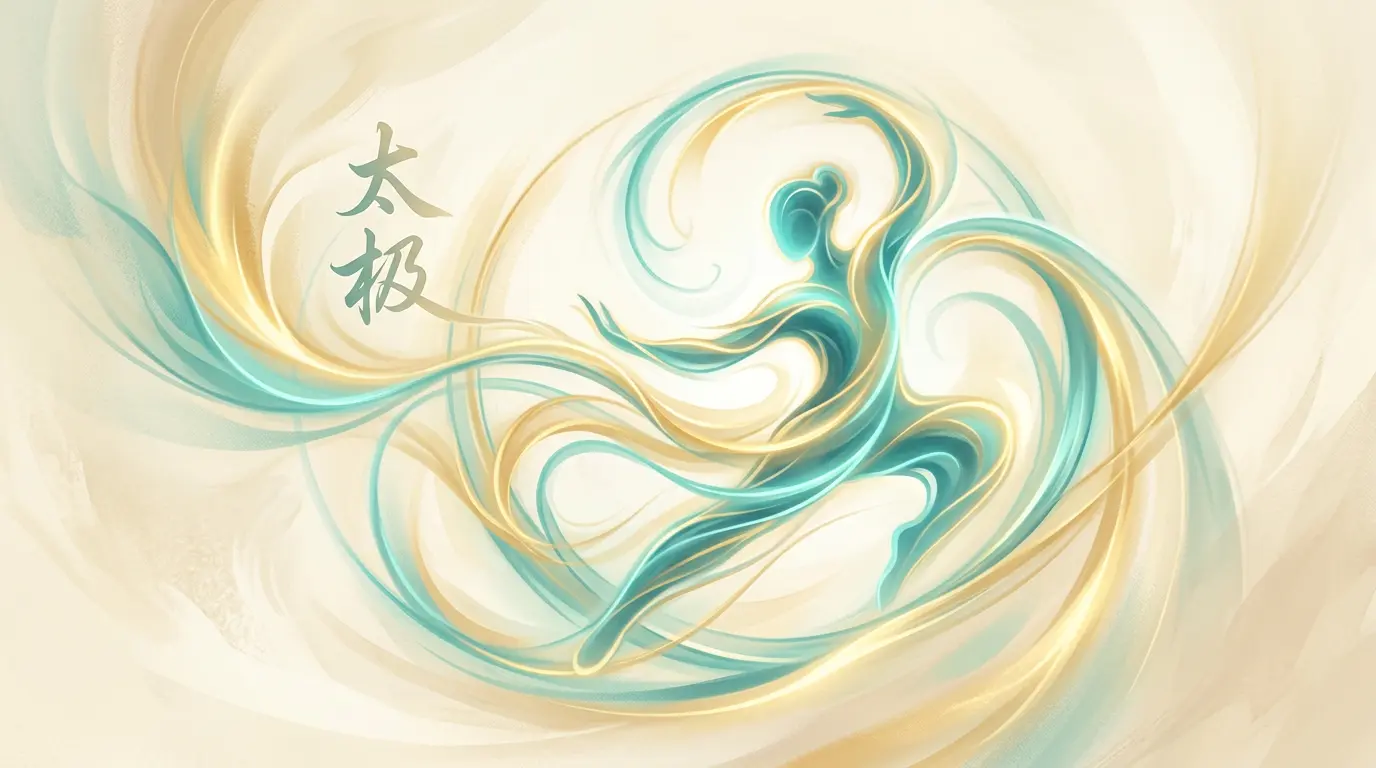
Tai Chi is the dance of Yin and Yang. Like water that flows, it finds its way without forcing, adapts without resisting, transforms without stopping. Each movement is a meditation in action, each posture is a balance between emptiness and fullness, between relaxation and internal force.
In Traditional Chinese Medicine
In TCM theory, Tai Chi is considered a form of Dao Yin (导引 Dǎo Yǐn), a traditional energetic gymnastics that circulates Qi and Blood, harmonises Yin and Yang, strengthens Zang-Fu organs, and develops Shen (spirit, consciousness). Tai Chi is distinguished by its gentle, slow and meditative approach, which suits all ages and all levels of physical condition.
Fundamental principles of Tai Chi include:
- Deep relaxation (松 Sōng): release of all superficial muscular tensions to enable Qi to circulate freely in meridians, muscles and fascias
- Mental concentration (意 Yì): concentration of mind (Yi, intention) on movement, on breathing, on body centre (Dan Tian 丹田), anchoring Shen in Heart and Body
- Deep abdominal breathing (气 Qì): slow, deep and natural breathing that descends into lower abdomen (lower Dan Tian), strengthening Lung, Kidney and Spleen Qi
- Circular and continuous movements (圆 Yuán): movements that describe circles, spirals and curves, reflecting natural Qi and Blood circulation, and avoiding blockages and tensions
- Balance between emptiness and fullness (虚实 Xū Shí): weight transfer from one leg to another, alternation between relaxation and force, between movement and immobility, developing balance, stability and internal force
- Connection of high and low (上下相连 Shàng Xià Xiāng Lián): coordination of arm, trunk and leg movements, ensuring harmonious Qi circulation throughout the body
Health benefits of Tai Chi include:
- Qi and Blood circulation: slow and continuous movements circulate Qi and Blood in meridians, organs and tissues, preventing Stagnations and Stases
- Strengthening of Lung and Kidney Qi: deep abdominal breathing strengthens Lung Qi (which governs breathing) and Kidney Qi (which captures air Qi)
- Tonification of Spleen and Stomach Qi: trunk and lower abdomen movements massage digestive organs, improving transformation and digestion
- Calming Shen and anchoring mind: mental concentration and meditation in movement calm Shen, reduce anxiety, improve sleep and strengthen concentration
- Strengthening legs and posture: semi-flexion movements strengthen leg muscles, improve balance, stability and posture
- Joint and muscle flexibility: circular and continuous movements improve joint mobility, muscle and fascia flexibility, preventing stiffness and pain
- Balance and coordination: weight transfer from one leg to another and coordination of high and low movements improve balance, coordination and proprioception
- Immunity and Wei Qi: regular practice strengthens Wei Qi (protective Qi) and immunity, preventing colds, flu and infections
Practical Applications
Tai Chi is ideally practised outdoors, in a calm and natural environment (park, garden, forest, seaside), where air is fresh and nature Qi is abundant. It is generally practised in the morning (between 5am and 9am, when Lung and Spleen Qi is active) or in the evening (between 5pm and 7pm, when Kidney Qi is active), on an empty stomach or 1 to 2 hours after meals. Clothing is loose and comfortable, shoes flat and non-slip.
Regular Tai Chi practice (ideally 20 to 60 minutes per day, 3 to 7 days per week) progressively develops internal force, flexibility, balance and concentration. It is recommended to learn Tai Chi with a qualified instructor who teaches traditional form, fundamental principles, breathing and meditation. The most widespread traditional forms include Yang form (24, 48, 88, 108 movements), Chen form (74 movements, more dynamic), Wu form (108 movements, more compact), and Sun form (73 movements, more fluid).
Chinese dietary therapy complements Tai Chi by providing nutrients that support Qi and Blood circulation, strengthen Zang-Fu organs, and calm Shen. Recommended foods include rice, millet, green vegetables, fresh fruits, nuts, sesame seeds, azuki beans, mushrooms, seaweed, tofu, chicken, fish, and chrysanthemum, jasmine, green tea and goji berry infusions.
Conclusion
Tai Chi (太极 Tài Jí) constitutes a fundamental internal martial art in Traditional Chinese Medicine for harmonising vital energy, body and mind, and developing longevity. Understanding its principles, techniques and complementary dietary approaches enables a clearer grasp of the therapeutic reasoning and support protocols offered within the Yin Shi universe.
To go further
Yin Shi ecosystem resources directly related to this article.
Reading the Taijitu, the Tai Chi symbol
The Taijitu entry decodes the symbol from which Tai Chi takes its name.
Read the article →The Yin–Yang dynamic that Tai Chi embodies
The lesson describes the cosmology of complementary opposites that Tai Chi sets in motion.
Take the lesson →