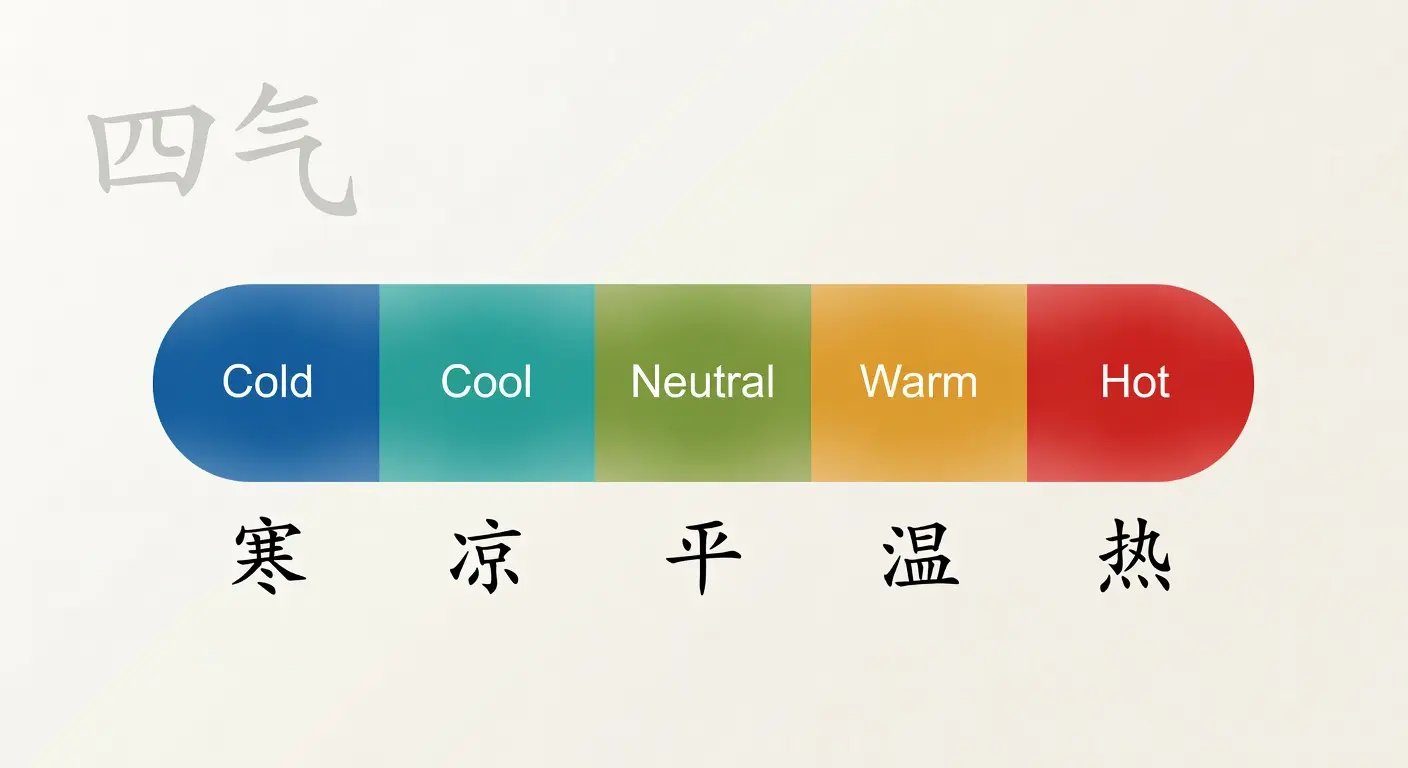
Thermal nature (性質 Xìng Zhì) is a fundamental concept of Chinese dietary therapy that classifies foods according to their energetic effect on the body. Each food possesses an intrinsic property that warms, reheats, neutralises, cools or chills the organism, independently of its physical temperature at consumption.
Thermal Nature
性質
- Hot - warms Yang, disperses Cold, activates circulation
- Warm - tonifies Qi and Yang, harmonises the Centre, stimulates digestion
- Neutral - balances Yin and Yang, suits all constitutions
- Cool - lightly refreshes, calms Heat, nourishes Yin
- Cold - cools intense Heat, clears Fire, preserves Yin
Thermal nature is like a person’s character. A hot food is like an enthusiastic friend who warms your heart. A cold food is like spring water that soothes summer thirst. A neutral food is like a reliable companion who adapts to all situations without ever unbalancing.
In Traditional Chinese Medicine
In TCM theory, thermal nature is one of the fundamental food properties, alongside flavour, tropism and therapeutic action. It determines the overall energetic effect of a food on the organism and guides food choice according to the patient’s constitution, season, climate, syndrome and terrain.
The five thermal natures
| Nature | Therapeutic effect | Indications | Examples |
|---|---|---|---|
| Hot (热 Rè) | Deeply warms Yang, disperses internal Cold, activates blood and energetic circulation, relieves Cold pain | Yang deficiency, internal Cold, Blood stagnation by Cold, cold intolerance, lower back pain, impotence, Cold diarrhoea | Lamb, beef, chicken, ginger, garlic, cinnamon, clove, leeks, Chinese chives |
| Warm (温 Wēn) | Tonifies Qi and Yang, harmonises the Centre, stimulates digestion, favours Spleen transformation and transport | Qi deficiency, mild Yang deficiency, digestive upset by Cold, fatigue, loss of appetite, loose stools | Carrots, sweet potatoes, beetroot, turnips, pattypan squash, pumpkins, cherries, strawberries, blackcurrants, pomegranates |
| Neutral (平 Píng) | Balances Yin and Yang, suits all constitutions, does not unbalance Cold or Heat | Balanced constitutions, convalescence, children, elderly, all seasons | Rice, millet, quinoa, buckwheat, potatoes, cabbage, apples, pears, grapes, figs, almonds, sesame seeds, nuts |
| Cool (凉 Liáng) | Lightly refreshes, calms moderate Heat, nourishes Yin, soothes mild irritations | Mild Heat, moderate thirst, mild redness, agitation, mild insomnia | Cucumbers, courgettes, melons, watermelons, tomatoes, lemons, oranges, grapefruits, kiwis, bananas, yoghurt |
| Cold (寒 Hán) | Cools intense Heat, clears Fire, preserves Yin, stops bleeding by Heat | Intense Heat, internal Fire, intense thirst, fever, redness, acute inflammation, bleeding by Heat | Lychees, longans, mangoes, papayas, pineapples, passion fruits, chillies, peppers, aubergines, asparagus, chard, lettuce, endive, chicory, escarole, frisée, lamb’s lettuce, rocket, purslane, sorrel, tamarind, pomegranate, raspberries, redcurrants, blackcurrants, blueberries, blackberries, elderberries, hazelnuts, sea buckthorn, rose hips |
Practical Applications
In Chinese dietary therapy, thermal nature guides food choice to compensate for the patient’s energetic imbalances. A patient with a Cold syndrome (Yang deficiency, cold intolerance, lower back pain, Cold diarrhoea) will be treated with hot and warm foods. A patient with a Heat syndrome (internal Fire, intense thirst, fever, redness, inflammation) will be treated with cool and cold foods.
Cooking method modifies thermal nature. Long, slow cooking strengthens the hot or warm nature of a food. Quick cooking over high heat or raw consumption strengthens the cool or cold nature. Smoked, grilled, roasted, fried or sautéed foods are hotter than the same foods boiled, steamed or raw.
Concrete Examples
A patient presenting with Yang deficiency with persistent cold intolerance, lower back pain, diminished libido, loose stools, pale complexion, pale and swollen tongue, deep and weak pulse, will benefit from a hot and warm diet: lamb stewed with ginger and cinnamon, roast chicken with leeks and garlic, rice porridge with dates and nuts, roasted carrots and sweet potatoes, clove, cinnamon and ginger infusions.
A female patient presenting with internal Heat with intense thirst, fever, redness, inflammation, bleeding, red complexion, red tongue with little coating, rapid and full pulse, will benefit from a cool and cold diet: cucumber and tomato salads, watermelon and mint smoothies, fresh seasonal fruits (watermelons, melons, kiwis, citrus fruits), chrysanthemum, pear juice, goji berries and black sesame seed infusions.
Conclusion
Thermal nature is a fundamental classification that guides food choice in Chinese dietary therapy. Understanding the five natures (Hot, Warm, Neutral, Cool, Cold), their therapeutic effects, indications and examples enables a better grasp of the therapeutic reasoning and support protocols proposed in the Yin Shi universe.
- Flavour of Foods
- Tropism
- Hot Foods
- Cold Foods
- Diet in TCM
To go further
Yin Shi ecosystem resources directly related to this article.