Tropism (归经 Guī Jīng) is a fundamental concept of Chinese dietary therapy that designates the specific affinity of a food or therapeutic substance for a meridian and its associated Zang-Fu organ. This property enables precise targeting of imbalanced organs and optimisation of dietary prescription efficacy.
Tropism
归经
- Specific affinity for a meridian and a Zang-Fu organ
- Precise targeting of imbalanced organs
- Optimisation of therapeutic food efficacy
- Complement to thermal nature and flavour
- Guidance of food choice according to syndrome
Tropism is like mail addressed to a precise recipient. A food with tropism for Liver meridian will directly nourish, tonify or drain Liver and its associated tissues (tendons, eyes, nails). A food with tropism for Spleen meridian will act directly on digestion, transformation and transport.
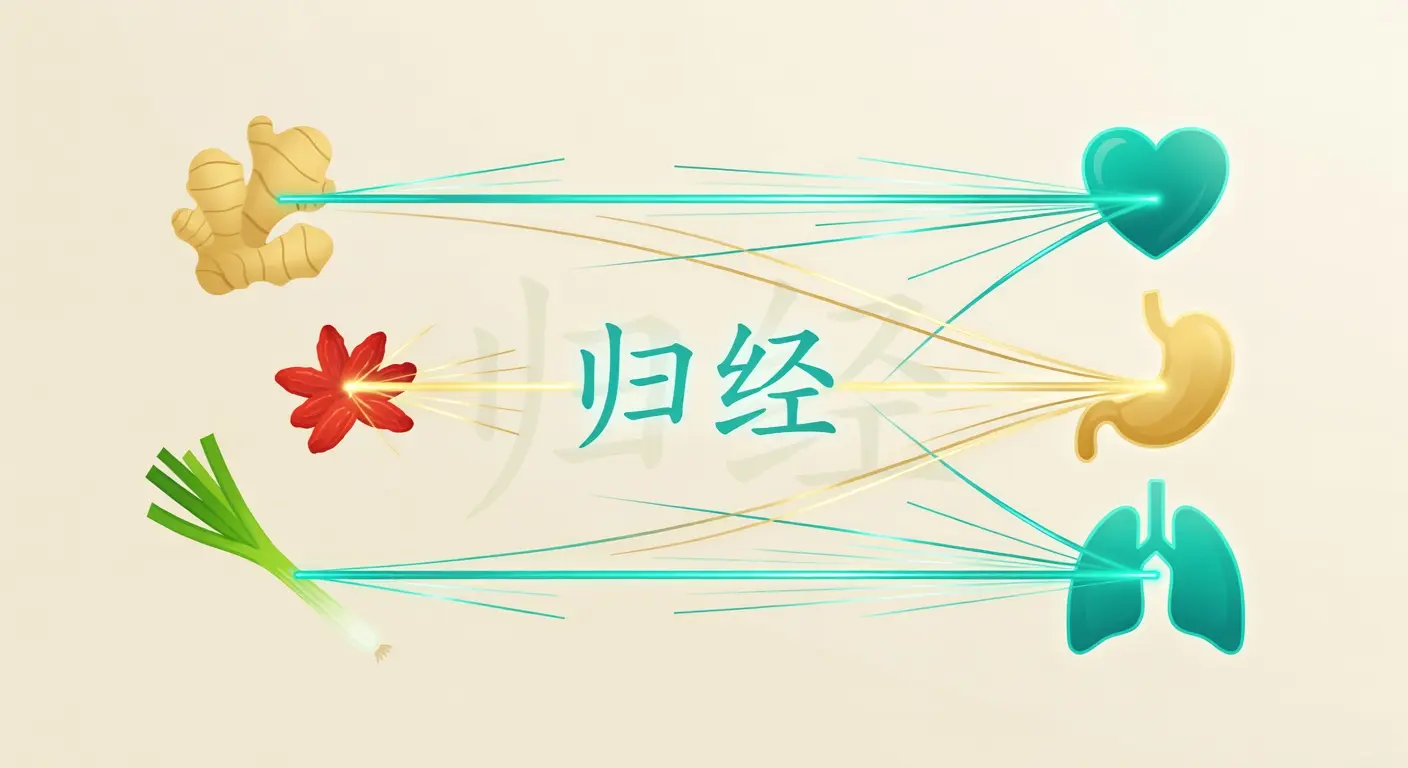
In Traditional Chinese Medicine
In TCM theory, each food possesses a natural affinity for one or more meridians and their associated Zang-Fu organs. This affinity is determined by centuries of clinical observation and therapeutic practice. Tropism complements thermal nature and flavour to form a complete energetic portrait of the food.
Main tropisms and associated organs
| Zang-Fu organ | Associated meridian | Main actions | Food examples |
|---|---|---|---|
| Liver (肝 Gān) | Liver meridian (肝经 Gān Jīng) | Circulates Qi, mobilises Blood, harmonises emotions, nourishes tendons, eyes and nails | Radish, beets, bamboo shoots, artichokes, mustard, cress, rocket, sea buckthorn, rose hips, dog rose |
| Heart (心 Xīn) | Heart meridian (心经 Xīn Jīng) | Subdues Fire, calms mind, clarifies Blood, nourishes tongue and vessels | Tomatoes, watermelons, strawberries, cherries, beets, cress, rocket, saffron, chrysanthemum, red jujubes |
| Spleen (脾 Pí) | Spleen meridian (脾经 Pí Jīng) | Tonifies Qi, harmonises digestion, transforms foods, transports nutrients, nourishes muscles and lips | Rice, millet, potatoes, carrots, sweet potatoes, squashes, dates, figs, grapes, honey, liquorice, jujubes |
| Lung (肺 Fèi) | Lung meridian (肺经 Fèi Jīng) | Diffuses defensive Qi, moistens, lowers Qi, nourishes skin and hair | Pears, apples, apricots, almonds, sesame seeds, ginger, leeks, spring onion, basil, mint |
| Kidney (肾 Shèn) | Kidney meridian (肾经 Shèn Jīng) | Stores Jing, governs growth, reproduction, bones, marrow, hair and ears | Black beans, black sesame seeds, seaweed, oysters, prawns, mussels, sardines, anchovies, lotus seeds, walnuts |
| Stomach (胃 Wèi) | Stomach meridian (胃经 Wèi Jīng) | Receives and lowers foods, transforms foods, harmonises Qi | Rice, millet, potatoes, carrots, beets, apples, pears, honey, liquorice, jujubes, ginger, leeks |
| Small Intestine (小肠 Xiǎo Cháng) | Small Intestine meridian (小肠经 Xiǎo Cháng Jīng) | Receives foods, separates clear from turbid, transforms fluids | Rice, millet, potatoes, carrots, apples, pears, melons, watermelons, cucumbers, courgettes |
| Large Intestine (大肠 Dà Cháng) | Large Intestine meridian (大肠经 Dà Cháng Jīng) | Transmits residues, drains faeces, manages fluids | Plums, figs, grapes, beets, carrots, sweet potatoes, sesame seeds, flax seeds, seaweed, oysters |
| Bladder (膀胱 Páng Guāng) | Bladder meridian (膀胱经 Páng Guāng Jīng) | Stores and excretes urine, expels external pernicious influences | Melons, watermelons, cucumbers, courgettes, azuki beans, black beans, lotus seeds, seaweed, oysters, prawns |
| Gall Bladder (胆 Dǎn) | Gall Bladder meridian (胆经 Dǎn Jīng) | Stores and excretes bile, facilitates fat digestion, makes decisions | Artichokes, radishes, beets, rocket, cress, sunflower seeds, walnuts, almonds, sesame seeds |
| Triple Burner (三焦 Sān Jiāo) | Triple Burner meridian (三焦经 Sān Jiāo Jīng) | Regulates water and Qi in the three burners, coordinates digestion and metabolism | Rice, millet, potatoes, carrots, sweet potatoes, squashes, melons, watermelons, cucumbers, courgettes |
Practical Applications
In Chinese dietary therapy, tropism enables precise targeting of imbalanced organs and optimisation of dietary prescription efficacy. A food can possess several simultaneous tropisms, which enables treating several organs at the same time. For example, rice possesses tropism for Spleen, Stomach and Triple Burner, which makes it a fundamental food for digestion and metabolism.
The combination of tropisms with thermal natures and flavours enables creation of very precise dietary prescriptions. For example, a hot and pungent food with tropism for Lung (like ginger) will warm Lung, activate defensive Qi circulation and treat colds by Cold. A cool and bitter food with tropism for Heart (like chrysanthemum) will clarify Heart heat, calm mind and treat agitation and insomnia.
Concrete Examples
A patient presenting with Kidney Yang deficiency with persistent cold intolerance, lower back pain, impotence, nocturia, pale complexion, pale swollen tongue, deep weak pulse, will benefit from food with tropism for Kidney, of hot and warm nature, and salty and sweet flavour: bone and marrow broth with seaweed and black beans, grilled oysters with ginger and garlic, sautéed prawns with leeks and cinnamon, black bean and black sesame seed porridge, dry-roasted lotus seeds as snacks.
A patient presenting with Liver Heat with migraines, dizziness, irritability, insomnia, red complexion, red tongue with yellow coating, wiry rapid pulse, will benefit from food with tropism for Liver, of cool and cold nature, and bitter and sour flavour: chrysanthemum infusion with lemon juice, artichoke and rocket salad, fresh grapefruit with honey, chicory and cress herbal tea, beetroot and lemon juice, radish and rocket salad.
Conclusion
Tropism (归经 Guī Jīng) constitutes a fundamental concept of Chinese dietary therapy that enables precise targeting of imbalanced organs. Understanding main tropisms, their associated organs, their actions and their food examples enables a clearer grasp of the therapeutic reasoning and support protocols offered within the Yin Shi universe.
To go further
Yin Shi ecosystem resources directly related to this article.
Which organ should your plate lean towards?
The five-organ test spots the Zang-Fu system your foods should target.
Take the test →Gui Jing, the tropism of foods
The lesson shows how each food targets a specific meridian and organ.
Take the lesson →