Water (水 Shuǐ) in Traditional Chinese Medicine is one of the five fundamental elements (五行 Wǔ Xíng) that govern the cyclical transformations of nature and the human body. It corresponds to winter, the North, the Kidney (肾 Shèn), the Bladder (膀胱 Páng Guāng), the movement of concentration, conservation, storage and depth, the colour black or dark blue, the salty flavour, the emotion of fear, the bones and spinal marrow, and the ears.
Water
水
- Governs concentration, conservation, storage and depth
- Corresponds to the Kidney (肾 Shèn) and the Bladder (膀胱 Páng Guāng)
- Stores Jing (Essence), original Qi and will
- Governs the bones, marrow, brain and teeth
- Influences the ears, hearing and balance
- Is associated with fear, will and wisdom
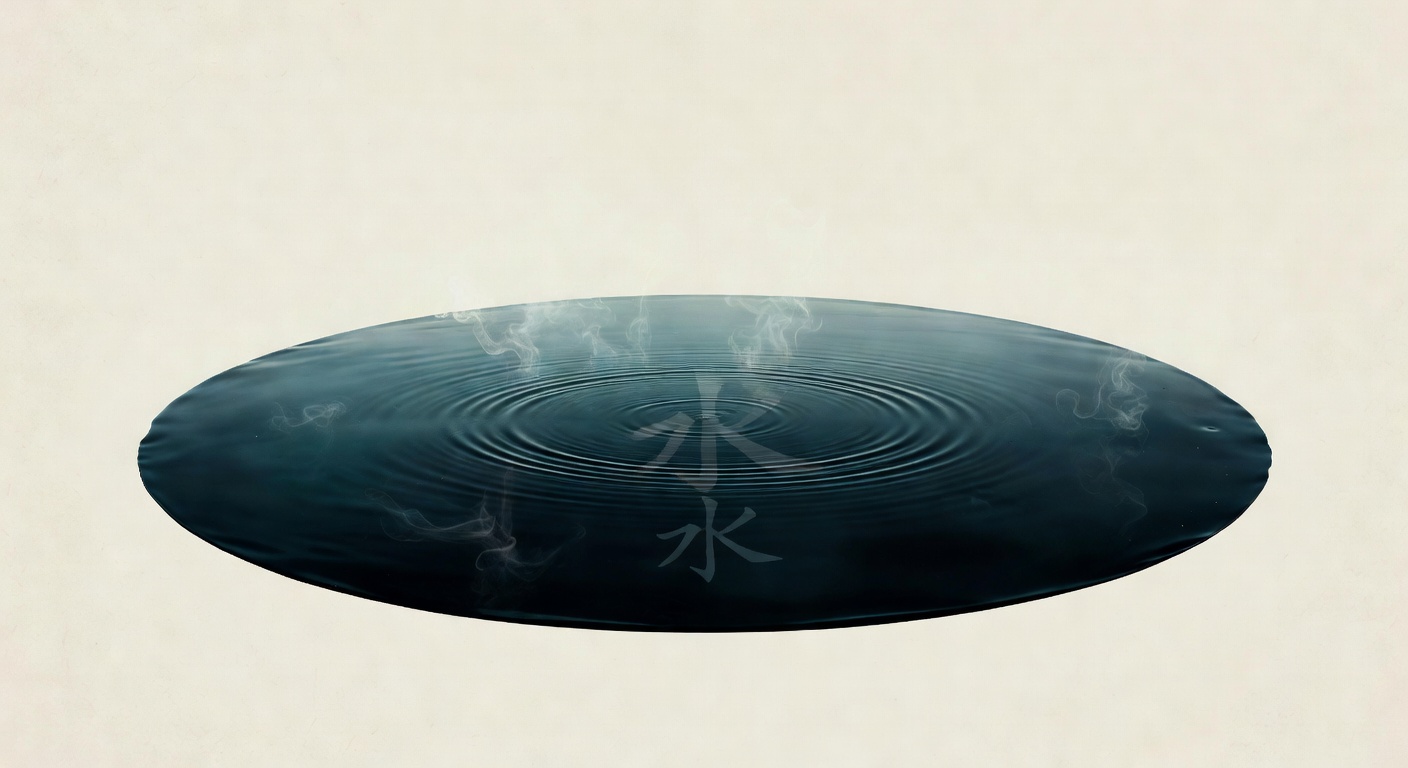
Water is the winter depth of the organism. Like a frozen lake that preserves its warmth at the bottom, or like an underground river that feeds the entire valley, it embodies reserve, storage, patience and quiet wisdom. It is the foundation of all vitality, the hidden treasure that nourishes growth, reproduction and longevity.
In Traditional Chinese Medicine
In the theory of the five elements (五行 Wǔ Xíng), Water governs concentration, conservation, storage, depth and wisdom. It is the element of rest, winter, full maturity and return to sources. Its fundamental characteristics include:
- Season: winter (冬 Dōng), when nature concentrates, conserves, regenerates and prepares for spring renewal
- Direction: North, where cold is most intense and night is longest
- Organs: Kidney (肾 Shèn, Zang) and Bladder (膀胱 Páng Guāng, Fu)
- Colour: black or dark blue (黑 Hēi), colour of depth, night and ocean
- Flavour: salty (咸 Xián), flavour that descends Qi, softens masses, purifies blood and nourishes the Kidney
- Emotion: fear (恐 Kǒng), which descends Kidney Qi and can cause urinary incontinence, diarrhoea, trembling, paralysis or agitation if excessive
- Tissues: bones and marrow (骨 Gǔ), which are nourished by Kidney Jing and constitute the structure and strength of the organism
- Openings: ears (耳 Ěr), which reflect the state of the Kidney and Jing, and allow hearing and balance
- Fluid: urine (尿 Niào), which is transformed and excreted by the Bladder under the influence of Kidney Qi
- Sound: groaning (呻 Shēn), vocal expression associated with Kidney Qi
- Sense: hearing, which depends on Kidney Jing that nourishes the ears
The Kidney (肾 Shèn), organ of Water, has vital functions:
- Stores Jing (肾藏精 Shèn Cáng Jīng): the Kidney stores Jing (Essence 精 Jīng), the fundamental substance of growth, development, reproduction, sexual maturity, fertility, gestation, lactation and ageing. Jing divides into inherited essence (先天之精 Xiān Tiān Zhī Jīng) and acquired essence (后天之精 Hòu Tiān Zhī Jīng). Kidney Jing deficiency causes growth retardation, infertility, impotence, frigidity, bone weakness, hair loss, memory loss, senile dementia and premature ageing
- Governs water and fluids (肾主水 Shèn Zhǔ Shuǐ): the Kidney governs the transformation and excretion of fluids by the Bladder, urine production, and the body’s water balance. Kidney imbalance causes urinary disorders (polyuria, oliguria, anuria, nocturia, incontinence, retention, clear or dark urine, painful urination), oedema, excessive thirst or absence of thirst, and abnormal dryness or dampness
- Governs the reception of Qi (肾主纳气 Shèn Zhǔ Nà Qì): the Kidney captures and retains the Qi inhaled by the Lung, ensuring deep breathing and vitality. Kidney imbalance causes breathlessness, short and superficial breathing, respiratory asthenia, inability to inhale deeply, and profound fatigue
- Governs the bones, marrow and produces bone marrow (肾主骨生髓 Shèn Zhǔ Gǔ Shēng Suǐ): the Kidney nourishes the bones through Jing, produces bone marrow that fills the bones and spinal marrow that nourishes the brain and spinal cord. Kidney imbalance causes fragile bones, osteoporosis, fractures, bone and joint pain, spinal marrow disorders, neurological disorders, memory disorders, concentration disorders, and senile dementia
- Opens into the ears (肾开窍于耳 Shèn Kāi Qiào Yú Ěr): the Kidney nourishes the ears through Jing. Kidney imbalance causes hearing disorders (deafness, hypoacusis, tinnitus, dizziness), balance disorders, ear infections, and ear pain
- Is associated with fear (肾主恐 Shèn Zhǔ Kǒng): moderate fear allows prudence, vigilance and protection. Excessive fear descends Kidney Qi, causing urinary incontinence, diarrhoea, trembling, paralysis, agitation, insomnia and panic. Absence of fear causes imprudence, recklessness, insensitivity to danger and dissipation of Qi
Practical Applications
In Chinese dietary therapy, Water is supported by foods that tonify the Kidney, nourish Jing, Kidney Yin and Kidney Yang, and govern fluids. Recommended foods include black and dark foods (black beans, black sesame seeds, black seaweed, black mushrooms, blueberries, blackberries, blackcurrants, black grapes), salty foods (seaweed, sea fish, prawns, oysters, mussels, sardines, anchovies), foods that tonify the Kidney and Jing (bone and marrow broths, lotus seeds, walnuts, almonds, pumpkin seeds, sunflower seeds, eggs, fatty fish, lean meats), foods that nourish Kidney Yin (tofu, black beans, black sesame seeds, lotus seeds, goji berries, longan, jujubes, pears, apples, cucumbers, courgettes), foods that warm Kidney Yang (lamb, beef, chicken, ginger, garlic, cinnamon, clove, sesame seeds, walnuts, sweet potatoes, cooked carrots), seasonal vegetables (cabbages, kohlrabi, radishes, turnips, carrots, beetroot, celery, courgettes, leeks), seasonal fruits (pears, apples, grapes, plums, gooseberries, cranberries, kiwis, lemons), aromatic herbs (ginger, leeks, basil, mint, thyme, rosemary, sage), mushrooms, seaweed, eggs, poultry, lean and fatty fish, and liquorice, ginger, goji berry, black sesame seed, black bean and lotus infusions.
Lifestyle directly influences Water balance: moderate physical activity that tonifies the Kidney and Qi (walking, tai chi, qi gong, swimming, yoga), stress management that avoids excessive fear and panic (meditation, deep breathing, relaxation, emotional expression, psychotherapy, protection rituals), sufficient sleep that allows the Kidney to store Jing (7 to 9 hours, ideally 22h-6h, more in winter), balanced sexuality that does not dissipate Jing (frequency adapted to age, constitution and season, more conservation in winter), regular and moderate eating that nourishes the Kidney and Jing, sufficient hydration (warm or room-temperature water, no iced drinks), protection against cold and dampness (especially in winter, particularly the lower back, lower abdomen, feet and ankles), and living in harmony with the seasons (in winter: rest, conservation, introspection, reduced activity) strengthen Water. Physical and mental overwork, chronic stress, excessive fear, panic, lack of sleep, excessive sexuality, drugs, alcohol, tobacco, eating that exhausts Jing (excess sweets, fried foods, alcohol, coffee), chronic cold and dampness, and excessive activity in winter weaken or imbalance Water.
Concrete Examples
A patient presenting with Kidney Yang deficiency with coldness, lower back pain and nocturia may experience persistent and profound coldness, chronic and deep lower back pain improved by warmth, frequent nocturia (frequent urination at night), stress incontinence, diminished libido, impotence, profound fatigue, a sensation of cold in the lower abdomen and lower back, a pale and dull complexion, a pale swollen tongue with a white moist coating, and a deep weak pulse. The TCM dietary protocol will include hot and Kidney Yang tonifying foods such as lamb stewed with ginger, garlic and cinnamon, rice porridge with dates, walnuts and ginger, sweet potatoes roasted in the oven with honey and sesame seeds, dry-roasted black sesame seeds as snacks, bone and marrow broths with seaweed and mushrooms, hot clove, cinnamon and ginger infusions, and daily protection of the lower back and lower abdomen against cold.
A patient presenting with Kidney Yin deficiency with hot flushes, night sweats and lower back pain may experience intense and sudden hot flushes, abundant night sweats, chronic and deep lower back pain, vaginal dryness, diminished libido, infertility, profound fatigue, a sensation of heat in the lower abdomen and lower back, a red and poorly coated complexion, a red poorly coated tongue with cracks, and a fine rapid pulse. The TCM dietary protocol will include fresh and Kidney Yin nourishing foods such as black bean and goji berry porridge, tofu stir-fried with mushrooms and spinach, dry-roasted black sesame seeds as snacks, steamed pears with honey and lotus seeds, lotus seed infusions, light cucumber and courgette salad, fatty grilled or steamed fish (salmon, mackerel, sardines), seasonal green sautéed vegetables, seasonal fresh fruits, and chrysanthemum, pear juice, goji berry and black sesame seed infusions.
Frequently Asked Questions
What is the relationship between Water and the other elements?
In the generation cycle (生 Shēng), Water engenders Wood (水生木 Shuǐ Shēng Mù): water nourishes trees and plants. In the control cycle (克 Kè), Water dominates Fire (水克火 Shuǐ Kè Huǒ): water extinguishes fire. Water is engendered by Metal (金生水 Jīn Shēng Shuǐ): heated metal produces water vapour, and metallic minerals purify water. Water is dominated by Earth (土克水 Tǔ Kè Shuǐ): earth absorbs and channels water. These relationships explain the interactions between organs, emotions, flavours and seasons in TCM.
How to recognise a Water imbalance?
Classic signs of a Water imbalance include urinary disorders (polyuria, oliguria, anuria, nocturia, incontinence, retention, clear or dark urine, painful urination), reproductive disorders (infertility, impotence, frigidity, libido disorders, menstrual disorders, premature menopause, miscarriages), bone and joint disorders (fragile bones, osteoporosis, fractures, lower back pain, bone and joint pain, stiffness), neurological and cognitive disorders (memory disorders, concentration disorders, senile dementia, dizziness, tinnitus, balance disorders, deafness), growth and development disorders (growth retardation, delayed sexual maturity, mental retardation, malformations), skin and hair disorders (dry, dull, wrinkled skin, premature white hair, hair loss), sleep disorders (insomnia, nocturnal awakenings, frequent dreams, nightmares), abnormal coldness or heat, profound and chronic fatigue, excessive fear or imprudence, a pale swollen tongue with a white moist coating (Kidney Yang deficiency) or a red poorly coated tongue with cracks (Kidney Yin deficiency), and a deep weak pulse (Kidney Yang deficiency) or fine rapid pulse (Kidney Yin deficiency). Water imbalance can manifest as Kidney Yang deficiency (coldness, lower back pain, nocturia, incontinence), Kidney Yin deficiency (hot flushes, night sweats, dryness), Kidney Jing deficiency (infertility, growth retardation, premature ageing), Kidney Heat (dark urine, painful urination, urinary infections), or Kidney Dampness (oedema, cloudy urine, leucorrhoea).
Which foods support Water?
Foods that support Water are generally black, dark, salty, that tonify the Kidney, that nourish Jing, Yin and Kidney Yang, and that govern fluids. We cite black and dark foods (black beans, black sesame seeds, black seaweed, black mushrooms, blueberries, blackberries, blackcurrants, black grapes), salty foods (seaweed, sea fish, prawns, oysters, mussels, sardines, anchovies), foods that tonify the Kidney and Jing (bone and marrow broths, lotus seeds, walnuts, almonds, pumpkin seeds, sunflower seeds, eggs, fatty fish, lean meats), foods that nourish Kidney Yin (tofu, black beans, black sesame seeds, lotus seeds, goji berries, longan, jujubes, pears, apples, cucumbers, courgettes), foods that warm Kidney Yang (lamb, beef, chicken, ginger, garlic, cinnamon, clove, sesame seeds, walnuts, sweet potatoes, cooked carrots), seasonal vegetables, seasonal fruits, aromatic herbs, mushrooms, seaweed, eggs, poultry, lean and fatty fish, and liquorice, ginger, goji berry, black sesame seed, black bean and lotus infusions. Foods to avoid are those that exhaust Jing (excess sweets, fried foods, alcohol, coffee, drugs), those that engender Kidney Heat or Dryness (alcohol, coffee, chilli, fried foods, grilled foods, excessive sweets), those that produce Dampness (dairy products, sweets, fried foods, processed foods), smoking, drugs, and physical and mental overwork.
Conclusion
Water constitutes the fundamental element of winter, depth, conservation and wisdom in Traditional Chinese Medicine. Understanding its characteristics, associated organs (Kidney and Bladder), dysfunctions and dietary and lifestyle approaches to balance it enables a clearer grasp of the therapeutic reasoning and support protocols offered within the Yin Shi universe.
To go further
Yin Shi ecosystem resources directly related to this article.
Water: Kidneys, winter and the salty flavour
The free lesson from the free course links the Water element to the Kidneys, the Bladder and the salty flavour.
Take the lesson →Which element dominates your terrain?
The Five Elements test locates Wood, Fire, Earth, Metal and Water in your profile.
Take the test →