Wood (木 Mù) in Traditional Chinese Medicine is one of the five fundamental elements (五行 Wǔ Xíng) that govern the cyclical transformations of nature and the human body. It corresponds to spring, the East, the Liver (肝 Gān), the Gall Bladder (胆 Dǎn), the movement of expansion and growth, the colour green, the sour flavour, the emotion of anger, the tendons and the eyes.
Wood
木
- Governs the movement of expansion, growth and birth
- Corresponds to the Liver (肝 Gān) and the Gall Bladder (胆 Dǎn)
- Ensures the free circulation of Qi throughout the body
- Stores Blood and regulates its flow according to activity
- Influences the tendons, eyes and nails
- Is associated with anger, decision and planning
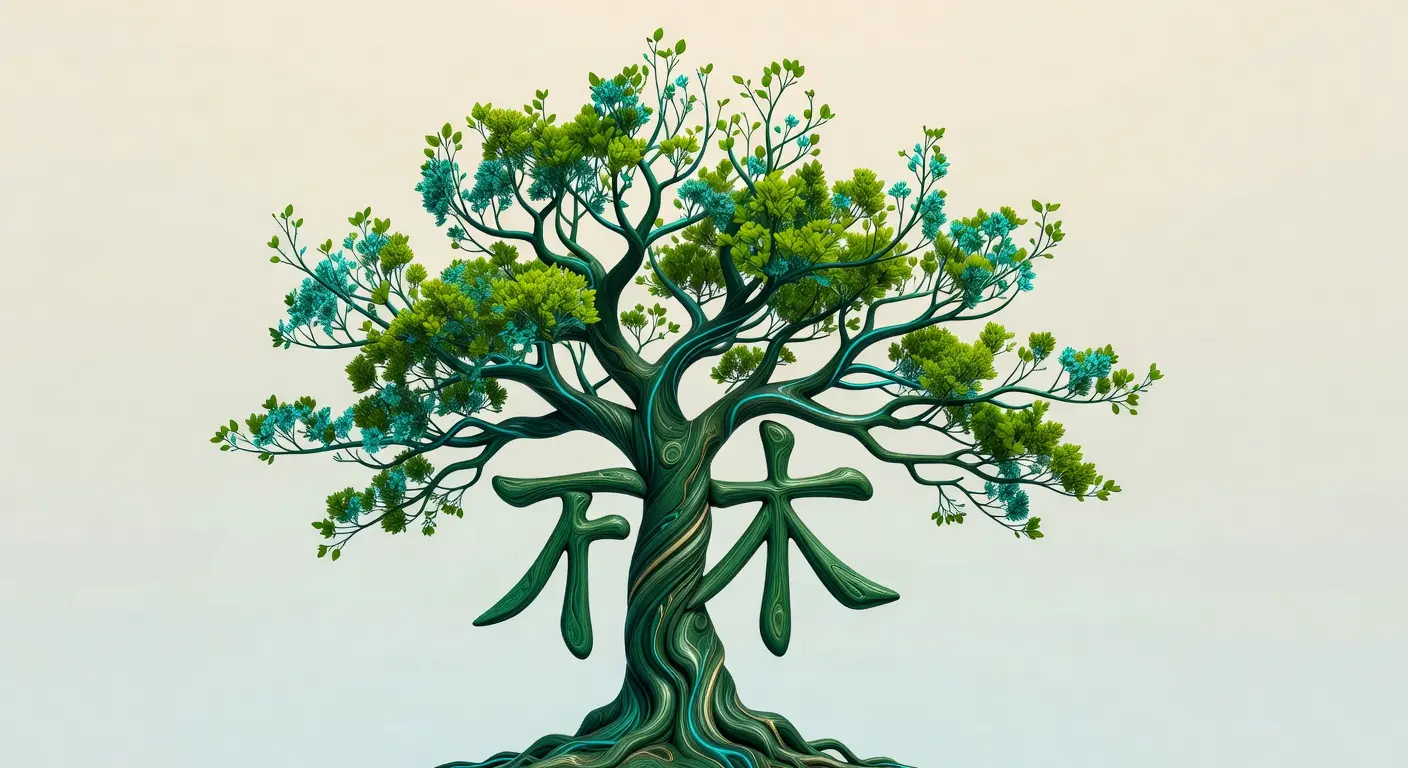
Wood is the vital impulse of spring. Like a young tree growing towards the light, it embodies expansion, suppleness, the capacity to adapt without breaking, and the quiet strength of continuous growth. It is the movement that unblocks, opens and circulates.
In Traditional Chinese Medicine
In the theory of the five elements (五行 Wǔ Xíng), Wood governs birth, growth and expansion. It is the first element of the cycle, the one that initiates movement and transformation. Its fundamental characteristics include:
- Season: spring (chūn 春), when nature awakens, buds, pushes and opens
- Direction: East, where the sun rises and the day begins
- Organs: Liver (肝 Gān, Zang) and Gall Bladder (胆 Dǎn, Fu)
- Colour: green (青 Qīng), colour of youth, growth and vitality
- Flavour: sour (酸 Suān), flavour that astringes, contracts and tonifies Liver Yin
- Emotion: anger (怒 Nù), which raises Qi and Blood, and can cause Liver Qi Stagnation or eruption
- Tissues: tendons (筋 Jīn), which allow movement, suppleness and contraction
- Openings: eyes (目 Mù), which reflect the state of the Liver and Blood
- Fluid: tears (泪 Lèi), which moisten the eyes and flow when Liver Qi is in excess or imbalance
- Sound: shout (呼 Hū), vocal expression associated with Liver Qi
- Sense: sight, which depends on Liver Blood that nourishes the eyes
The Liver (肝 Gān), organ of Wood, has vital functions:
- Ensures the free circulation of Qi (肝主疏泄 Gān Zhǔ Shū Xiè): the Liver circulates Qi throughout the body, in the organs, meridians, tissues and emotions. Liver Qi Stagnation causes tension, pain, digestive disorders, headaches, dizziness, nausea, insomnia and repressed emotions
- Stores Blood (肝藏血 Gān Cáng Xuè): the Liver stores Blood during rest and releases it during activity. Liver Blood deficiency causes vision disorders, dizziness, trembling, cramps, fragile nails, scanty menstruation and insomnia
- Governs the tendons and nails (肝主筋 Gān Zhǔ Jīn): the Liver nourishes the tendons, which allow movement, and the nails, which reflect the state of Liver Blood. Liver imbalance causes stiffness, contractions, trembling, cramps and fragile nails
- Opens into the eyes (肝开窍于目 Gān Kāi Qiào Yú Mù): the Liver nourishes the eyes through Blood. Liver imbalance causes vision disorders (myopia, hypermetropia, astigmatism, cataract, glaucoma), red and dry eyes, lacrimation, prickling and eye pain
- Is associated with anger (肝主怒 Gān Zhǔ Nù): anger raises Liver Qi and Blood, causing headaches, dizziness, redness, nosebleeds, insomnia and outbursts of anger. Repressed anger causes Liver Qi Stagnation
Practical Applications
In Chinese dietary therapy, Wood is supported by foods that circulate Liver Qi, nourish Liver Blood, clear Liver Heat, and calm Shen. Recommended foods include green vegetables (spinach, broccoli, asparagus, peas, artichokes, green salads), green and sour fruits (lemon, lime, kiwi, green apple, green grapes), aromatic herbs (basil, mint, coriander, tarragon, chives, parsley), seeds and nuts (sesame seeds, walnuts, almonds, sunflower seeds), legumes (green beans, peas, broad beans, edamame), eggs, lean fish, poultry, chrysanthemum, mint, basil and liquorice infusions.
Lifestyle directly influences Wood balance: moderate physical activity that circulates Liver Qi (walking, tai chi, qi gong, yoga, stretching, swimming), stress management that releases Qi Stagnation (meditation, deep breathing, relaxation, creative activities, emotional expression), sufficient sleep that allows the Liver to store Blood (7 to 9 hours, ideally 22h-6h), regular and moderate eating that does not overload the Liver and Spleen, and healthy emotional expression that does not repress anger strengthen Wood. Chronic stress, repressed emotions, bottled-up anger, sedentary lifestyle, lack of sleep, stagnating food (excess fats, fried foods, sweets, alcohol) and drugs weaken or block Wood.
Concrete Examples
A patient presenting with Liver Qi Stagnation from chronic stress may experience hypochondriac and intercostal tension, lateral and throbbing headaches, dizziness, nausea, bloating, irregular stools, irritability, a lump in the throat sensation (globus hystericus), a tongue with a white coating on the edges, and a wiry pulse. The TCM dietary protocol will include foods that circulate Liver Qi such as chicken sautéed with basil and lime, garlic-sautéed spinach with sesame seeds, grated carrots in a light salad with parsley and coriander, poached eggs on a bed of spinach, fresh citrus fruits as snacks, mint and chrysanthemum infusions, and a daily practice of tai chi, qi gong or yoga to circulate Qi.
A patient presenting with Liver Blood deficiency with vision disorders and insomnia may experience vision disorders (myopia, hypermetropia, astigmatism, cataract, glaucoma), dry and tired eyes, dizziness, trembling, nocturnal cramps, fragile and ridged nails, scanty or absent menstruation, insomnia with difficulty falling asleep, frequent dreams, a pale poorly coated tongue, and a fine weak pulse. The TCM dietary protocol will include foods that nourish Liver Blood such as chicken liver sautéed with spinach and black sesame seeds, rice porridge with jujubes, dates and goji berries, poached eggs with lotus seeds, black beans stewed with seaweed and ginger, fatty grilled or steamed fish (salmon, mackerel, sardines), seasonal green sautéed vegetables, seasonal fresh fruits, and liquorice, jujube and goji berry infusions.
Frequently Asked Questions
What is the relationship between Wood and the other elements?
In the generation cycle (生 Shēng), Wood engenders Fire (木生火 Mù Shēng Huǒ): wood burns and produces fire. In the control cycle (克 Kè), Wood dominates Earth (木克土 Mù Kè Tǔ): tree roots pierce and absorb the earth. Wood is engendered by Water (水生木 Shuǐ Shēng Mù): water nourishes trees. Wood is dominated by Metal (金克木 Jīn Kè Mù): the metal axe cuts wood. These relationships explain the interactions between organs, emotions, flavours and seasons in TCM.
How to recognise a Wood imbalance?
Classic signs of a Wood imbalance include muscular and articular tension (stiffness, contractions, cramps, trembling), vision disorders (dry, tired, red, watery eyes, vision problems), lateral and throbbing headaches, dizziness, nausea, bloating, irregular stools, irritability, easy anger or repressed anger, a lump in the throat sensation, insomnia with difficulty falling asleep, frequent dreams, fragile and ridged nails, irregular or painful menstruation, a tongue with a white or yellow coating on the edges, and a wiry or fine pulse. Wood imbalance can manifest as Liver Qi Stagnation (tension, irritability, headaches), Liver Heat (anger, red eyes, insomnia), Liver Blood deficiency (vision disorders, dizziness, insomnia), or Liver Wind (trembling, dizziness, convulsions).
Which foods support Wood?
Foods that support Wood are generally green, sour, that circulate Liver Qi and nourish Liver Blood. We cite green vegetables (spinach, broccoli, asparagus, peas, artichokes, green salads), green and sour fruits (lemon, lime, kiwi, green apple, green grapes), aromatic herbs (basil, mint, coriander, tarragon, chives, parsley), seeds and nuts (sesame, walnuts, almonds, sunflower seeds), legumes (green beans, peas, broad beans, edamame), eggs, lean fish, poultry, and chrysanthemum, mint, basil and liquorice infusions. Foods to avoid are those that stagnate and obstruct Liver Qi (excess fats, fried foods, sweets, alcohol), those that engender Liver Heat (alcohol, coffee, chilli, fried foods, grilled foods), and meals taken in stress or anger.
Conclusion
Wood constitutes the fundamental element of spring, expansion and growth in Traditional Chinese Medicine. Understanding its characteristics, associated organs (Liver and Gall Bladder), dysfunctions and dietary and lifestyle approaches to balance it enables a clearer grasp of the therapeutic reasoning and support protocols offered within the Yin Shi universe.
To go further
Yin Shi ecosystem resources directly related to this article.
Wood: Liver, spring and the sour flavour
The free lesson from the free course links the Wood element to the Liver, the Gallbladder and the sour flavour.
Take the lesson →Which element dominates your terrain?
The Five Elements test locates Wood, Fire, Earth, Metal and Water in your profile.
Take the test →