Why is Chinese dietetics complex to convey?
Advising a patient according to the principles of traditional Chinese medicine requires simultaneously analysing the thermal nature (cold, cool, neutral, warm, hot), the flavour (sour, bitter, sweet, pungent, salty) and the organ-meridian tropism of each food. Each energetic prescription requires the synthesis of these three dimensions for each recommended or proscribed food. This intellectual gymnastics, though fundamental, remains time-consuming and a source of omissions during a dense consultation.
This is precisely what Yin Shi 1.0.38 resolves by enabling the creation of personalised food cards, without sacrificing clinical rigour. The practitioner retains therapeutic control; the software eliminates administrative friction.
What are the Yin Shi food cards?
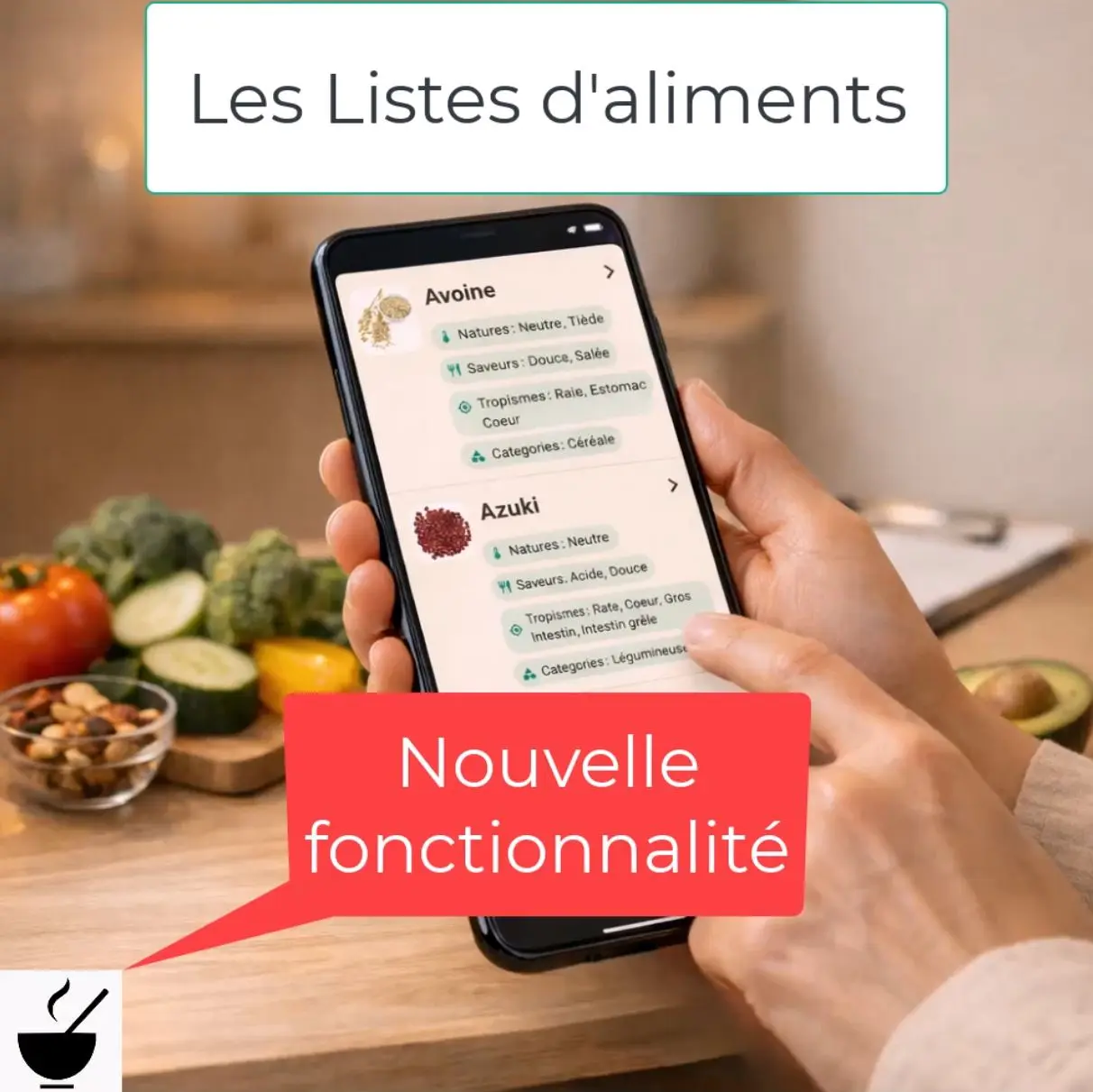
Update 1.0.38 introduces personalised food card management: lists that you create according to each patient’s energetic profile or that you prepare in advance according to common syndromes or pathologies.
The 3 intelligent search filters
The engine is not limited to the names of foods. You filter directly by:
| Criterion | Clinical application | Practical example |
|---|---|---|
| Nature | Treat Heat or Cold syndromes | Warm/Hot nature for Yang Deficiency |
| Tropism | Target the organ in imbalance | Spleen for digestive disorders, Liver for Qi stagnation |
| Flavour | Refine according to energetic needs | Pungent flavour to circulate Qi and Blood |
This cross-filter approach avoids approximations. When a patient presents with Liver Qi stagnation with rising Yang, the practitioner can isolate in a few seconds the foods of Cool or Cold nature, with Liver-Gall Bladder tropism and Sour or Bitter flavour, such as turmeric or certain specific cereals.
Tutorial: create a personalised MTC food card in under 2 minutes
Clinical example: Dampness-Cold Syndrome
Let us take the case of a 58-year-old patient presenting with joint pain aggravated by cold and dampness, with a pale tongue and a white greasy coating, a Slippery (滑 Huá) and Slow (迟 Chí) pulse. The TCM diagnosis retains a Bi Obstruction Syndrome by Dampness-Cold.
Without a tool, the practitioner must manually identify:
- Foods of Hot or Warm nature to dissipate Cold (dried ginger, cinnamon, chicken)
- Foods with Spleen tropism to drain Dampness (mi-vaporised, azuki bean)
- Foods of Pungent flavour to circulate Qi and Blood
- Foods to proscribe: dairy products, raw foods, excess fresh fruit
With Yin Shi, this reasoning is translated into active filters. The generated card instantly presents the suitable cereals, the relevant proteins and the recommended vegetables, accompanied by a list of unfavourable foods with energetic justification.
From fundamentals to clinical prescription
The strength of this functionality lies in the bridge it builds between TCM theory and daily practice. Abstract concepts such as Yin Deficiency, Qi Stagnation, Dampness-Heat become tangible lists that the patient can take away and consult when shopping.
This transposition reinforces therapeutic adherence. A patient suffering from digestive disorders or chronic headaches better understands their dietary prescription when they have a structured card rather than fragmented oral instructions.
Personalisation by pathology
Yin Shi allows the design of “standard” cards by pathology - for example a specific card for osteoarthritis (Dampness-Cold) or Liver Qi stagnation - and to duplicate them to adapt them to each client’s unique constitution. This model-based approach guarantees protocol consistency within a practice whilst preserving the individualisation dear to TCM.
Time saving and protocol reliability
Beyond the speed of execution, standardisation via cards reduces human error. Even an experienced practitioner can, under the time pressure of a consultation, forget a contraindication or invert two close thermal natures. The Yin Shi engine applies the rules exhaustively and reproducibly.
This reliability is particularly precious in training and internships. The teacher can share their standard cards with their students, who then have a validated reference framework for their first prescriptions. The MTC energetic tests complement this approach by refining the preliminary diagnosis.
Professional sending in two clicks
Once the card is established, no printing or manual writing is necessary. The interface allows sending the dietary plan by email directly from Yin Shi. The patient receives a structured list, organised by recommended foods and foods to avoid, with associated precautions for use.
The email format respects professional standards: customisable header with the practitioner’s contact details, structuring by food categories, and space for free comments. The patient can thus transfer the card to their spouse or consult it on their smartphone in the aisle.
Who benefits from this functionality?
This functionality is designed for:
- Practitioners in traditional Chinese medicine who prescribe energetic diets and wish to professionalise their nutritional advice
- Dieticians-nutritionists specialised in integrative nutrition and wishing to integrate the Chinese energetic paradigm into their practice
- Naturopaths and therapists in natural medicine integrating energetic dietetics as a pillar of their holistic approach
- Trainers and teachers in TCM who share standard protocols with their students
Frequently asked questions
How to create a personalised food card in Yin Shi?
Go to the “Food Cards” tab, create a new model or duplicate an existing card. Activate the Nature, Tropism and Flavour filters according to the patient’s diagnosis. The engine automatically generates the sorted list. You can manually adjust each food before the final sending.
What foods are referenced in the Yin Shi database?
The database covers more than 320 common foods in the West: cereals and pseudo-cereals, vegetables, fruits, animal proteins, oils, algae, spices and aromatic plants. Each food card details the thermal nature, flavours, meridians and main clinical indications or contraindications.
Can I export the cards to share them with other practitioners?
Yes, the cards are shareable by email directly from the interface. You can also duplicate a card to adapt it to a new patient without rebuilding the filters from scratch.
Conclusion
The personalised food cards of Yin Shi transform a time-consuming constraint into a clinical and relational asset. By automating the selection and energetic classification of more than 320 foods, the practitioner gains in precision, fluidity and credibility in the patient’s eyes. Chinese dietetics ceases to be a discipline reserved for memorisers to become an everyday tool that is accessible, verifiable and shareable.
To go further
Yin Shi ecosystem resources directly related to this article.
Which constitution will your lists serve?
The CCMQ questionnaire provides the terrain that the app's lists personalise.
Take the test →Create your lists in the app
The Yin Shi app filters foods by TCM pattern and constitution — the feature described in the article.
Open the app →