The question “is dairy good for you?” has a TCM answer that neither the pro-milk nor the anti-milk camp expects: it depends on the terrain. Milk nourishes Yin and fluids, and it engenders Phlegm on a weak Spleen. The same pint that repairs one person’s Dryness clogs another’s Dampness. Fermentation moves the cursor. This guide unfolds the central tension of the dairy family, the most misread in dietetics.
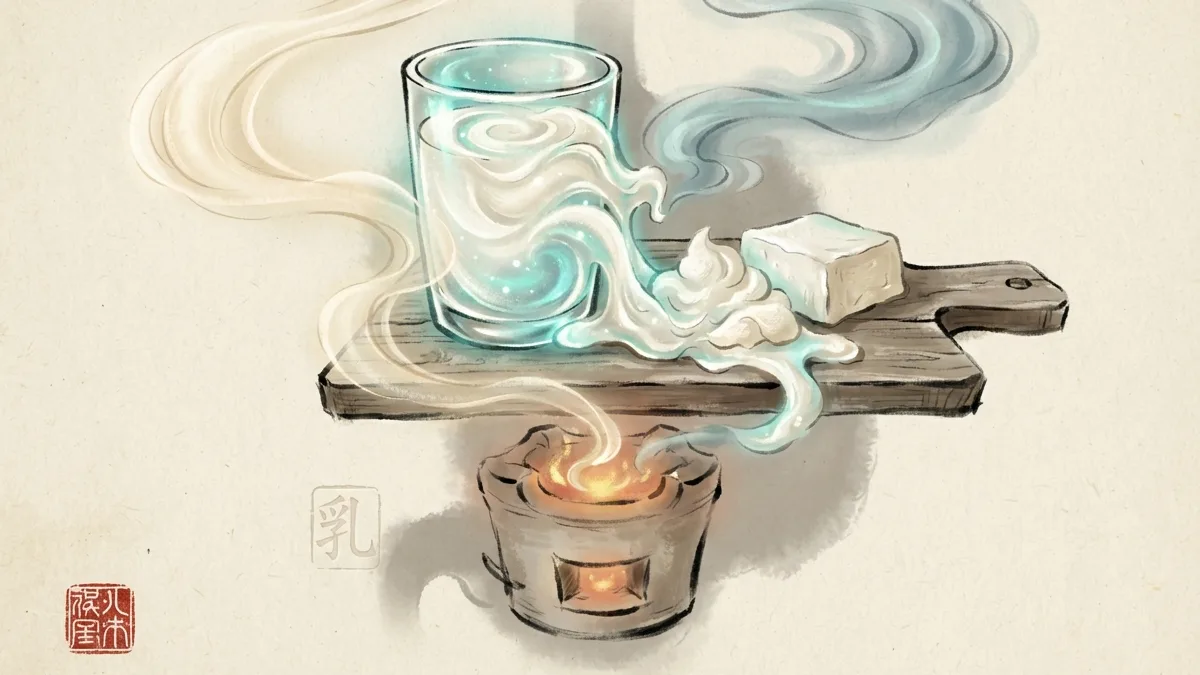
Milk in TCM: a fluid that nourishes Yin
Milk is a Yin food: cool, sweet, moist. It nourishes Yin, engenders fluids, lubricates Dryness, settles empty Heat. For a Yin deficiency terrain (thirst, dry mouth, night sweats, a peeled tongue), warm milk is a gentle remedy: it brings the moisture Yin is lacking.
That is the bright side the dairy critics forget: milk is not a universal problem, it is a Yin with its indications.
The dark side: weak Spleen and Phlegm production
The flip side: milk is moist and cold, and moisture demands a Spleen that transforms. On a weak Spleen (loose stools, bloating, post-meal fatigue, coated tongue), raw milk becomes what the Spleen cannot transform: Tan, Phlegm.
The clinical picture is classical: morning milk produces mucus (runny nose, congested throat), loaded sinuses, loose stools, fatigue. Milk itself is not “bad”: it is the untransformed moisture becoming Phlegm. A Spleen that transforms well tolerates milk; a tired one stores it as Phlegm.
Fermentation as the remedy: less Phlegm, same Yin
Fermentation changes the Yin/Phlegm ratio: yoghurt, ripened cheeses and kefir “break” the density of milk, pre-digest casein and lactose, and add the bacteria that do the Spleen’s work. Yoghurt engenders less Phlegm than raw milk on the same terrain; aged cheese, less still.
That is Chinese dietetics’ answer to the dairy dilemma: Yin without the Phlegm comes through fermentation. Kefir and yoghurt keep the milk’s Yin while opening it; daily raw milk keeps the whole Phlegm.
Different animal milks: cow, ewe, goat, mare
Not all milks share the same nature:
- Cow: cool, the most “moist Yin”, the greatest Phlegm-generator on a weak Spleen.
- Ewe (sheep): warm, more tonifying, less cold, better tolerated by a weak Spleen.
- Goat: neutral-warm, tonifies Qi, often digests better than cow’s.
- Mare: cold, more clearing, the milk of traditional nomads, lighter.
- Plant milks (almond, oat, rice, soya): not “milks” in TCM but drinks with their own natures (cool almond generates fluids, warm oat tonifies, bland rice tonifies the Spleen); they replace the Yin of milk without the cow’s Phlegm on certain terrains.
The choice of milk follows the terrain: a weak Spleen tolerates ewe and goat better; Dryness prefers cow; Dampness often chooses the plant option.
Cheeses: ripening concentrates
Cheese is not a uniform block: ripening changes the nature. Fresh cheese (yoghurt, faisselle, mozzarella) keeps the moist Yin, with less Phlegm than milk. Aged cheese (Comté, Parmesan, mature cheddar) concentrates: denser, fattier, more “Yang”; it tonifies but burdens a weak Spleen more.
The rule: the more aged the cheese, the more concentrated it is, and the smaller the serving. Daily fresh cheese is a manageable Yin; old cheese is a tonifying condiment, not a course.
Lactose, casein and FODMAPs: the modern reading of intolerance
Modern nutrition reads dairy intolerance differently: lactose (milk sugar) requires the lactase many adults lose; casein (protein) digests slowly on certain permeabilities; milk FODMAPs ferment in sensitive bowels.
The two readings converge without merging: lactose intolerance looks like “milk the Spleen cannot transform”; aged cheeses and yoghurt, low in lactose, are better tolerated in both systems. The food intolerance protocol treats casein in particular. Fermentation resolves both: it pre-digests lactose and casein, and lightens the Chinese Phlegm.
Eggs: the Yin and Blood of the Heart
The egg is the other “liquid animal” food: it nourishes Yin, Blood and the Shen of the Heart. The yolk nourishes Blood and Yin (the food of the Shen at rest), the white clears Heat and engenders fluids.
For the insomnia of Blood deficiency, the fatigue of the heart, a soft-boiled yolk is a classic: it nourishes what the spirit inhabits. The modern reading notes the yolk’s choline (memory, neurotransmitters) and tryptophan; the Chinese reading files it under “nourishing Heart Yin”.
The whole cooked egg (not raw, which “breaks” its Yin) is the easiest animal-Yin to transform: it tonifies without the milk’s Dampness on a weak Spleen.
Table: dairy product, nature, terrain
| Product | Nature | Action | Terrain that benefits | Terrain that is burdened |
|---|---|---|---|---|
| Cow's milk | Cool, sweet, moist | Lung, Stomach | Nourishes Yin and fluids | Yin deficiency, Dryness. Burdens: weak Spleen, Phlegm |
| Ewe's milk | Warm | Spleen, Lung | Tonifies, less Phlegm | Average Spleen. Burdens: established Dampness |
| Goat's milk | Neutral-warm | Spleen, Kidney | Tonifies Qi, easier to digest | Moderately weak Spleen, children |
| Yoghurt / kefir | Cool-warm | Spleen, Stomach | Fermented Yin, less Phlegm | Dryness + average Spleen. Burdens: severe Phlegm |
| Fresh cheese | Neutral | Spleen | Moderate Yin, gentle | All moderate terrains |
| Aged cheese | Warm, concentrated | Spleen, Kidney | Tonifies, dense | Dry Yin deficiency. Burdens: Dampness, Phlegm |
| Butter | Neutral-warm | Spleen | Lubricates, gentle fat | Dryness. Burdens: Dampness |
| Egg (yolk) | Neutral-warm | Heart, Kidney | Nourishes Blood and Heart Yin | Blood deficiency, restless Shen |
| Egg (white) | Cool | Lung | Clears Heat, engenders fluids | Heat, Dryness |
| Almond milk | Cool | Lung | Engenders fluids, light | Dryness, alternative to cow's milk |
Nature, action, and the terrain that benefits or is burdened
Frequently asked questions about milk in TCM
Does dairy really produce mucus?
On a weak Spleen, yes: fresh raw milk becomes the Phlegm the Spleen cannot transform (runny nose, congested throat, sinuses). On a Spleen that transforms well, the same milk nourishes Yin. Mucus is not a property of milk: it is the sign that the terrain cannot transform it. Fermentation reduces Phlegm on the same terrain.
Is yoghurt better than milk?
For an average or weak Spleen, yes: fermentation pre-digests casein and lactose, adds the bacteria that do the Spleen’s work, and keeps the Yin with less Phlegm. Daily raw milk is the most “Phlegm” product of the family; yoghurt is its compromise.
Do plant milks replace cow’s milk?
Partly: plant drinks (almond, oat, rice, soya) have their own natures, often lighter than cow’s milk on a weak Spleen. They replace the milk’s Yin without its Phlegm, but they do not nourish Yin as densely. On frank Dryness or Yin deficiency, cow’s milk or yoghurt remains more nourishing than almond drink.
Do eggs nourish the Shen?
The yolk nourishes the Blood and Yin of the Heart, the seat of the Shen: it is the food of the spirit that cannot rest (insomnia, palpitations, agitation). The white clears Heat. The whole cooked egg is the easiest animal-Yin to transform for a tired Spleen.
The Yin that asks for a Spleen
Milk is neither good nor bad: it is the moist Yin that benefits Dryness and burdens the weak Spleen. Fermentation moves the cursor (yoghurt keeps the Yin, removes the Phlegm), the animal changes the nature (cool cow, warm ewe), ripening concentrates. The egg is the other animal-Yin, that of the Heart. The question is not “dairy or not” but “which product, on which terrain, in which form”.
In the Yin Shi app, each dairy card shows its nature and Phlegm potential: cow’s milk answers Yin deficiency, yoghurt answers the average Spleen, and the card always flags the terrain that will be burdened.
Further reading: Yin deficiency, Phlegm and Tan, Spleen deficiency, food intolerances, and the Shen.
To go further
Yin Shi ecosystem resources directly related to this article.
Does your terrain tolerate dairy?
The CCMQ questionnaire spots the Phlegm-Dampness constitution that milk can congest.
Take the test →Milk, between Yin and Phlegm
The lesson cross-references Ayurvedic milk with the TCM reading of Yin that can become Phlegm.
Take the lesson →