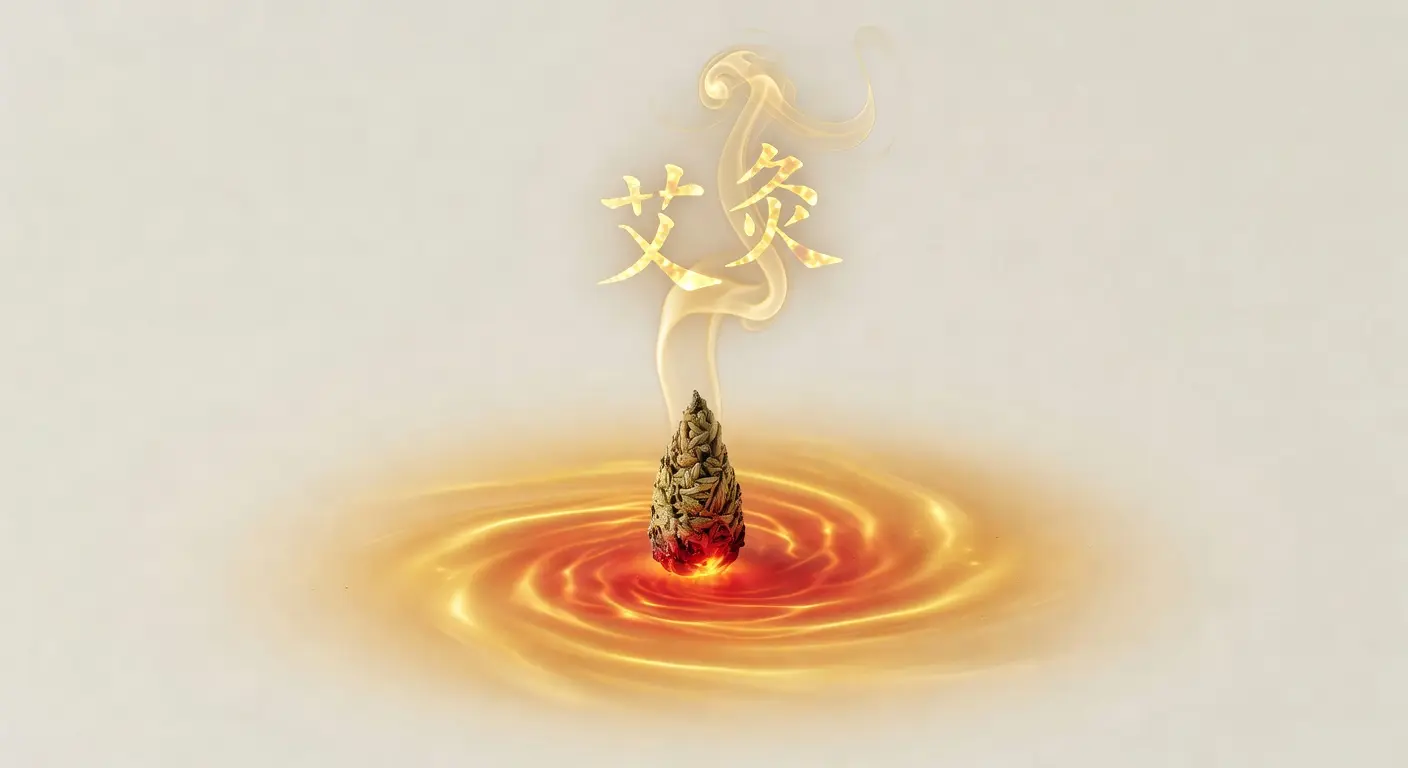
Moxibustion (艾灸 Ài Jiǔ) in Traditional Chinese Medicine is a heat therapy that consists of burning mugwort (艾 Ài, Artemisia argyi) on or near acupuncture points or body zones to tonify Yang, warm Qi, disperse Cold, activate Qi and Blood circulation, and strengthen immunity.
Moxibustion
艾灸
- Tonifies Yang and warms Qi
- Disperses internal and external Cold
- Activates Qi and Blood circulation
- Strengthens immunity and Wei Qi
- Relieves pain through heat
- Nourishes Shen and calms the mind
Moxibustion is like an interior campfire. It brings heat where Cold has settled, reactivates circulation where Qi has stagnated, and tonifies Yang where vital heat has been exhausted. Its mugwort fragrance penetrates meridians and warms organs deeply.
In Traditional Chinese Medicine
In TCM theory, moxibustion is one of the five principal therapies (五术 Wǔ Shù) alongside acupuncture (针 Zhēn), pharmacopoeia (药 Yào), massage (推拿 Tuī Ná) and energetic exercises (气功 Qì Gōng, 导引 Dǎo Yǐn). It is particularly indicated for Cold syndromes, Yang deficiency, Qi and Blood stagnation, and for strengthening immunity.
Moxibustion is practised in different ways:
- Direct moxibustion (直接灸 Zhí Jiē Jiǔ): a mugwort cone is placed directly on the skin and burned. The skin can be protected by a thin layer of garlic, ginger or salt to avoid burns (non-scarring moxibustion) or left bare (scarring moxibustion, which leaves a small scar)
- Indirect moxibustion (间接灸 Jiàn Jiē Jiǔ): a mugwort cone is placed on a medium (garlic, ginger, salt, atractylodes) placed on the skin, which protects the skin while transmitting heat and the medium’s properties
- Moxa stick moxibustion (艾条灸 Ài Tiáo Jiǔ): a mugwort stick or cigar is lit and passed near the skin or acupuncture points, without direct contact
- Moxa box moxibustion (灸盒 Jiǔ Hé): a wooden or bamboo box containing burning mugwort is placed on a body zone (abdomen, back, lumbar region) to heat an extended zone
- Moxibustion on needle (温针灸 Wēn Zhēn Jiǔ): a mugwort cone is placed on the handle of an acupuncture needle inserted in a point, transmitting heat directly into the meridian
Moxibustion is indicated for:
- Cold syndromes: joint pain aggravated by cold, cold intolerance, cold limbs, slow digestion, diarrhoea with clear stools
- Yang deficiency syndromes: deep fatigue, persistent cold intolerance, lower back pain, nocturia, diminished libido, pale complexion, pale swollen tongue
- Qi and Blood stagnation syndromes: fixed pain, masses, ecchymosis, purplish tongue, wiry pulse
- Digestive disorders by Cold: nausea, vomiting, bloating, loose and clear stools, lack of appetite, preference for hot foods
- Gynaecological disorders by Cold: dysmenorrhoea with pain improved by heat, scanty and delayed periods, infertility by Cold of the uterus
- Respiratory disorders by Cold: cough with white and abundant expectorations, shortness of breath, repeated colds, asthma by Cold
- Immunity strengthening: stimulation of tonification points of Qi and Yang, prevention of colds and flu
Practical Applications
Moxibustion is complemented by Chinese dietary therapy that strengthens Yang, warms Qi and avoids Cold. Recommended foods include ginger, garlic, leeks, cinnamon, clove, fennel, basil, turmeric, chilli, lamb, beef, chicken, rice, sweet potatoes, carrots, sesame seeds, walnuts and ginger-cinnamon infusions.
Lifestyle is crucial to maximise moxibustion effects: protection against cold and dampness (especially after a moxibustion session where pores are open), warm and dry housing, moderate physical activity that circulates Qi and warms Yang (walking, tai chi, qi gong), stress management that releases Qi stagnation, hot and warming diet, and protection of lumbar region and lower abdomen against cold. Exposure to cold and dampness after a moxibustion session, cold and humid housing, sedentary lifestyle, chronic stress and a cold and humid diet cancel moxibustion effects.
Concrete Examples
A patient presenting with Yang deficiency with deep fatigue, cold intolerance and lower back pain may experience persistent fatigue even after rest, cold sensation in the body, cold hands and feet, lower back pain improved by heat, nocturia, pale complexion, pale swollen tongue with white moist coating, and deep weak pulse. After moxibustion sessions on points that tonify Kidney Yang (Mingmen GV4, Shenshu BL23, Guanyuan CV4), the dietary protocol will include warming foods that tonify Yang such as lamb stewed with leeks, ginger and cinnamon, rice porridge with dates and walnuts, roasted sweet potatoes, hot ginger-cinnamon-clove infusions, and daily protection of the lumbar region and lower abdomen against cold.
A patient presenting with Cold digestive disorders with nausea, bloating and loose stools may experience nausea, vomiting, bloating after meals, loose and clear stools with cold sensation, lack of appetite, preference for hot foods, cold hands and feet, heavy fatigue, pale swollen tongue with teeth marks and white moist coating, and deep soft pulse. After moxibustion sessions on points that warm the Middle Burner (Zhongwan CV12, Zusanli ST36, Shenque CV8), the dietary protocol will include warming foods that disperse Middle Burner Cold such as rice porridge with ginger and dates, chicken stewed with carrots, leeks and ginger, roasted sweet potatoes, hot ginger and cinnamon infusions, and elimination of cold, raw, dairy and sweet foods.
Frequently Asked Questions
What is the difference between moxibustion and acupuncture?
Acupuncture (针 Zhēn) uses fine needles inserted into acupuncture points to regulate Qi and Blood circulation, disperse stagnation, clear Heat and relieve pain. It is particularly indicated for syndromes of Excess, Heat, Stagnation and pain. Moxibustion (灸 Jiǔ) uses burning mugwort on or near points to tonify Yang, warm Qi, disperse Cold and strengthen immunity. It is particularly indicated for syndromes of Deficiency, Cold, Yang deficiency and chronic fatigue. Acupuncture is more regulatory and dispersing; moxibustion is more tonifying and warming. The two therapies are often combined for a synergistic effect.
Is moxibustion dangerous?
Moxibustion is generally safe when practised correctly by a trained practitioner. However, there are risks of burns if the mugwort cone is placed too close to the skin or left too long. Direct moxibustion can leave scars (scarring moxibustion) or cause blisters (non-scarring moxibustion). Indirect moxibustion and moxa stick moxibustion are safer as the skin is protected. It is important to consult a trained practitioner for the first sessions to learn the correct technique and contra-indications. Moxibustion is contra-indicated on inflamed zones, active skin infections, areas with impaired sensation, and in certain pregnancy conditions.
How often can moxibustion be practised?
Moxibustion can be practised once a week for prevention and maintenance, or more frequently (2-3 times a week) for acute Cold conditions or Yang deficiency. It is important to let the skin rest between sessions and to wait for any redness to disappear before treating the same zone again. For chronic Yang deficiency, regular sessions over several weeks or months may be necessary. It is recommended to consult a trained practitioner to establish an appropriate treatment plan.
Conclusion
Moxibustion constitutes a fundamental heat therapy in Traditional Chinese Medicine that tonifies Yang, warms Qi, disperses Cold, activates Qi and Blood circulation, relieves pain and strengthens immunity. Understanding its principles, indications, techniques and complementary dietary and lifestyle approaches enables a clearer grasp of the therapeutic reasoning and support protocols offered within the Yin Shi universe.
To go further
Yin Shi ecosystem resources directly related to this article.
The Gate of Life fire that moxibustion supports
The free lesson from the free course explains the Kidney Yang that moxa heat seeks to rekindle.
Take the lesson →Warming up through the plate too
The hot-foods entry extends the logic of moxibustion into daily life.
Read the article →