Cupping therapy (拔罐 Bá Guàn) in Traditional Chinese Medicine is a suction therapy that consists of applying cups (made of glass, bamboo, silicone or plastic) to the skin to create suction that circulates Qi and Blood, clarifies Heat, disperses Stagnations, relieves pain and strengthens immunity.
Cupping Therapy
拔罐
- Circulate Qi and Blood through suction
- Clarify Heat and disperse external perverses
- Relieve muscular and joint pain
- Dissipate Qi and Blood Stagnations
- Strengthen immunity and Wei Qi
- Relax muscles and fascias
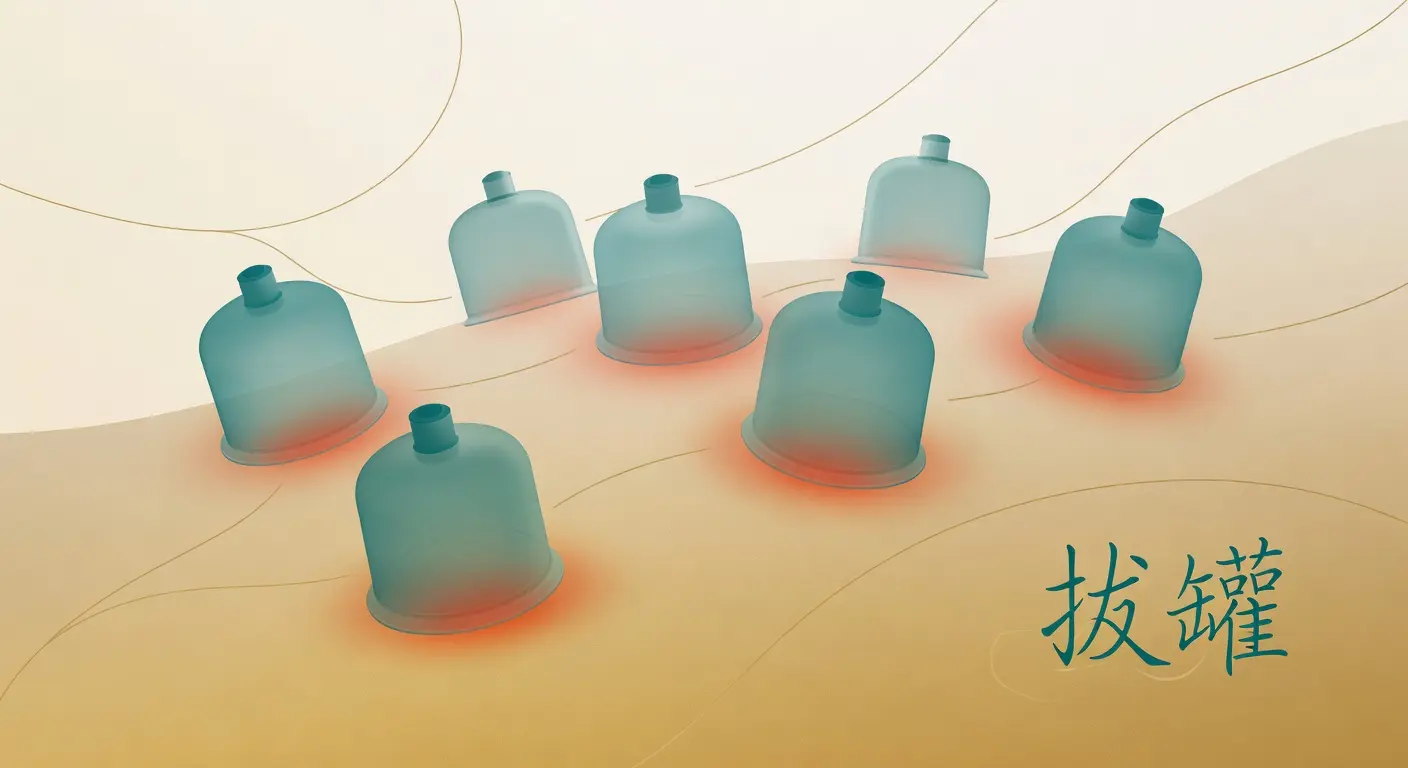
Cupping cups are like pumps that suck stagnation at the body surface. By creating a depression under the cup, they pull Qi, Blood and perverses towards the surface, circulate and dissipate them, leaving the skin relaxed, warm and revitalised.
In Traditional Chinese Medicine
In TCM theory, cupping works by creating a depression (suction) on the skin that aspirates Qi, Blood and pathogenic factors (Cold, Wind, Dampness, Heat) towards the body surface, circulating and dissipating them. The suction increases local Qi and Blood circulation, relaxes muscles and fascias, and stimulates underlying acupuncture points and meridians.
Cupping is practised in different ways:
- Fixed cups (定罐 Dìng Guàn): cups are applied on specific points or zones and left in place for 5 to 15 minutes. Used to treat local troubles, clarify Heat, disperse Cold and Dampness, and relieve pain
- Mobile cups (走罐 Zǒu Guàn): cups are moved on skin lubricated with oil, generally along meridians or muscular zones. Used to circulate Qi and Blood over large areas (back, thighs, arms)
- Flash cupping (闪罐 Shǎn Guàn): cups are applied and quickly removed several times on the same point. Used to stimulate a point without marking the skin
- Combined cupping (刺络拔罐 Cì Luò Bá Guàn): a needle is inserted into the point to lightly bleed it, then a cup is applied to aspirate stagnant blood. Used to disperse intense Blood Stasis
- Wet cups (水罐 Shuǐ Guàn): herbs or medicines are added inside the cup before application. Used to enhance therapeutic effect (warming herbs for Cold, cooling herbs for Heat)
Cupping is indicated for:
- Muscular and joint pain: contractures, tensions, lower back pain, neck pain, stiff shoulders, sciatica, osteoarthritis
- Cold and Dampness syndromes: rheumatism, arthritis, pain aggravated by cold and humidity
- Wind syndromes: colds, flu, coughs, bronchitis, headaches by Wind
- Heat syndromes: infections, fevers, inflammation, hot eczema (with caution)
- Qi and Blood Stagnations: masses, nodules, bruises, fixed pains
- Digestive troubles: bloating, nausea, constipation (cupping on back and abdomen)
- Immunity strengthening: stimulation of dorsal Shu points, prevention of colds and flu
Cupping is contraindicated on fragile skin areas, varicose veins, active haemorrhages, tumours, pregnancy (certain zones), very young children, and people with coagulation disorders.
Practical Applications
Chinese dietary therapy complements cupping by providing nutrients that support Qi and Blood circulation, clarify external perverses, and strengthen immunity. Recommended foods according to indication include ginger, garlic, leeks, turmeric, basil, mint, fennel, citrus fruits, celery, carrots, spinach, sesame seeds, walnuts, azuki beans, and ginger-lemongrass infusions.
Lifestyle is crucial to maximise cupping effects: protection against cold and wind after a session (pores are open and the body is vulnerable), warm and dry housing, sufficient hydration (suction can locally dry out), moderate physical activity that maintains circulation (but no intense sport immediately after), sufficient sleep that allows regeneration, and stress management that releases muscular tension. Exposure to cold and wind after a cupping session, iced drinks, direct air conditioning, intense sport immediately after, and chronic stress that contracts muscles weaken or cancel cupping effects.
Concrete Examples
A patient presenting with lower back pain by Cold and Dampness may experience deep, shooting lumbar pain, improved by heat and aggravated by cold and humidity, morning lumbar stiffness, cold intolerance of the lumbar region, fatigue, pale tongue with white humid coating, and deep slow pulse. Cupping will be applied on dorsal Shu points of the Kidneys (BL23 Shenshu), local lumbar points (BL25 Dachangshu, BL26 Guanyuanshu), and Bladder meridian points along the back. The complementary dietary protocol will include lamb stewed with ginger and cinnamon, rice porridge with leeks and ginger, roasted carrots and sweet potatoes, hot ginger-cinnamon infusions, and daily protection of the lumbar region against cold and humidity.
A patient presenting with a cold by Wind and Cold with cough, clear nasal discharge and cold intolerance may experience cold intolerance, shivers, cough with clear and abundant expectorations, clear nasal discharge, nasal congestion, fatigue, pale tongue with thin white coating, and superficial tight pulse. Cupping will be applied on dorsal Shu points of the Lung (BL13 Feishu), Governor Vessel points (GV14 Dazhui, GV12 Shenzhu), and local upper back points. The complementary dietary protocol will include rice porridge with ginger and leeks, chicken stewed with ginger and leeks, hot ginger-lemongrass-cinnamon infusions, and daily protection of the neck and nape against wind and cold.
Frequently Asked Questions
What is the difference between cupping and massage?
Cupping and massage are two complementary manual therapies in TCM. Massage (推拿 Tuī Ná, 按摩 Àn Mó) uses pressures, frictions, kneading and stretches to stimulate acupuncture points, meridians, muscles and fascias. Cupping uses suction to aspirate Qi, Blood and perverses towards the surface, circulating and dissipating them. Massage is more active and direct; cupping is more passive and deep. Massage is particularly indicated for superficial muscular tensions, circulation troubles, localised pains; cupping is particularly indicated for deep pains, Cold and Dampness syndromes, intense Qi and Blood Stagnations, and troubles by external perverses. Both therapies can be combined for synergistic action.
Are cupping marks dangerous?
The circular marks left by cupping (generally red, purple or black) are not bruises in the Western medical sense. They are signs of Qi and Blood circulation under the cup: the darker the mark, the deeper the Qi and Blood Stagnation was. Marks generally dissipate in 3 to 7 days. They are not painful unlike traumatic bruises. However, cupping must not be applied on zones with varicose veins, active haemorrhages, tumours, or on people with coagulation disorders. Cupping must be applied by a qualified practitioner who knows contraindications and zones to avoid.
How does dietary therapy complement cupping?
Chinese dietary therapy complements cupping by providing nutrients that support Qi and Blood circulation, clarify external perverses, and strengthen immunity. Foods that circulate Qi and Blood (ginger, turmeric, basil, citrus, celery, carrots, spinach) support cupping action by maintaining circulation. Foods that clarify Heat (cucumbers, courgettes, pears, apples, tofu, chrysanthemum infusions) support cupping action for Heat syndromes. Warming foods (ginger, garlic, leeks, cinnamon) support cupping action for Cold syndromes. Cold and raw foods (salads, raw vegetables, sushi, iced drinks), dairy products and sweets weaken or cancel cupping effects by engendering Cold and Dampness or obstructing circulation.
Conclusion
Cupping therapy constitutes the fundamental suction therapy in Traditional Chinese Medicine, particularly indicated for Cold and Dampness syndromes, Qi and Blood Stagnations, muscular and joint pain, and immunity strengthening. Understanding its principles, indications, contraindications and complementary dietary approaches enables a clearer grasp of the therapeutic reasoning and support protocols offered within the Yin Shi universe.
- Acupuncture Points
- Meridien
- Moxibustion
- Gua Sha
- Heat
To go further
Yin Shi ecosystem resources directly related to this article.
The stases cupping mobilises
The entry explains the Blood stagnation the technique seeks to set in motion again.
Read the article →Understanding the meridians before cupping
The lesson lays down the meridian network on which cupping acts.
Take the lesson →