Sweetness is the flavour of the Spleen in TCM: it nourishes the centre, it harmonises, it relaxes. But sweetness has degrees: yi tang (maltose) is the sugar of the Spleen that builds, honey nourishes Yin, and refined white sugar is the sweetness that clogs. This guide reads sugars by terrain: the one that tonifies, the one that engenders fluids, the one that adds Dampness to a tiring Spleen.
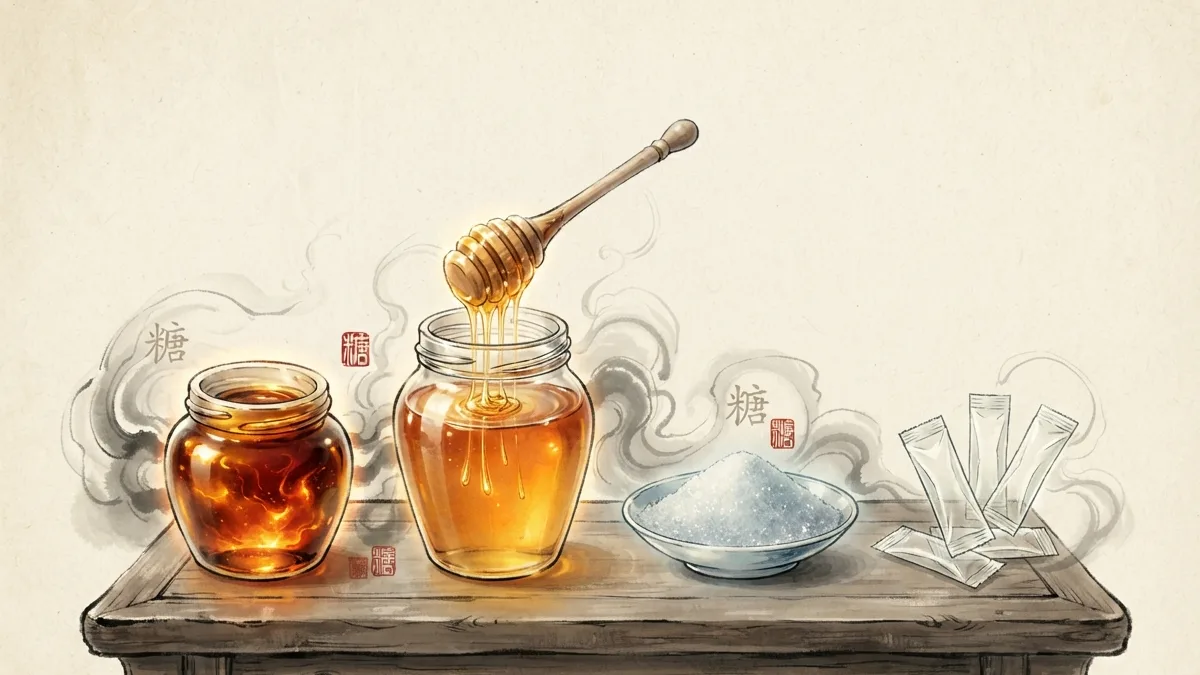
Sweetness in TCM: the flavour of the Spleen
The sweet flavour is the flavour of the Spleen: it “goes” to the centre, it tonifies Qi, it harmonises the other flavours, it relaxes the Liver (sweetness “softens” tension). It is the most “earth” flavour: it builds the middle.
But sweetness has a double face: in excess or on the wrong terrain, it engenders Dampness and Phlegm. The Spleen that receives too much sweetness clogs: the flavour meant to nourish it becomes what suffocates it. The sugar reading is not moral: it is the reading of dose and terrain.
Yi tang: the maltose that tonifies the Spleen
Yi tang (饴糖), rice or barley maltose, is the sugar of the Chinese pharmacy: warm and sweet, it tonifies the Qi of the Spleen, gently brings down Liver Qi (the tightening anger), and “builds” the centre. It is the sugar of the classical formulae (Xiao Jian Zhong Tang, the decoction of the weak centre): the sugar that repairs rather than the one that clogs.
Its cousins: rice syrup, barley malt syrup, molasses are the maltose family: warm, sweet, tonifying the Spleen in small doses. That is the “constructive” sweetness: for the tired Spleen, the rumbling belly, the afternoon slump, a touch of yi tang in soup or congee tonifies where white sugar would burden.
Honey: nourishing Yin and lubricating
Honey (feng mi) is the sugar of Yin: neutral-warm, it nourishes Yin and fluids, lubricates the intestines (Dryness constipation), soothes dry throat and dry cough, and “conducts” herbs (cooked honey binds remedies). It is the most “fluid” sugar: it engenders fluids rather than clogging.
Its uses: warm honey in morning water lubricates the Large Intestine; raw honey in herbal tea soothes the throat; honey with ginger for dry cough. Its limit: it is sweet, so it adds sweetness to a Spleen that is clogging. Honey nourishes Yin, but it is sugar: dose is the reading.
White and refined sugar: the sweetness that engenders Phlegm
Refined white sugar is denatured sweetness: stripped of its minerals and substance, it is “empty”; it gives sweetness without construction. In the TCM reading, it engenders Phlegm and Dampness without tonifying: it is the taste without the function. Chinese dietetics reads it as “clogging the Spleen and emptying the Blood” (sugar raises then drops the Qi).
The modern reading adds sucrose: glucose plus fructose, the fructose going straight to the liver. The soft drink, the cake, the sweet are the sweetness that inflames then exhausts. See diabetes and Xiao Ke for the reading of overflowing sweetness.
Modern sweeteners: stevia, erythritol, aspartame, sweetness without the Qi
Modern sweeteners give sweetness without the sugar: the TCM reading reads them as “flavour without substance”; they do not tonify the Spleen (no Qi), but they deceive a body expecting constructive sweetness.
- Stevia: sweet, cool, “empty”: the sweetness that does not nourish.
- Erythritol: sweet, cool, laxative at dose: the sweetness that passes through.
- Aspartame, sucralose: artificial sweetness: neither Yin nor Qi, and the modern reading questions their signal to a brain expecting sugar.
The honest reading: sweeteners are not the “good alternative”; they are the deceiving sweetness. For the clogging Spleen, reducing total sweetness (sugar plus sweeteners) is the healthier reading than substitution.
Table: sugar, nature, action
| Sugar | Nature | Action | Suited terrain | Caution |
|---|---|---|---|---|
| Yi tang (maltose) | Warm | Spleen, Stomach | Tonifies Spleen Qi, harmonises | Spleen deficiency. Dose: small |
| Rice/barley syrup | Warm | Spleen | Tonifies Spleen, sweet | Spleen deficiency, small dose |
| Honey | Neutral-warm | Lung, Large Intestine, Yin | Nourishes Yin, lubricates, soothes | Dryness, dry cough. Dose: measured |
| Molasses | Warm | Spleen, Blood | Tonifies Blood, minerals | Blood deficiency, small dose |
| Palm/coconut sugar | Neutral-warm | Spleen | Sweetness with minerals | Same caution as sugars |
| Refined white sugar | Neutral (empty) | Spleen | Engenders Phlegm, empties Blood | Burdens: Spleen, Dampness, diabetes |
| Fructose/corn syrup | Neutral (empty) | Liver | Engenders Phlegm, overloads Liver | Soft drinks, gout, fatty liver |
| Stevia | Cool (empty) | none | Sweetness without substance | Does not tonify |
| Erythritol | Cool | Large Intestine | Laxative sweetness | Loose stools at dose |
Nature, action, and the terrain that receives or is burdened
Frequently asked questions about sugars in TCM
Is honey better than white sugar?
Yes: honey nourishes Yin, lubricates and soothes (it has a function beyond taste), where white sugar is “empty” (sweetness without construction). Raw honey in herbal tea is the “functional” sugar; white sugar in cake is the sweetness that clogs. But honey remains sugar: the clogging Spleen measures it.
Can yi tang still be found?
Yes: rice or barley maltose (yi tang) is sold in Asian stores, and its cousins (rice syrup, molasses) in wholefood shops. A touch in soup or congee is the classical prescription of the weak Spleen. It is the “constructive” sugar where white is “empty”.
Do sweeteners help the Spleen?
No: they give sweetness without the Qi. The clogging Spleen does not need artificial sweetness: it needs less total sweetness. Stevia does not tonify, erythritol laxatively burdens the stools, aspartame deceives a brain expecting substance. Reducing overall sweetness is the healthier reading than substitution.
Does sugar “bring down” Qi?
The classical reading says it “gently brings down Liver Qi” (sweetness relaxes tension), but only constructive sweetness (yi tang, honey) in small doses. White sugar in large doses raises then drops the Qi: the soft-drink high then the crash is the reading of Qi emptying after the rise.
The sweetness that chooses its terrain
Sweetness is the flavour of the Spleen: it nourishes or it clogs according to the sugar and the dose. Yi tang and maltose that tonify the centre, honey that nourishes Yin and lubricates, white sugar that engenders Phlegm, sweeteners that deceive: the family has its degrees. The reading is not “sugar or no sugar”: it is which sugar, which dose, which terrain.
In the Yin Shi app, the sugar card shows its nature: yi tang answers Spleen deficiency, honey answers Dryness, and the card always flags the Spleen clogging under total sweetness.
Further reading: Spleen deficiency, Yin deficiency, Dampness, diabetes and Xiao Ke, and sugar cravings.
To go further
Yin Shi ecosystem resources directly related to this article.
Is your terrain asking for the sweet flavour?
The CCMQ questionnaire locates the constitution behind the sugar craving.
Take the test →See the honey in the app
The full honey sheet — the traditional sweetener mentioned in the guide.
Full sheets available after the 30-day free trial or with a subscription.
The sweetness that congests
The lesson links desserts and sweeteners to the Phlegm and Dampness they can generate.
Take the lesson →