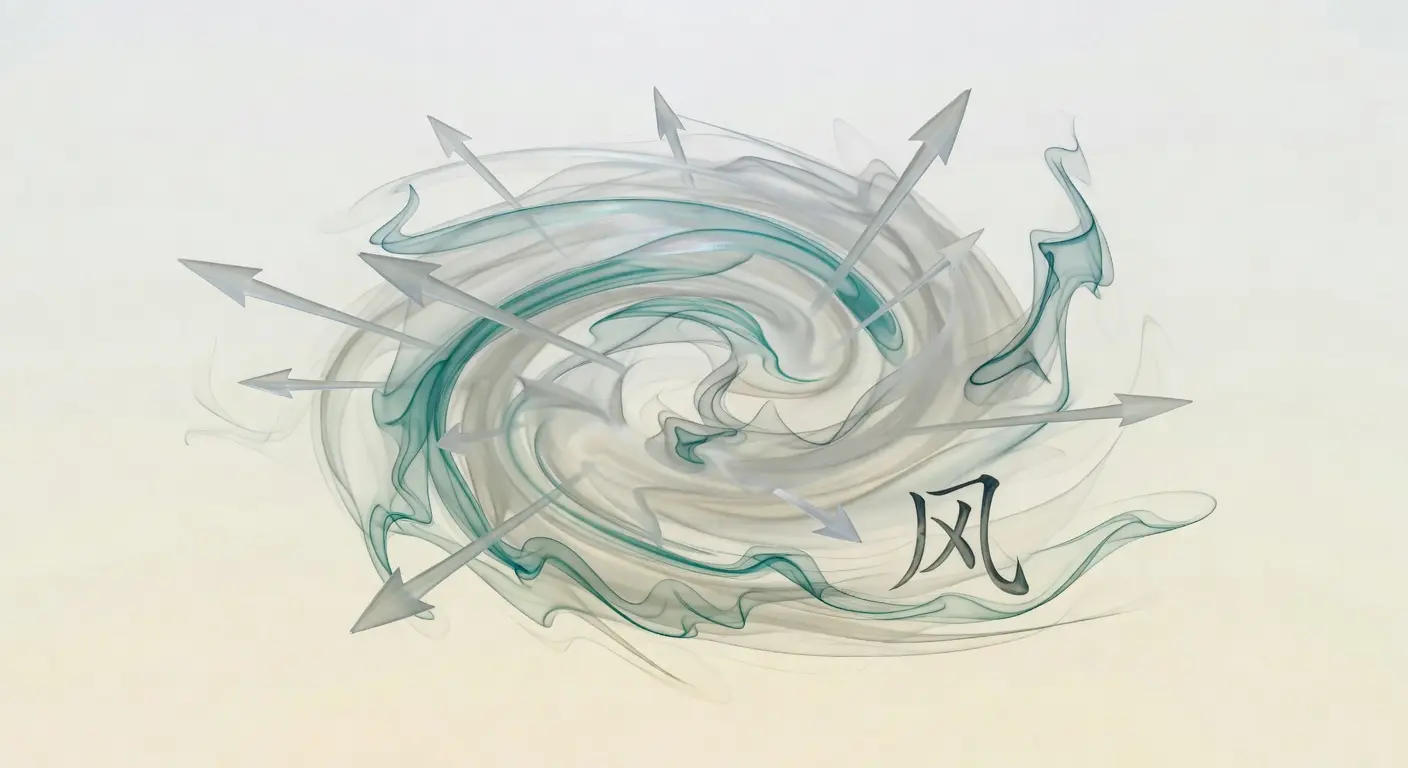
Wind (风 Fēng) is the leader of pathogenic factors in Traditional Chinese Medicine, internal or external, mobile and changing, which causes headaches, itching, trembling, migratory pains and symptoms that move rapidly from one place to another in the body.
Wind
风
- Leader of the six pernicious influences, mobile and changing
- Causes headaches, trembling and migratory pains
- Can carry Cold, Heat, Dampness or Dryness
- Affects Liver, skin, joints and upper body
- Requires foods that disperse Wind and anchor Liver
Wind is the most active and most changing pathogenic factor. Like wind in nature, it blows in gusts, changes direction, carries other elements (cold, heat, moisture) and causes sudden and unpredictable disorders.
In Traditional Chinese Medicine
In TCM theory, Wind is the leader of the six pernicious influences (六淫 liù yín: Wind, Cold, Heat, Dampness, Dryness, Fire). It is mobile, changing, sudden and tends to affect the upper body (head, neck, eyes) and surface (skin, muscles, joints). External Wind penetrates through skin, nape, back and top of the head (Bai Hui 百会).
External Wind manifests in acute syndromes: cold with sneezing, occipital headaches, cough, skin itching, urticaria, sprains, migratory joint pains. It often carries other factors:
- Wind-Cold: occipital headaches, cold intolerance, absence of sweating, dry cough, joint pains
- Wind-Heat: frontal headaches, red eyes, irritated throat, moderate fever, red urticaria
- Wind-Dampness: heavy headaches, foggy head sensation, heavy and diffuse joint pains, wet eczema
- Wind-Dryness: light headaches, dry eyes, dry skin, dry cough, dry throat
Internal Wind (内风 Nèi Fēng) results mainly from Liver disorder (Liver governs Wind and tendons). It manifests through trembling, dizziness, convulsions, migraines, vertigo, tics, spasms and sometimes strokes (CVA). Main causes are Liver Blood deficiency, Liver Yin deficiency with Yang rising, Liver Heat, or Liver Qi Stagnation transforming into Fire.
Practical Applications
In Chinese dietary therapy, external Wind is treated by foods that disperse it, make it exit through the surface (light diaphoresis) and protect the surface. Foods that disperse Wind include fresh ginger, green onion (spring onion), leek, lemon, grapefruit, mint, basil, chrysanthemum, sesame seeds, seaweed and hot ginger-lemon infusions.
Internal Wind is treated by foods that nourish Liver Blood, anchor Liver Yang and calm Wind. Foods that calm internal Wind include spinach, beets, chicken liver, black sesame seeds, goji berries, jujubes, longan, eggs, mushrooms, seaweed and chrysanthemum infusions.
Cooking method directly influences Wind management: light steam cooking, foods consumed hot, hot diaphoretic infusions disperse external Wind. Cold, raw, refrigerated foods and iced drinks close pores and retain Wind inside.
Concrete Examples
A patient presenting with external Wind-Cold (acute cold) may experience cold intolerance with shivering, absence of sweating, occipital and frontal headaches, dry cough, blocked nose with clear mucus, chest constriction sensation, pale tongue with thin white coating, and tight superficial pulse. The dietary protocol will include diaphoretic foods that disperse Wind-Cold such as rice porridge with fresh ginger and leeks, hot chicken broth with green onion and ginger, very hot ginger-lemon infusions with a little honey, and a warm blanket to provoke light sweating.
A patient presenting with internal Wind with Liver Blood deficiency may experience dizziness and vertigo, fine hand trembling, pulsating migraines, dry eyes with sand sensation, facial tics, tingling, irritability, pale little-coated tongue, and fine wiry (corded) pulse. The dietary protocol will include foods that nourish Liver Blood and calm Wind such as jujube and longan porridge, spinach sautéed with garlic, steamed chicken liver, dry-roasted black sesame seeds, goji berry infusions and poached eggs.
Conclusion
Wind (风 Fēng) constitutes a fundamental pathogenic factor in Traditional Chinese Medicine for understanding mobile and changing disorders. Understanding its causes, manifestations, external and internal forms, and dietary and lifestyle treatment approaches enables a clearer grasp of the therapeutic reasoning and support protocols offered within the Yin Shi universe.
To go further
Yin Shi ecosystem resources directly related to this article.
Surface or depth: where is your imbalance playing out?
The Eight Principles test locates your terrain between exterior and interior.
Take the test →Wind, the gateway of perverse influences
The lesson shows how Wind-Cold invades the Lung and triggers a cold.
Take the lesson →