“Should I take black sesame or white sesame?” The question comes up endlessly in consultations, and the answer in modern manuals fits in one line: black is “more nourishing”, white is “lighter”. Handy, but a little lazy. Open the ancient texts and the story gets more interesting: Chinese dietetics treated black and white sesame as two distinct entries for over a thousand years, with thermal natures that sometimes contradict each other, and it even argued about whether they were one plant or two.
I have translated some sixty works of Chinese dietetics, from the eighth-century Shiliao Bencao to the 1861 Suixi Ju Yinshipu, to feed the “Nourish Life” library of the Yin Shi Academy. Cross-referencing these texts with the sesame sheet in my Chinese dietetics app, here is what actually emerges.
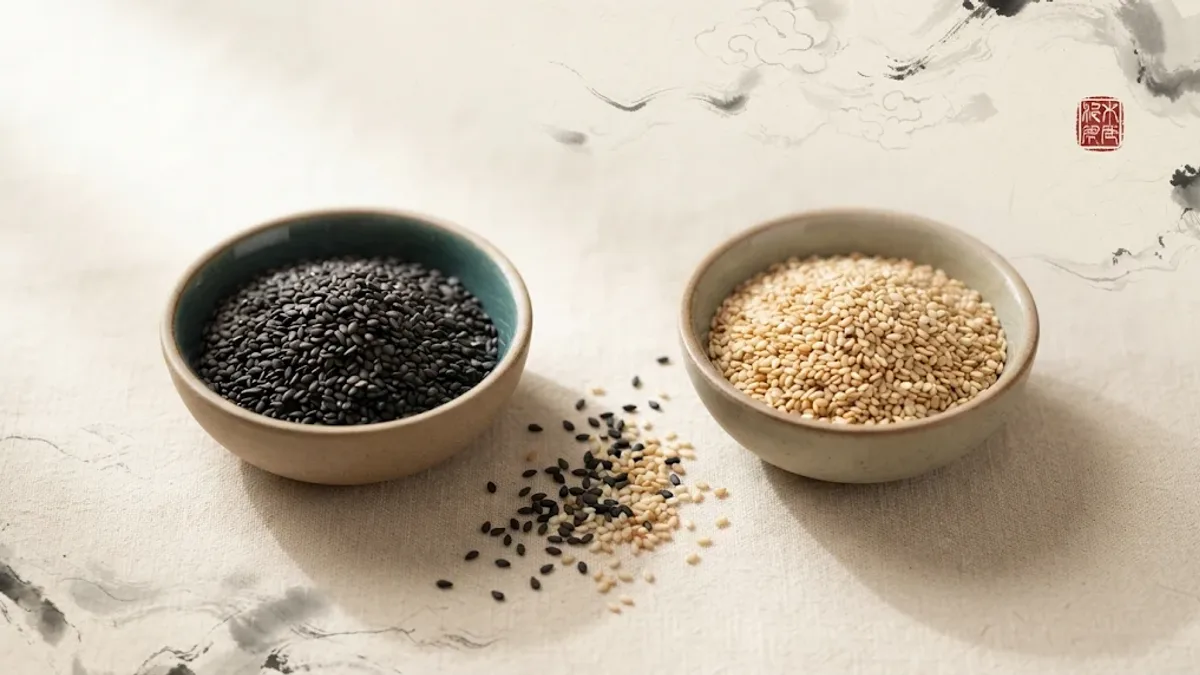
One plant, two seeds
Botanically there is only one species: Sesamum indicum, native to Africa and South Asia, cultivated in China since antiquity. In English we mostly distinguish the colour of the seeds: the dark grains, with a black or brown seed coat, and the pale grains, hulled or naturally light. In Chinese, the old terminology is more telling:
- 胡麻 (hú má, “the sesame of the Hu”) and 芝麻 (zhī má) designate black sesame, or at least the reference medicinal seed. The Yinshi Xuzhi (飲食須知, Ming dynasty) states it without ambiguity: “it is black sesame” (黑脂麻).
- 白芝麻 (bái zhī má), 白油麻 (bái yóu má, “white oil sesame”) and 白胡麻 designate white or blond sesame.
The name “sesame of the Hu” already tells a story: the seeds are said to have come from Ferghana, among the Hu peoples, brought to China by Zhang Qian in the second century BCE. The Bencao Yanyi (本草衍義, 1116) settles a debate that divided the bencao: hú má and bái yóu má “are a single plant”, the name coming from the terroir and the quality of the seeds. In other words, Chinese dietetics never really believed in two species: it classified two grades of the same seed.
Which makes sense when you look closely: today’s “black” sesame is usually the whole seed, coat included, while the “blond” one is the hulled seed, with a creamy cotyledon. The seed coat concentrates part of the polyphenols and fibre; the naked seed is fattier and sweeter, as the Suixi Ju Yinshipu (隨息居飲食譜, 1861) notes: “there are two kinds, black and white; the white is fattier”.
What the ancient texts say
Here is the surprise: read the notices one by one and black and white sesame do not carry the same label.
| Aliment | Nature | Saveur | Méridiens | Actions | Précautions |
|---|---|---|---|---|---|
| Shiliao Bencao (c. 750) · 白油麻 | Cool | Sweet | · | Deficiency-exhaustion, lubricates intestines-stomach; raw cool, fried hot | Kept too long: cholera; prolonged use causes weight loss |
| Yinshan Zhengyao (1330) · 白芝麻 | Cool | Sweet | · | Deficiency-exhaustion, lubricates, unblocks the vessels; given to the wet nurse | · |
| Yinshan Zhengyao (1330) · 胡麻 | Fresh | Sweet | · | Sweet and slightly cool; removes inveterate diseases | · |
| Qianjin Yaofang, ch. 26 (~652) · 胡麻 | Neutral | Sweet | · | Central damage, deficiency-emaciation, tonifies the five viscera, prolongs life | Non-toxic |
| Bencao Yanyi (1116) · 胡麻 / 白油麻 | · | · | · | Proves huma and baizhima are a single plant; name due to terroir | · |
| Bencao Gangmu (1596) · 胡麻 | Neutral | Sweet | Liver, Kidney, Large Intestine | Tonifies, lubricates, strengthens; the virtues of Blood and Yin deficiency | · |
| Bencao Gangmu (1596) · 白油麻 | Cool | Sweet | · | Same actions: deficiency-exhaustion, lubrication, vessels | · |
| Yinshi Xuzhi (Ming) · 胡麻 | Neutral | Sweet | · | Identifies huma with black sesame; steamed without cooking makes hair fall | Diarrhoea: do not eat |
| Suixi Ju Yinshipu (1861) · 胡麻 | Neutral | · | · | Fills the five viscera, replenishes marrow and brain; two kinds, black and white | Diarrhoea: do not eat |
| Gikin Honzo (Edo, 17th c.) · 黒胡麻 / 白胡麻 | · | · | · | Table of appropriateness: "the black grain is good, the white inferior" | · |
Nature and flavour declared by each work, translated from the 'Nourish Life' corpus
Two guiding lines emerge.
First, black is the reference seed. Of the twenty-odd works in the corpus that deal with sesame, it is the black hú má / zhī má that concentrates the strongest virtues: tonifying the five organs, filling marrow and brain, growing the muscles, “prolonging the years”. The Bencao Bei Yao (本草備要, 1683) even describes how to choose at market: “all-black skin and flesh: good, it enters the Kidney; chestnut colour: even better”. The Gikin Honzo, the Japanese materia medica of the Edo period, sums up the hierarchy in a dry formula: “the black grain is good, the white inferior”.
Second, white carries a colder label. The Shiliao Bencao calls it “great cold” (大寒), the Bencao Gangmu also “great cold”, the Yinshan Zhengyao “great coolness”: three sources, three eras, same verdict. Black, meanwhile, is almost everywhere “neutral” or “slightly fresh”. This is not a nuance of translation: the two notices coexist in the same chapter of the Bencao Gangmu with different natures.
胡麻味甘性平。即黑脂麻。修制蒸之不熟,令人發落。泄瀉者勿食。 “Sesame has a sweet flavour and a neutral nature. It is black sesame. Prepared by steaming without being cooked through, it makes the hair fall. Whoever has diarrhoea should not eat it.”
Black sesame: the seed of deficiency
The energetic profile of black sesame is stable across the corpus: sweet flavour, neutral nature (raw), tropism Liver, Kidney and Large Intestine. In TCM terms, it is the food of deficiency terrains:
- Blood and Yin deficiency: it nourishes Liver Blood and Kidney Yin. It is the seed recommended for signs of internal dryness: hair that thins or greys early, dry skin and mucous membranes, hard stools.
- Constipation from Fluid deficiency: its “slippery” effect on the Large Intestine is one of the most cited in the corpus, from the Qianjin Yaofang to the Bencao Gangmu. Careful: this is dryness constipation, not stagnation.
- Fatigue and deep deficiency: “fills the five viscera, replenishes marrow and brain” (Suixi Ju Yinshipu). Jing, the essence, belongs to the same family as walnut and sunflower seed, but black sesame is the most “Blood” of the three.
Black sesame
黑芝麻
- Nourishes Liver Blood and Kidney Yin
- Lubricates the Large Intestine (dryness constipation)
- Tonifies the five viscera, fills the marrow
- Supports the hair (classical reading)
In TCM, the black seed coat concentrates the action on Blood: the Bencao Bei Yao notes that the all-black seed “enters the Kidney”. The common form is the whole unhulled seed, more fibrous and more “medicinal” than the naked seed.
Two precautions recur in the texts: diarrhoea (sesame “slides”, which does not suit an intestine already too mobile) and Spleen deficiency struggling to transform fats. The full sheet, with its TCM syndromes and dosages, is in the Yin Shi app.
White sesame: the colder cousin
White or blond sesame shares the same profile of actions (deficiency-exhaustion, intestinal lubrication, vessels, wet nurse), but its nature is judged colder. Three bencao call it “great cold”. The nuance is real within the tradition: white was the table seed, the one given to the wet nurse “so that the child is never ill” (Yinshan Zhengyao), while black remained the drug of deficiency.
In practice, white suits heat or fullness terrains better: dry hot mouth, constipation with signs of heat, skin that breaks out in summer. Black, being more neutral, goes everywhere but is the choice for marked deficiencies. The Yangsheng Shijian (養生食鑑) sums up the rule well: white “raw is cold, fried hot, boiled-steamed warm”.
And white has another use that black lacks: the Riyong Bencao (日用本草) draws a juice from it, the “sesame drink”, for host heats. It is the seed chosen to cool, where black gently warms through its seed-coat concentration.
Cooking changes the nature
This is the point clients forget most often: a food’s nature is not fixed, preparation modifies it. The bencao put it bluntly for sesame:
生者性寒而治疾,炒則性熱而發病,蒸食性温而充飢。 “Raw it is cold and treats illness; fried it is hot and triggers it; steamed it is warm and nourishes.” (Shiwu Bencao, quoted in the Bencao Gangmu)
In other words: raw sesame suits heat deficiencies taken cool; the same sesame roasted becomes a warm food, able to “trigger” wind disease in an already fragile terrain; steamed sesame, as in congee or sesame porridge, is the warm, nourishing form par excellence. Roasting is not a matter of taste: it is a change of action.
In practice:
- Whole black seed, raw or lightly roasted: the “medicine” form for Blood and Yin deficiencies. Ground, it mixes into yoghurt, salads, the morning congee.
- Hulled blond seed, roasted: the “kitchen” form, for the table and heat terrains. The base of tahini, gomasio, stir-fries.
- Sesame oil: the bencao describe it as cold and slippery, excellent for the Large Intestine but “it stirs the Qi” if left overnight. Roasted sesame oil (the dark, fragrant kind, not the clear one) has a warmer nature.
- Sesame paste (tahini): the most “Spleen” form: pre-chewed, unctuous, it digests without effort.
For the cooking rules that modify a food’s nature, see our article on cooking methods in TCM.
What modern nutrition adds
The Western reading confirms part of the tradition without copying it. Black and white sesame are the same plant, but the black seed coat concentrates compounds the hulled white seed loses: more calcium, iron, magnesium, and above all lignans (sesamin, sesamolin), antioxidants studied for their effect on blood pressure and cholesterol. Sesame is also one of the major allergens recognised in Europe: it appears in the 14 allergens of EU list 1169/2011, something the bencao obviously could not have known.
The interesting point of convergence: Chinese tradition says “black nourishes Blood and Kidney”, nutrition says “black is denser in minerals and antioxidants”. Two grids, same direction. And the “whiter is fattier” of the Suixi Ju Yinshipu checks out: the hulled seed concentrates the lipids, which explains both its sweetness and its calorific richness.
Frequently asked questions about sesame in TCM
Does black sesame make hair grow?
It is the most cited classical reading: black sesame nourishes Liver Blood and Kidney Jing, and hair is in TCM the “surplus of Blood”. For hair that thins or greys prematurely on a deficiency terrain, a teaspoon of ground black sesame a day is the simplest dietary tonic. It does not “blacken” hair, it nourishes what makes it grow.
Black or white sesame for constipation?
For dryness constipation (hard stools, dry terrain), both work, black first because it is more “Blood”. For constipation with signs of heat or agitation, raw or fresh white is more suitable. In both cases the dose matters: a teaspoon of ground seeds or a tablespoon of tahini is enough; excess “slides” too much and can tire the Spleen.
Can you mix black and white?
Yes, and it is even good practice: a half-and-half mix gives a balanced profile (black tonifies, white cools slightly). Many shop-bought gomasio and tahini already blend the two. The only rule: roast before eating for digestion, and grind the black because its hard seed often passes through whole.
Is sesame good for everyone?
No. Two classical contraindications: diarrhoea or Spleen deficiency with loose stools (sesame “slides”, it will aggravate), and sesame allergy, increasingly common. The Yinshi Xuzhi has said it for centuries: “whoever has diarrhoea should not eat it”. And if you take anticoagulants, speak to your doctor: sesame is rich in vitamin K.
Black, white or both
The honest answer of the ancient texts: both are the same seed, and tradition ended up preferring black for its tonifying virtues, while keeping white for heat terrains and the everyday table. In practice nothing stops you alternating: ground black in the morning for Blood, roasted white as a garnish for cooking, tahini for a tired Spleen.
What changes everything is cooking: raw, sesame is cold and “medicinal”; roasted, it becomes warm and digestible; steamed, it is the most nourishing form. Colour matters, but preparation matters just as much.
To go further, the full black sesame sheet (TCM syndromes, dosage, nutritional composition, 15 recipes from around the world) is in the Yin Shi app, and the ancient texts quoted in this article can be read free in the “Nourish Life” library of the Yin Shi Academy.
To go further: nuts and seeds in TCM, Blood deficiency, Yin deficiency, the thermal nature of foods, and Shi Liao, food as medicine.