Between the case history and the client leaving the room, there is one step that eats up every Chinese dietetics practitioner’s time: translating the assessment into concrete dietary advice. Which foods for this Spleen Deficiency? Which to avoid with this Liver Qi stagnation? Answering requires crossing thermal nature, flavour, tropism and syndromes for every candidate food. That is exactly the kind of task a good tool handles in a few seconds. Here is what a real Chinese dietetics tool must do in practice, and what Yin Shi actually brings.
The consultation bottleneck
The TCM assessment itself is quick once the case history is done: tongue, pulse, general signs, the dashboard of the eight principles. The time is spent afterwards, when you have to move from syndrome to foods.
Three habits slow this step down:
- Memory: remembering that millet is cool in nature and suits the Spleen in cases of Dampness, that fresh ginger moves without heating, that crab is to be avoided with Yang Deficiency
- Books: leafing through the Bencao or its correspondence tables while the client waits, or postponing the advice to “next time”
- Copy-paste: rewriting the same list by hand for every client, unable to fine-tune it to the terrain
A serious tool removes these three frictions. But not all of them are equal: some are pure TCM databases that ignore modern nutrition, others are nutrition apps that ignore TCM. The full comparison is in the article on Chinese dietetics apps.
What a TCM tool must really do
A tool designed for the consulting room is not judged on the size of its database, but on the workflow it enables. The ideal sequence:
- Set the assessment: select the syndrome or syndromes identified (Qi Deficiency, Damp-Heat, Liver stagnation…)
- Filter the foods: cross nature, flavour, tropism and indications to isolate the foods to recommend and those to avoid
- Check the detail: open a food’s full sheet for contraindications and precautions for use
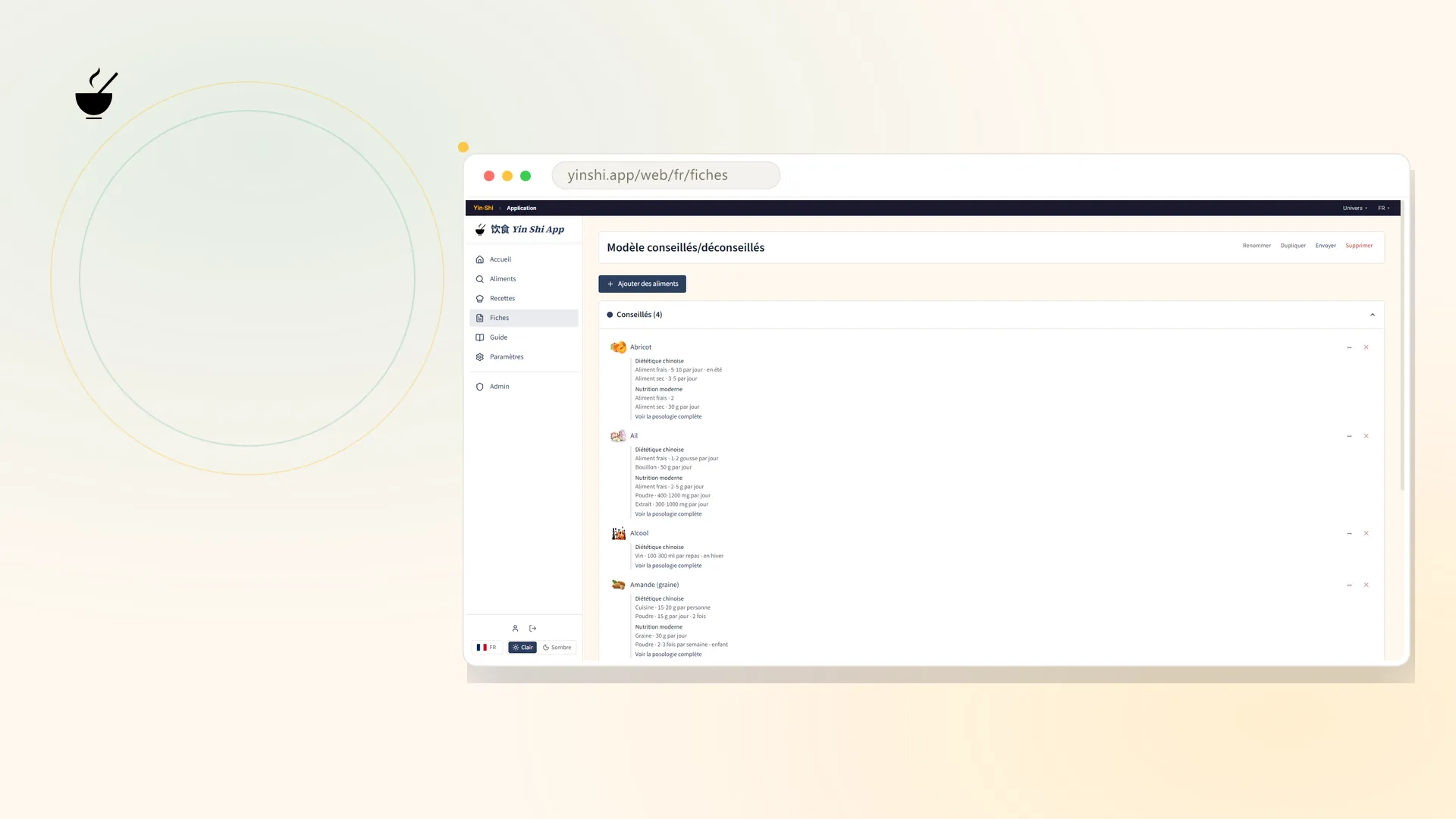
- Produce the client sheet: generate a clear, readable list that can be emailed or printed
- Stay available: work during consultation, including offline, on the practice computer and on a tablet
Every step counts. A tool that does 1 and 2 well but not 4 leaves the practitioner with a list in their head that they have to retype. A tool that does 4 but not 1-3 produces generic sheets with no clinical value.
Yin Shi in the practice: the functions that matter
Yin Shi was built around this workflow. Concretely:
- Multi-criteria search: filter by TCM syndrome (94 documented syndromes) and by nutritional criterion in a single query. “Foods for Spleen Deficiency, low glycaemic index” is a search that classic TCM databases cannot handle.
- 13-tab food sheets: every food documents its thermal nature, flavours, tropisms, syndromes, contraindications, nutritional composition and culinary uses. Thermal nature and flavours are no longer columns in a table but filterable dimensions.
- Exportable client sheets: the list of recommended and avoided foods is generated in one click, sent by email or printed. The client leaves with a professional document, not rough notes. This function is covered in detail in the dedicated article on personalised food lists.
- Food comparator: two foods side by side, TCM properties and nutrients, to arbitrate between two cereals or two proteins for example.
- Offline: the installed app works without a network, which makes it usable in areas with poor coverage or in a practice without Wi-Fi.
What it changes in practice
The gain is not only time saved, though that is real: producing a client sheet takes a few seconds instead of ten to fifteen minutes of manual searching. Over a day of consultations, that easily adds up to an hour or two recovered.
The most lasting effect lies elsewhere: consistency. When every client sheet is generated by the same rule engine, advice looks the same from one consultation to the next. No more days when, tired, you forget a contraindication or swap two similar thermal natures. The client also receives a document they remember: a clean email with food lists, not a verbal “make sure you note this down”.
For teachers and trainers, it is an additional asset: the standard sheets by pathology can be shared with students, who get a validated reference framework. The article on the 5 elements in Chinese dietetics sets out the theoretical foundations the tool puts into practice.
Frequently asked questions
Do you need TCM training to use Yin Shi in consultation?
The tool assumes you have carried out a TCM assessment to advise relevantly, but it does not do the assessment for you. That said, the sheets explain every term: a dietitian or a naturopath can use it without full TCM training.
Can Yin Shi replace my reference books?
No, and that is not the point. The classics remain the basis of your training. Yin Shi is the daily consultation tool: it does not replace reading the texts, it avoids leafing through them in front of the client.
What happens to the client sheet after it is sent?
It is sent by email from the app and the client keeps it. No health data is stored on a third-party server: generation is local and sending goes through the usual email channel.
Does the app work on a tablet in the practice?
Yes: Yin Shi is an installable web app (PWA) that works on computer, tablet and smartphone, Android and iPhone alike, with offline mode once installed.
The right tool is the one that disappears
A good Chinese dietetics tool goes unnoticed: it does its job while you talk to the client, and the advice arrives ready-made. That is exactly what Yin Shi aims for: you set the assessment, it translates into foods, you validate, the client leaves with their sheet.