Ask a Chinese dietetics practitioner where they find the thermal nature of quinoa or the tropism of celery, and they will probably pull out a PDF, a bedside book or a laminated poster hanging on the practice wall. These paper references have accompanied the profession for decades. But in 2026, the question arises: does digital really have something to bring to a TCM food database, or is it just a trend? The answer lies in what paper cannot do.
What exists today for knowing foods in TCM
Four families of references coexist, and each has its loyal users.
PDF charts. Practitioners and teachers distribute correspondence charts of nature-flavour-tropism in PDF, sometimes with instructions. Free or nearly so, this format circulates in training courses and professional groups. The best known in France remains the reference correspondence chart used in TCM schools.
Posters and charts. Specialist publishers sell laminated A2 or A1 charts summarising the properties of 300 to 400 foods, meant to be displayed in the practice or waiting room. It is the collector’s item of enthusiasts: beautiful, educational, and consultable at a glance by the client.
Reference books. Chinese dietetics works (Georges Charles, Christophe Labigne, translations of the Chinese classics) document foods in their context: seasons, cooking methods, classical prohibitions. These are the bedside texts, the ones read to understand rather than to look something up.
Free online lists. A few sites offer consultable databases, such as the German meine-tcm.com list which references 283 foods filterable by temperature and flavour. Practical, but without the modern nutritional dimension or clinical use.
What paper still does well
Let us be honest: paper has real advantages that no software will reproduce.
- Zero recurring cost: a free PDF or a €20 book has no subscription
- Zero friction: no account, no password, no forced update
- Tangibility: a chart displayed on the wall speaks to the client during the consultation; a printed list slips into a folder
- Stability: a book does not change content before your eyes, an online database evolves
- No dependency: no breakdown, no network, no service shutdown
For a practitioner who already knows TCM and wants a quick reference check, paper remains a legitimate option. The question is not “paper or digital” but “what does digital do more”.
What digital adds, concretely
The difference is not the medium, it is what the medium makes possible.
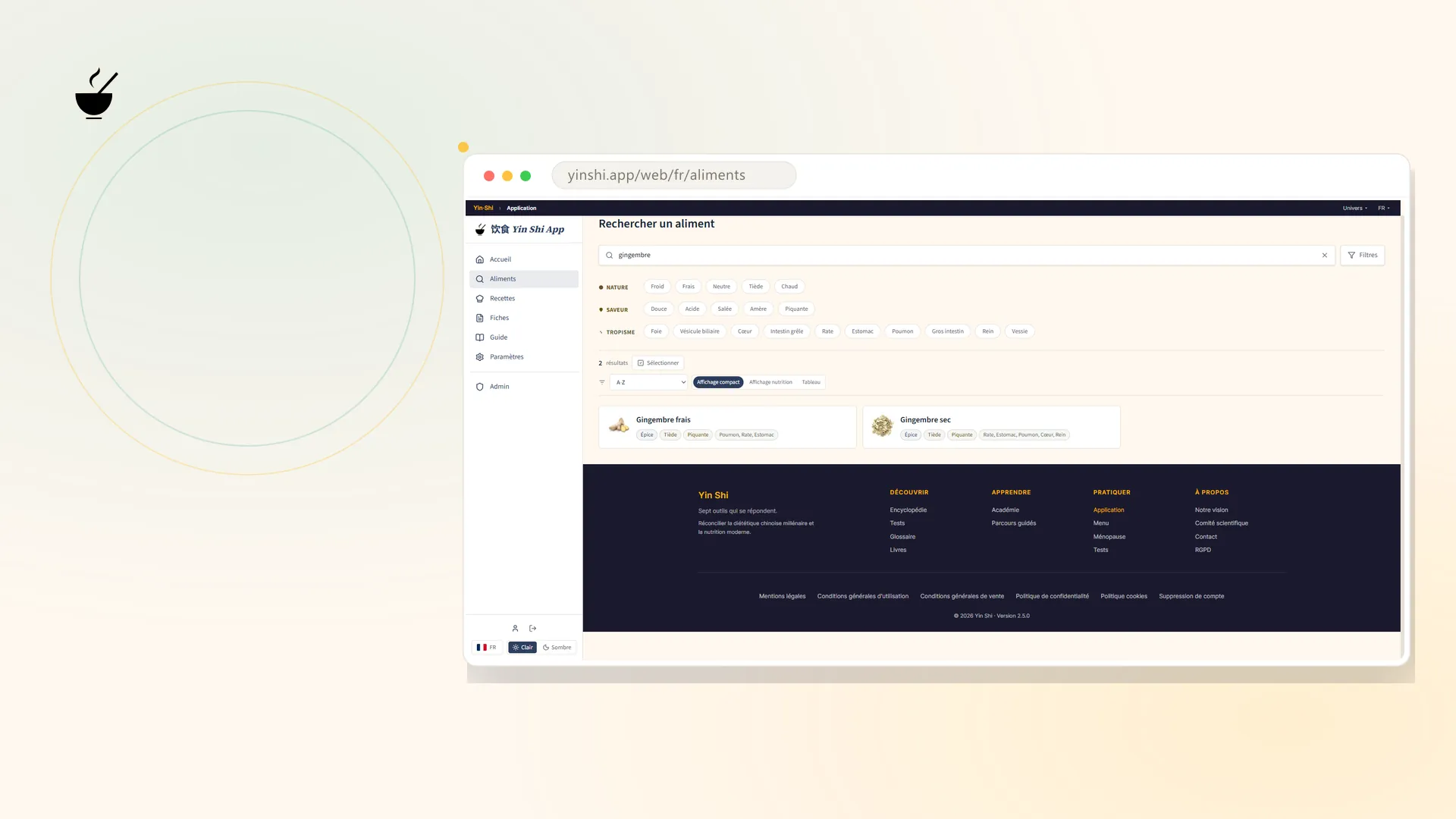
Cross-search. On a paper chart, you read one row per food. On a digital database, you query: “all cool-natured foods with Spleen tropism and a low glycaemic index”. This combined query, impossible on paper, is exactly the one posed in consultation facing a specific client.
Data freshness. A 2021 PDF reflects the knowledge of 2021. A maintained database integrates corrections, newly referenced foods and updated precautions. The thermal nature of millet or interactions with medicines evolve with research.
The second grid. TCM paper ignores modern nutrition: no detailed calories, no glycaemic index, no micronutrients. A practitioner who wants to recommend a food “good for Spleen Qi AND low in fast sugars” has to cross-reference two sources. An integrated database answers within the same sheet.
The client sheet. Paper informs the practitioner; it produces nothing for the client. A digital tool generates the list of recommended and avoided foods, formats it, and sends it by email in one click. That is the difference between information and advice ready to hand over.
Mobility. The chart stays in the practice. The app installed on a tablet or smartphone follows the practitioner everywhere, including offline.
The Yin Shi database: 262 foods, two grids
Concretely, Yin Shi documents 262 foods across 13 tabs per sheet: thermal nature, flavours, tropisms, TCM syndromes, contraindications, modern nutritional composition (macronutrients, glycaemic index, vitamins, minerals), world recipes and cooking methods. The search crosses TCM and Western filters: you can isolate foods for Spleen Deficiency with high fibre content, or spot hot-natured foods contraindicated on a Heat terrain.
All of this is available in 5 languages (French, English, Spanish, Arabic, German), making it the only TCM database of this kind accessible to the general public and practitioners alike.
When digital is not the right answer
Two cases where paper keeps its relevance:
- For learning TCM: books and classics remain irreplaceable for understanding theory. A database gives answers, not explanations. The Yin Shi encyclopaedia complements this role for concepts.
- For displaying in the waiting room: a beautiful educational poster remains more telling than a screen for a non-connected client. The two approaches complement each other.
Frequently asked questions
Is an online database reliable for TCM?
It depends on the source. Yin Shi documents each sheet with its TCM and nutritional correspondences, validated by a scientific committee. The most serious databases cite their sources (Chinese classics, nutritional tables). Beware of lists without provenance.
Why not settle for a free PDF chart?
A PDF is a frozen snapshot: no cross-search, no updates, no client sheet. If your need is an occasional quick lookup, it is enough. If you advise regularly, the time lost navigating a static chart is paid for in the quality of your advice.
Does Yin Shi replace my Chinese dietetics books?
No. Books remain your training, the database is your consultation tool. The two complement each other: the book explains why, the app shows which foods.
Are Yin Shi sheets accessible to clients?
Yes: client sheets generated by the practitioner are sent by email to the client, who consults them on their own device. The app itself is also usable by a curious client without TCM training.
Paper has had its time, digital does the rest
Chinese dietetics does not need a new tool to exist: it needs a tool that translates assessment into advice without friction. Paper has carried the profession for centuries; digital adds the cross-search, data freshness and client sheet the practice expects.