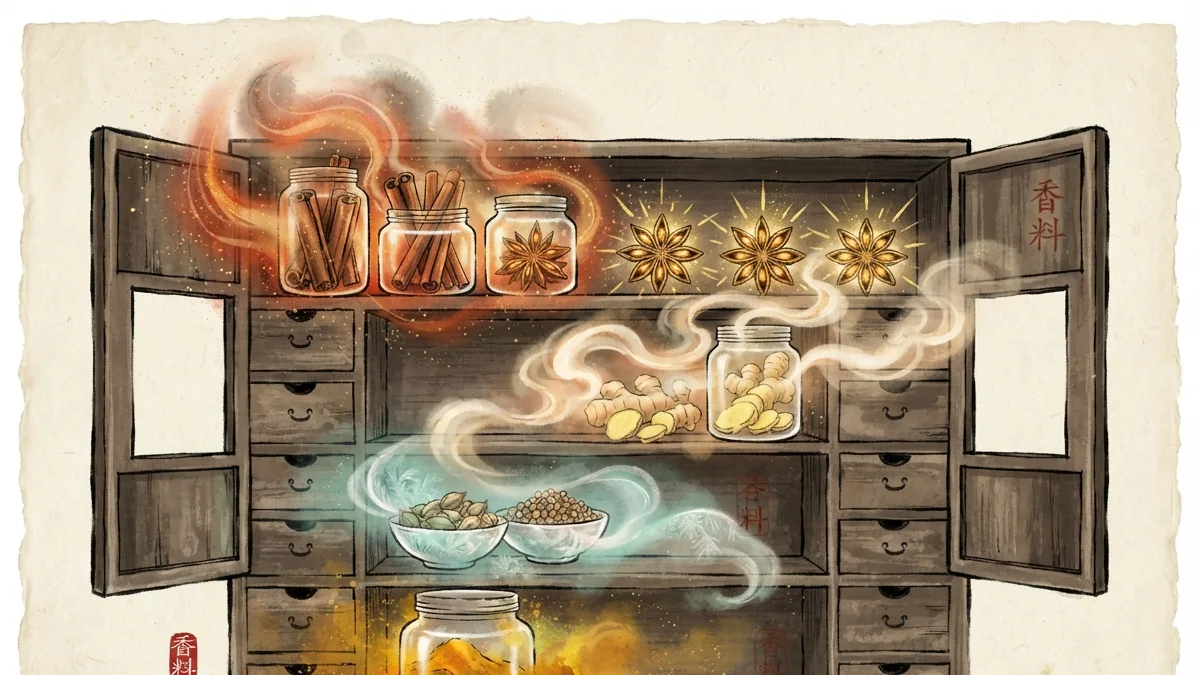
The spice is the only food whose dose is naturally “medicinal”: small quantity, directed effect, therapeutic margin. Chinese dietetics makes it the cupboard pharmacy: pepper warms the Stomach, fresh ginger releases the surface, turmeric moves the Blood, cardamom moves the Qi, chen pi transforms Phlegm. This guide does for spices what the vegetables guide does for its family: a reading by terrain and by action.
Why the spice is the gateway to the pharmacopoeia
What distinguishes the spice from ordinary food is its density of action: a pinch does what a plateful cannot. Fresh ginger that “expels” an incoming chill, pepper that warms a cold stomach, turmeric that unblocks a stagnant pain: these are actions, not flavours.
That is also its limit: the spice is not a daily staple, it is a directed tool. Chinese dietetics treats it by “dose” (a pinch, a short decoction, a dish), not by “volume”. A spice given too generously is a fire that burns instead of warming.
Dispersing Cold: pepper, clove, dried ginger, nutmeg
The first family: spices that disperse internal Cold. For a cold abdomen, loose stools, pains that improve with heat.
- Black pepper: hot, warms the Stomach, disperses Cold, relieves cold pain. The “gentle fire” of the centre.
- Clove: hot, warms Stomach and Kidney, brings down rising Qi (cold belching, hiccups).
- Dried ginger (gan jiang): hot, warms the centre more deeply than fresh; the ginger of established internal Cold.
- Nutmeg: warm, warms the Spleen, binds the intestines (cold diarrhoea), in minuscule doses; its toxicity makes it the spice with the narrowest margin.
- Cinnamon: hot, tonifies Kidney Yang, warms the Blood. The cinnamon of the cold centre, not of the cinnamon bun.
For an internal-Cold terrain, these spices are the kitchen’s answer: they rewarm what cold has slowed.
Releasing the surface: fresh ginger, chilli, star anise
The second family: spices that “release the surface”, that drive out the Wind at the first shiver.
- Fresh ginger (sheng jiang): warm, releases the surface, warms the Lung. The ginger of the incoming cold with chills: the hot decoction that induces a gentle sweat.
- Mild chilli: hot, releases the surface, induces sweating; stronger than ginger, for cold that is “entering”.
- Star anise: warm, releases the surface, circulates. The star anise of hot broth for a cold.
- Fennel seed: warm, heats, also aids digestion.
Timing is decisive: these spices release the surface at the chill stage, when the cold has just arrived. If the throat burns and fever climbs, this is no longer the surface: warm pungents are no longer indicated.
Moving Qi: cardamom, fennel, caraway, cumin
The third family: spices that move the Qi of the centre. For Qi that stagnates: bloating, distension, digestion blocked by stress.
- Cardamom: warm, moves the Qi of the Spleen, transforms Dampness, relieves bloating.
- Fennel seed: moves the Qi of the centre, relieves gas and distension.
- Caraway, cumin: move Qi, aid the digestion of heavy dishes. Caraway with cabbage, cumin with legumes: the spice-food marriage is no accident.
- Coriander seed: circulates, aids digestion, mildly clearing.
These spices “mobilise” the meal: they move what a rich dish or stress freezes.
Moving Blood: turmeric, saffron
The fourth family: spices that move the Blood. For fixed pains, painful periods, stasis.
- Turmeric: warm, moves Blood, dissolves stasis, relieves pain. The turmeric of stagnant pain and chronic inflammation; the piperine of black pepper multiplies its absorption.
- Saffron: cool, moves Blood, also calms the Shen. The saffron of stagnant Blood and a restless mind.
- Cinnamon (again): also moves Blood through its heat.
For fixed pains and stasis, these spices move with the Blood rather than against it. They are measured: saffron works in milligrams, not grams.
Transforming Phlegm: liquorice, chen pi, garlic
The fifth family: spices that transform Phlegm. For mucus, a congested throat, loaded sinuses.
- Chen pi (dried mandarin peel): moves Qi, transforms Phlegm, settles nausea. The most “domestic” materia medica substance.
- Liquorice: neutral, tonifies the Spleen, transforms Phlegm, harmonises formulae. In measured doses: excess raises blood pressure.
- Garlic: hot, transforms Phlegm, kills parasites (the classical reading). The garlic of the mucus-laden cold.
- Thyme, oregano: circulate, warm, help Lung Phlegm.
For visible Phlegm (mucus, sinuses) and invisible (coated tongue, heaviness), these spices “open” what thickens.
Fresh versus dried: why ginger changes families
Ginger illustrates a Chinese rule: processing changes the action. Fresh ginger (sheng jiang) releases the surface: the spice of the chill. Dried ginger (gan jiang) warms the centre: the spice of internal Cold. Roasted/charred ginger (pao jiang) warms and stops Blood: the spice of cold bleeding. Three spices, one root: preparation changes the tropism.
The same logic applies elsewhere: fresh pepper is more “volatile”, ground pepper more “internal”; stick cinnamon is more “descending” than powder. Chinese dietetics reads preparation as a modification of the medicine.
Table: spice, nature, action, terrain
| Spice | Nature | Action | Suited terrain | Caution |
|---|---|---|---|---|
| Fresh ginger | Warm | Lung, Spleen, Stomach | Releases surface, warms Lung | Early Wind-Cold. Caution: Heat, Yin |
| Dried ginger | Hot | Spleen, Stomach, Heart, Lung | Warms centre, warms Lung | Internal Cold. Caution: Heat, Yin deficiency |
| Black pepper | Hot | Stomach, Large Intestine | Warms Stomach, disperses Cold | Cold Stomach. Caution: Yin, Heat |
| Clove | Hot | Spleen, Stomach, Kidney | Warms, descends rebellious Qi | Cold, hiccups. Caution: Heat |
| Cinnamon | Hot | Kidney, Spleen, Liver | Tonifies Yang, warms Blood | Cold-deficiency. Caution: pregnancy, Heat |
| Nutmeg | Warm | Spleen, Stomach, Large Intestine | Warms Spleen, binds intestines | Cold diarrhoea. Caution: minimal dose, toxic |
| Cardamom | Warm | Spleen, Stomach, Lung | Moves Qi, transforms Dampness | Bloating, Dampness |
| Cumin / caraway | Warm | Spleen, Stomach | Moves Qi, aids digestion | Distension, heavy dishes |
| Turmeric | Warm | Liver, Spleen, Stomach | Moves Blood, dissolves stasis | Fixed pain, stasis. Caution: gallstones |
| Saffron | Cool | Liver, Heart | Moves Blood, calms Shen | Stasis, agitation. Caution: pregnancy, dose |
| Chen pi | Warm | Spleen, Lung | Moves Qi, transforms Phlegm | Phlegm, nausea, bloating |
| Liquorice | Neutral | Spleen, Lung, Heart | Tonifies Spleen, transforms Phlegm | Cough, weak Spleen. Caution: hypertension |
| Star anise | Warm | Lung, Spleen, Stomach | Releases surface, circulates | Wind-Cold, hot broth |
| Garlic | Hot | Spleen, Stomach, Lung | Transforms Phlegm, disperses | Mucus, parasites. Caution: Stomach, Yin |
Nature, action, and the terrain that benefits
Frequently asked questions about spices in TCM
Which spice for an incoming cold?
Fresh ginger as a hot decoction: it releases the surface at the chill stage, induces a gentle sweat, warms the Lung. Star anise or mild chilli reinforce. If the throat burns and fever climbs (Wind-Heat), warm pungents are no longer indicated: that is the stage of Heat, not the surface.
Is turmeric really anti-inflammatory?
The two readings converge: TCM gives it the action of “moving Blood, dissolving stasis” for fixed pains; modern curcumin is a documented anti-inflammatory. Black pepper’s piperine multiplies its absorption tenfold: the turmeric-pepper combination of Indian cooking is not folklore.
Fresh or dried ginger for cold?
By level: fresh releases the surface (a chill that is starting, an incoming cold); dried warms the centre (established internal cold: cold abdomen, chronic loose stools). Fresh “expels”, dried “stays”. For the cold that begins, it is fresh; for the long-standing cold centre, it is dried.
Is liquorice dangerous?
In prolonged use and high doses, yes: glycyrrhizin raises blood pressure and depletes potassium. At the occasional culinary dose (an infusion, a dish), it tonifies the Spleen and transforms Phlegm. Hypertension and pregnancy limit its regular use.
The cupboard pharmacy, in directed doses
The spice is the food-medicine: small dose, directed effect, therapeutic margin. Pepper and dried ginger disperse Cold, fresh ginger and star anise release the surface, cardamom and cumin move Qi, turmeric and saffron move Blood, chen pi and liquorice transform Phlegm. Preparation changes the action, and dose makes the difference between remedy and fire.
In the Yin Shi app, each spice card shows its nature and action: fresh ginger answers Wind-Cold, turmeric answers stasis, cardamom answers bloating, and the card always flags the margin.
Further reading: the thermal nature of foods, Wind, Qi stagnation, Blood stasis, and the common cold in TCM.
To go further
Yin Shi ecosystem resources directly related to this article.
Which spice suits your terrain?
The Eight Principles test locates the nature your spices should correct.
Take the test →See these spices in the app
Cinnamon, ginger and turmeric: three spices from the guide, with full sheets.
Full sheets available after the 30-day free trial or with a subscription.
The pantry pharmacy
The lesson reviews cinnamon, ginger, turmeric and liquorice as medicinal spices.
Take the lesson →