Yi zang bu zang: “an organ nourishes the corresponding organ”. The principle is as old as Chinese dietetics: liver nourishes the Blood of the Liver, kidney nourishes the Kidney and Jing, heart settles the Shen, tripe tonifies the Spleen, gizzard helps you digest. Neither superstition nor sympathetic magic: organs concentrate the densest nutrients in the animal kingdom, and the correspondence often has a biochemical reading that holds up.
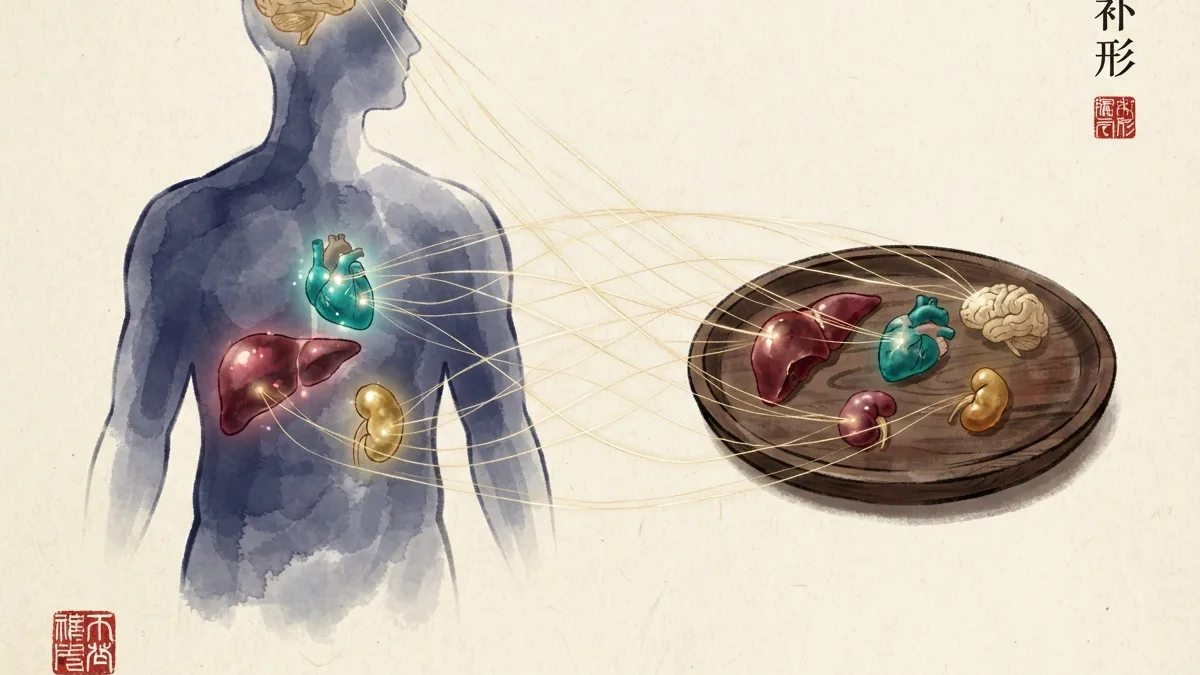
”Like nourishes like”: the principle and its honest limits
The principle is simple: an animal’s organ shares with the corresponding human organ the nutrients that organ needs. Animal liver concentrates the iron, B12 and retinol the human Liver needs to store Blood; kidney carries the minerals of Jing; heart carries the coenzymes of the beating muscle.
Honesty imposes the limit: Chinese dietetics does not claim that eating liver “cures” a diseased Liver. It says the organ nourishes the corresponding function: liver helps the Blood the Liver stores, kidney helps the Jing the Kidney keeps. It is a terrain reading, not a targeted therapy: liver does not cure hepatitis, it nourishes Blood deficiency. The nuance makes all the difference between dietetics and a promise.
Liver nourishes Liver Blood: eyes and sinews
The classical pairing: the Liver stores Blood, and Liver Blood nourishes the eyes and sinews. Animal liver is the densest food in the kingdom: haem iron (far better absorbed than plant iron), vitamin B12, retinol (active vitamin A), folate, copper.
For Blood deficiency (pallor, dizziness, dry or tired eyes, dull hair, pale periods, insomnia), liver is the most direct dietary prescription: one or two portions a week, pan-fried or as home-made pâté. It is the food that answers the “tired eyes, brittle nails” picture fastest.
Kidney nourishes the Kidney and Jing: lower back, ears, reproduction
The Kidney stores Jing, the essence: it governs the lower back, the ears, the bones, reproduction. Animal kidney (veal, lamb, pork) is dense in selenium, B12, zinc and coenzymes: the nutrients of depth.
For a weak-Kidney terrain (soft lower back, tinnitus, deep fatigue, fragile reproduction), kidney is the dietary Jing tonic. The modern reading notes its selenium and B12 density; the Chinese reading files it under “nourishing the deep”.
Heart nourishes the Shen: the resting of the spirit
The Heart houses the Shen, the spirit at rest. Animal heart (veal, lamb, poultry) is the hardest-working muscle in the body: it concentrates coenzyme Q10, taurine and the B vitamins of cardiac muscle.
For a restless Shen (anxious palpitations, light sleep, a mind that cannot settle), heart is the offal of settling. It is the most “literal” pairing of the principle: the muscle that beats the most nourishes the one that houses the spirit.
Tripe and gizzard: digestion that nourishes digestion
The offal of the digestive tract tonifies the Spleen and digestion itself:
- Tripe (ruminant stomach): tonifies the Spleen, aids digestion. The “like nourishes like” of the centre: for a weak Spleen that struggles to transform.
- Chicken gizzard (ji nei jin): the inner membrane of the gizzard is a classical materia medica substance: it “dissolves food accumulations”, helps digest stagnation, treats food retention in children. The powdered gizzard of formulae for “the child who cannot digest”.
- Black pudding: blood itself; nourishes Blood directly.
Tripe in soup or pot-au-feu is the dish of a tired Spleen: it digests slowly, tonifying the centre it passes through.
Brain and marrow: the deepest Jing
Brain and bone marrow are the offal of deep Jing: brain nourishes the “sea of marrow” (brain and spinal cord are, in TCM, extensions of Kidney Jing), marrow nourishes Blood and Jing. Rich in fats, DHA, phospholipids and minerals, they are the densest foods for deep fatigue and a brain that “lacks substance”.
Their purine and fat richness reserves them for small doses: marrow on the bone, an occasional brain, for the deep-deficiency terrain, not daily consumption.
The nutritional view: why the correspondence holds
Biochemistry partly explains the principle: organs concentrate the nutrients their human counterpart uses. Liver stores the iron and vitamin A that Blood needs; heart concentrates the CoQ10 that cardiac muscle consumes; kidney carries the selenium of the kidney. “Like nourishes like” is not a magical correspondence: it is a reading of nutritional density ahead of its time.
It is also the modern caution: organs also concentrate purines (gout), cholesterol, and for intensively farmed animals, whatever the organ filters. The quality of the source matters as much as the principle.
Table: offal, nourished organ, terrain
| Offal | Nourished organ | Action | Suited terrain | Caution |
|---|---|---|---|---|
| Liver | Liver / Blood | Eyes, sinews | Nourishes Blood, iron, B12, retinol | Blood deficiency, dry eyes. Limit: pregnancy, gout |
| Kidney | Kidney / Jing | Lower back, ears, reproduction | Nourishes Jing, selenium, B12 | Weak Kidney. Limit: gout |
| Heart | Heart / Shen | Spirit, rest | Settles the Shen, CoQ10, taurine | Restless Shen, light sleep |
| Tripe | Spleen / digestion | Centre, transformation | Tonifies the Spleen, aids digestion | Weak Spleen. Limit: gout |
| Gizzard (ji nei jin) | Digestion | Accumulations, stagnation | Dissolves food accumulations | Food retention, children |
| Brain | Kidney / Jing → brain | Sea of marrow | Nourishes deep Jing, DHA | Deep deficiency. Limit: purines, dose |
| Bone marrow | Kidney / Blood / Jing | Marrow, bones | Nourishes Blood and Jing, dense fats | Convalescence, deep deficiency. Limit: richness |
| Black pudding | Blood | Blood directly | Nourishes Blood, iron | Blood deficiency. Limit: density |
The organ-to-organ correspondence and its terrain
Frequently asked questions about offal in TCM
Is liver really good for the Blood?
Yes, on both sides: TCM prescribes it for Blood deficiency (dry eyes, pallor, sinews), and nutrition confirms its density in haem iron, B12 and retinol, the nutrients blood-building requires. One portion a week is enough: its density is both its strength and its limit.
Is “like nourishes like” scientific?
The principle is not targeted therapy (eating heart does not cure a diseased heart) but a reading of density: organs concentrate the nutrients their counterpart uses. It is a nutritional correspondence, not a magical one: liver nourishes Blood deficiency because it carries the iron and B12 of blood, not by sympathy.
Why tripe for digestion?
Tripe is the ruminant’s stomach: in TCM it tonifies the Spleen and “digestion nourishes digestion”. Chicken gizzard goes further: its inner membrane (ji nei jin) is a materia medica substance that dissolves food accumulations. Tripe soup for a tired Spleen is a folk practice that Chinese dietetics formalises.
Is offal safe in pregnancy?
With caution: liver, very rich in retinol (teratogenic vitamin A in excess), is limited during pregnancy to an occasional portion. Other offal (tripe, heart, black pudding) calls for thorough cooking and a sound source. Liver for Blood deficiency resumes after delivery; during, measure applies.
The organ that nourishes the function
“Like nourishes like” is the oldest density reading in dietetics: liver nourishes Liver Blood, kidney nourishes Kidney Jing, heart nourishes the Shen, tripe nourishes the Spleen, gizzard nourishes digestion. It is not organotherapy: it is the densest food for the corresponding function, in measured doses and from clean sources. The caution (purines, retinol, quality) is part of the prescription.
In the Yin Shi app, offal cards show the nourished organ and the nutritional density: liver answers Blood deficiency, kidney answers a weak Kidney, and the card always flags the limit (purines, retinol, frequency).
Further reading: the meat guide, Blood deficiency, Jing, the Shen, and the Spleen.
To go further
Yin Shi ecosystem resources directly related to this article.
Is your Blood calling for the richness of offal?
The Qi–Blood–Yin–Yang questionnaire locates the Blood deficiency that offal nourishes.
Take the test →See this offal in the app
Liver, kidney and gizzard: three types of offal mentioned, with full sheets in the app.
Full sheets available after the 30-day free trial or with a subscription.
Offal in the materia medica
The lesson reviews meats, fish and animal products, including offal.
Take the lesson →