Fruit is not “sugar to be moderated”. Chinese dietetics reads it as a food in its own right: a thermal nature, flavours that direct it towards particular organs, and actions that either generate fluids or burden the Spleen. Pear and jujube are not interchangeable: the first generates the fluids of the Lung, the second tonifies the Qi of the Spleen. This guide does for fruit what the cereals guide does for grains: a reading by terrain, not by calorie category.
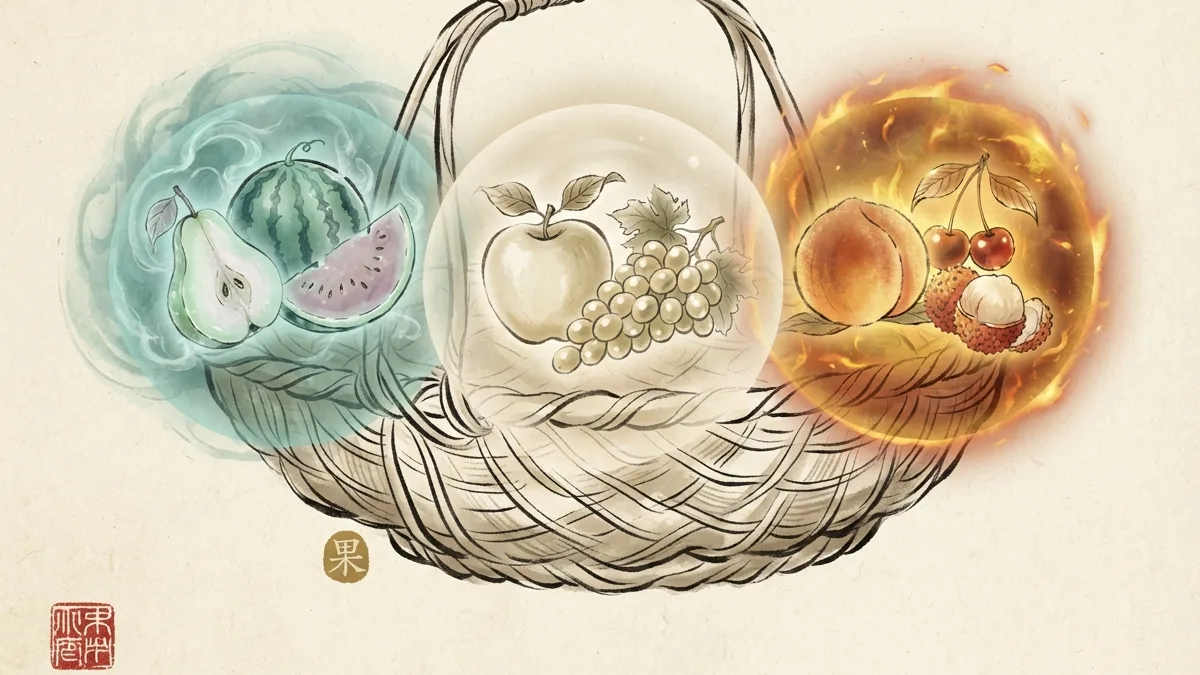
Nature and flavour: more than a question of sugar
The modern question “does fruit make you gain weight?” is, for Chinese dietetics, a badly framed question. A fruit is defined by three things that sugar does not sum up:
- Nature: watermelon is cool, cherry is warm, lychee is hot. Nature decides who can eat it and when, not the calorie count.
- Flavour: sweet nourishes the Spleen, sour gathers and raises fluids, the pungency of citrus moves things along. Flavour is the function.
- Tropism: pear goes to the Lung and Stomach, grape to the Kidney and Blood, chestnut to the Kidney and Spleen. The fruit “knows” where it is going.
A sour fruit is not simply a sweet fruit with less sugar: it is a food that gathers what is escaping (sweating, fluids). A warm fruit is not “more calorific”: it tonifies Yang. The terrain reading replaces the calorie table.
Fruits that generate fluids versus fruits that burden
The first terrain distinction: the fruit that generates fluids (sheng jin) and the one that generates Dampness (sheng shi).
The fluid generators: pear (the classic for Lung Dryness: dry cough, dry throat), apple raw or cooked (Stomach fluids), grape (Blood and fluids), persimmon (Lung Yin), watermelon in high summer (it quenches summer Heat like nothing else). For a Dryness or Yin deficiency terrain, these fruits act as gentle remedies.
The burdeners: any sweet fruit eaten raw in excess, particularly on a weak Spleen: very ripe banana, large quantities of grapes, abundant dates, concentrated juices. Excess sweet transforms into Dampness: bloating, a coated tongue, heaviness. The fruit itself is not “bad”: it is the quantity on that particular terrain.
Warm tonifying fruits: jujube, longan, cherry, chestnut
The family modern eating most overlooks: fruits that tonify. Chinese dietetics treats them as food-medicines:
- Jujube (da zao): tonifies the Qi of the Spleen, nourishes Blood, calms the Shen. The fruit of classical formulae (it accompanies half of the traditional decoctions) and of convalescent congees.
- Longan (long yan rou): nourishes the Blood of the Heart and Spleen, a food for insomnia and mental fatigue. Warmer than jujube.
- Cherry: warm, nourishes Blood, eases the sinews. The spring fruit that “restarts” things.
- Chestnut: warm, tonifies Kidney and Spleen. The autumn dried fruit that prepares the body for winter, useful for weak lower backs.
- Lychee: hot, tonifies Yang, with the caution that anything hot demands (bleeding, Heat).
For deficiency terrains (Qi, Blood or Yang depending on the case), these fruits genuinely work. Against the all-powerful watermelon of summer, they are the counterweight of winter.
Cooling fruits: for whom, and when
Watermelon, melon, persimmon, banana, kiwi, freshly squeezed orange: the cool-to-cold family. Its work is real: it clears Heat, generates fluids, quenches. But its prescription has two conditions:
- Terrain: it suits Heat (red tongue, thirst, irritability, dry constipation) and summer. On a weak, cold Spleen, morning melon produces bloating and loose stools.
- Season: watermelon in July is a remedy; in January it is a Cold the Spleen must compensate for. Seasonality is not an ecological luxury: it is the thermal reading of the moment.
The terrain rule: a cold fruit is eaten ripe, in season, in measured quantity, and never as the main course for a tired Spleen.
Citrus and Qi stagnation: chen pi, lemon, kumquat
Citrus has a virtue no other fruit carries: it moves Qi. The sour-pungent quality of its peel and pulp unblocks what stagnates.
- Chen pi (dried mandarin peel): a classical materia medica substance; it moves the Qi of the Spleen, transforms Phlegm, settles nausea. The medicine of the Chinese cupboard.
- Lemon: moves Liver Qi, gathers through its sourness, generates fluids. Morning lemon juice for Qi stagnation is not a “detox”: it is a movement.
- Kumquat, bergamot, yuzu: aromatic peels, the same family of action.
- Orange and mandarin: sweet, less moving, to be measured on a Damp terrain.
The stagnation terrain (stress, sighing, distension, PMS) finds in citrus a food that moves with the Liver rather than against it.
Fruit and blood sugar: crossing GI with thermal nature
The modern reading has its place: the glycaemic index measures the speed of sugar, the thermal nature measures its energetic effect. The two readings cross:
- Low GI + cool: cherry, apple, pear, berries; the fruits of a Heat terrain and a sensitive blood sugar.
- High GI + sweet: ripe banana, grapes, dates, dried fruit; a weak-Spleen terrain moderates them, a Blood-deficiency terrain uses them sparingly.
- Whole fruit versus juice: the fibre of whole fruit slows the sugar and “carries” the fruit; juice concentrates the sweetness without the substance. Chinese dietetics agrees with nutrition science: fruit is eaten, not drunk.
Seasonality: eating the fruit of its season
TCM eats the fruit of its moment: spring cherry restarts the Blood, summer watermelon quenches the Heat, autumn grape and apple generate the fluids of seasonal Dryness, winter chestnut and jujube tonify the centre. An imported out-of-season fruit loses two things: its thermal rightness (a cold fruit in winter) and its substance (a fruit ripened in transit). Seasonality is the first prescribing rule for fruit.
Summary table: fruit, nature, tropism, terrain
| Fruit | Nature | Tropism / action | Suited terrain | Caution terrain |
|---|---|---|---|---|
| Pear | Cool | Lung, Stomach | Generates fluids, settles dry cough | Dryness, Yin deficiency. Caution: cold Spleen |
| Apple | Neutral-cool | Spleen, Stomach | Fluids, Spleen Qi (cooked) | All terrains. Raw: caution on weak Spleen |
| Grape | Neutral | Kidney, Blood | Nourishes Blood, tonifies Qi | Blood deficiency. Excess: Dampness |
| Jujube | Warm | Spleen, Stomach | Tonifies Qi, nourishes Blood, calms Shen | Qi/Blood deficiency. Excess: Dampness |
| Longan | Warm | Heart, Spleen | Nourishes Heart Blood, soothes Shen | Insomnia, Blood deficiency. Caution: Heat |
| Cherry | Warm | Liver, Spleen | Nourishes Blood, restarts | Blood deficiency, spring. Caution: Heat |
| Chestnut | Warm | Kidney, Spleen | Tonifies Kidney and Spleen | Weak lower back, winter. Excess: stagnation |
| Watermelon | Cold | Stomach, Heart, Bladder | Quenches summer Heat | Heat, summer. Caution: cold Spleen |
| Banana | Cold | Large Intestine, Stomach | Lubricates the intestines, clears | Heat constipation. Caution: weak Spleen |
| Lemon | Cool | Liver, Stomach | Moves Qi, gathers | Qi stagnation. Caution: acid reflux |
| Persimmon | Cool | Lung, Large Intestine | Generates Lung fluids | Dryness. Caution: cold Stomach |
| Lychee | Hot | Liver, Spleen | Tonifies Yang and Blood | Cold-deficiency. Caution: Heat, bleeding |
Nature, tropism, and the terrain that benefits
Frequently asked questions about fruit in TCM
How many fruits a day according to TCM?
The answer depends on terrain, not on a number: one or two whole fruits, in season, suited to the person’s nature. A Heat terrain tolerates fresh fruit well; a weak Spleen prefers fruit cooked, warm or dried; Blood deficiency benefits from the tonics (jujube, longan, grapes). The universal rule: whole, in season, in measured quantity.
Is cooked fruit better for a weak Spleen?
Yes, almost always. Cooking “warms” the fruit (stewed apple is more neutral than raw apple), breaks down the fibres the Spleen struggles to transform, and concentrates the sweetness without assaulting it. Apple stewed with cinnamon is the fruit of a fragile Spleen; pear poached with ginger is the one for Dryness on a cold terrain.
Do citrus fruits really “move Qi”?
That is the classical TCM reading: the sour-pungent quality of citrus (particularly the peel: chen pi is a materia medica substance) moves the Qi of Spleen and Liver, aids digestion, transforms Phlegm. Lemon juice in the morning is an old Chinese practice, not an invention of the 2000s.
Can fruit be eaten in winter?
Yes, by choosing the family: warm tonics (jujube, longan, chestnut, dates in moderation), cooked fruit (stewed fruit, poached pears), and avoiding the very cold raw ones (watermelon, melon, chilled citrus juices). Winter is the season of storage: the tonifying fruit has its place.
Fruit as prescription, not category
Chinese dietetics does not sort fruits into “good” or “to be limited”: it prescribes them by terrain, season and preparation. Pear for Dryness, jujube for Blood deficiency, watermelon for summer Heat, lemon for stagnation, chestnut for the Kidney in winter. The question “is fruit good for you?” becomes “which fruit for which person?”.
In the Yin Shi app, each fruit card shows its nature, flavours and tropisms: pear answers Lung Dryness, jujube answers Blood deficiency, and the card flags the terrain that will be burdened as clearly as the one that benefits.
Further reading: the TCM cereals guide, the thermal nature of foods, the flavours, Spleen deficiency, and the glycaemic index and the sweet flavour.
To go further
Yin Shi ecosystem resources directly related to this article.
Fruits by season and colour
The free lesson from the free course links fruits, seasons and colours to the Five Elements.
Take the lesson →Which fruit suits your terrain?
The Eight Principles test locates the thermal nature your fruits should follow.
Take the test →See these fruits in the app
Apple, pear and banana: three fruits from the guide, with full sheets.
Full sheets available after the 30-day free trial or with a subscription.